
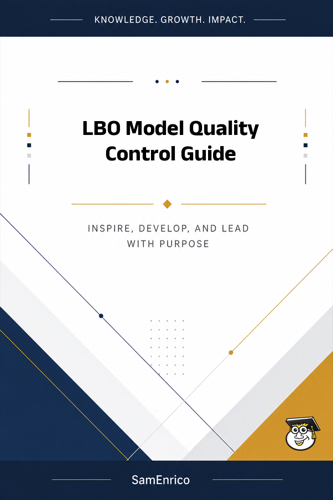
Non-FictionCapital & Valuation RegisterQuality Control
LBO Model Quality Control Guide
Implement error checks, consistency tests, and out
Implement error checks, consistency tests, and output validation.
Formats
About this book
Free sample
Chapter 1: The Invisible Breaks--–- The email arrived at 11:47 PM on a Thursday. The subject line read: “Urgent – Model error – Deal at risk.” The associate who built the LBO model had run the standard checks: balance sheet balanced, IRR was 22.3%, and the debt schedule footed perfectly. But the deal was now three days from signing, and the private equity partner had just noticed something odd. The cash sweep wasn’t sweeping. The revolver balance sat at zero despite a $50 million cash balance.
The error had been invisible for six weeks, across 17 versions, reviewed by four people. No one had caught it because no one had a systematic way to break the model before presenting it.This chapter introduces the foundational paradox of LBO quality control: the models that look correct on the surface are often the most dangerous because they breed false confidence. We will establish why traditional model-building education stops precisely where QC should begin, define the core vocabulary of error prevention versus detection, and reveal the psychological traps that cause even experienced professionals to overlook catastrophic mistakes. By the end of this chapter, you will understand why “it foots” is a dangerously low standard and why the most expensive errors in LBO history came from models that appeared perfectly balanced.The Silent Cost of Invisible Errors LBO models occupy a unique position in financial analysis. Unlike public company valuation models, which rely heavily on market comparisons and relative valuation, LBO models produce absolute outputs: a specific purchase price, a precise debt capacity, an exact IRR.
These numbers go into term sheets, debt commitment letters, and investment committee presentations. A 200-basis-point error in an LBO model is not an academic rounding difference; it can represent millions of dollars in misallocated equity or, in the worst cases, a leveraged transaction that becomes insolvent within two years.The academic literature on spreadsheet errors, most famously Panko’s 1998 study and subsequent updates, consistently finds that 88% to 94% of production spreadsheets contain material errors. But these studies aggregate across all spreadsheet types—budgets, forecasts, ad-hoc analyses. LBO models are more error-prone for three specific…
This is the end of the free sample. Get the eBook to keep going. Buy now
Contents
- Chapter 1
- Chapter 2
- Chapter 3
- Chapter 4
- Chapter 5
- Chapter 6
- Chapter 7
- Chapter 8
- Chapter 9
- Chapter 10
- Chapter 11
- Chapter 12
Details
- Author
- Tejada Floretta
- Publisher
- SamEnrico
- Language
- English
- Genre
- Non-Fiction, Capital & Valuation Register, Quality Control
- Released
- 2026-06-07
- Pages (approx.)
- 133
- Available as
- eBook, Audiobook

Read better in the ZLOADR app
Your eBooks on your phone or tablet. Sign in with your SamEnrico account and start reading.
More by Tejada Floretta
 Pelvic Pain MindfulnessTejada Floretta$11.99
 Order Solar Temple Transits To Sirius GuideTejada Floretta$11.99
 Free Creator Link Management StackTejada Floretta$11.99
 Mindfulness for Tinnitus ReliefTejada Floretta$11.99
 The Phantom Trader: How a Rogue Analyst Cracked the Code on Wall StreetTejada Floretta$11.99
 The Day the Internet Broke: How a Single Bug Crashed the Digital WorldTejada Floretta$11.99
 Supply Chain ESG ComparisonTejada Floretta$12.99
 Russian University Dubai GuideTejada Floretta$12.99
 Understanding Cerebellar Ataxia Infantile With Progressive External OphthalmoplegiaTejada Floretta$17.99
 Analytics And Optimization ManagerTejada Floretta$11.99
 How to Become a Automatic StackerTejada Floretta$11.99
You may also like
 Hong Kong Handover 1997Dunn Johnnie$11.99
 Zumba For Postnatal Recovery CourseNeal Christian$11.99
 Zumba for BeginnersLadner Nikia$11.99
 YouTube Comment Mining GuideHumes Pandora$12.99
 Worry Box MeditationCarlin Rudy$11.99
 Workplace Stress MeditationNguyen Lynn$11.99
 Workplace Stress and Sleep RepairHawley Ivory$11.99
 Workplace Perfectionism CureDelaney Jeffry$11.99
 Workplace Injustice Anger GuideWallen Isabelle$11.99
 Work Addiction and Burnout LinkGreenwood Ester$11.99
 Women in Yoga and WellnessBeattie Galina$11.99
 Women in Stand Up ComedyChun Evangeline$11.99