
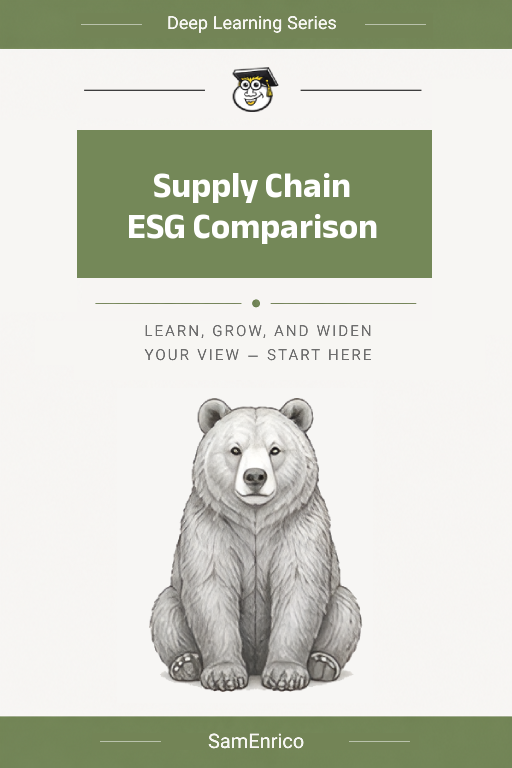
Non-FictionStrategic AtlasSupply Chain
Supply Chain ESG Comparison
Compare scope 3 emissions reporting and supplier e
Compare scope 3 emissions reporting and supplier engagement programs among public consumer goods firms.
Formats
About this book
Free sample
Chapter 1: The 11.4x Blind Spot--–- On a Tuesday morning in March 2024, a senior portfolio manager at one of Europe’s largest asset managers did something that sent shockwaves through the ESG investing community. She quietly divested €340 million from a consumer goods company that had, for three consecutive years, been rated as a “climate leader” by every major ESG rating agency. The reason was not a scandal, not a factory fire, not a child labor exposé. The reason was a single line buried on page 147 of the company’s sustainability report: “Scope 3 emissions are not currently material to our business and have been excluded from our net zero pathway.”That company made toothpaste, shampoo, and household cleaners. Its factories ran on renewable energy.
Its Scope 1 and 2 emissions had dropped 42% over five years. Its annual report featured glossy photographs of solar panels and electric forklifts. And yet, the portfolio manager had done something that most investors still fail to do: she had calculated the ratio between the company’s reported operational emissions (Scope 1+2) and its unreported supply chain emissions (Scope 3). The ratio was 1 to 19. For every ton of carbon the company emitted from its own factories and vehicles, another 19 tons were emitted by its suppliers, its logistics providers, and its customers using its products.
The company had effectively outsourced its carbon footprint while claiming victory over it.This is not an isolated story. It is the rule, not the exception. And it is the single most important and least understood dynamic in corporate climate accountability today.The Great Disconnect For the past decade, the corporate sustainability movement has been built on a convenient fiction: that a company’s climate impact can be measured by looking at its own operations. This fiction is reinforced by every major ESG rating agency, every sustainability award, and every “net zero” pledge that fills the pages of corporate annual reports. The logic is seductive in its simplicity.
If a company puts solar panels on its factory roof, switches its fleet to electric vehicles, and installs LED lighting in its offices, it can claim to be a…
This is the end of the free sample. Get the eBook to keep going. Buy now
Contents
- Chapter 1
- Chapter 2
- Chapter 3
- Chapter 4
- Chapter 5
- Chapter 6
- Chapter 7
- Chapter 8
- Chapter 9
- Chapter 10
- Chapter 11
- Chapter 12
Details
- Author
- Tejada Floretta
- Publisher
- SamEnrico
- Language
- English
- Genre
- Non-Fiction, Strategic Atlas, Supply Chain
- Released
- 2026-05-30
- Pages (approx.)
- 142
- Available as
- eBook, Audiobook

Read better in the ZLOADR app
Your eBooks on your phone or tablet. Sign in with your SamEnrico account and start reading.
More by Tejada Floretta
 Pelvic Pain MindfulnessTejada Floretta$11.99
 Order Solar Temple Transits To Sirius GuideTejada Floretta$11.99
 Free Creator Link Management StackTejada Floretta$11.99
 LBO Model Quality Control GuideTejada Floretta$11.99
 Mindfulness for Tinnitus ReliefTejada Floretta$11.99
 The Phantom Trader: How a Rogue Analyst Cracked the Code on Wall StreetTejada Floretta$11.99
 The Day the Internet Broke: How a Single Bug Crashed the Digital WorldTejada Floretta$11.99
 Russian University Dubai GuideTejada Floretta$12.99
 Understanding Cerebellar Ataxia Infantile With Progressive External OphthalmoplegiaTejada Floretta$17.99
 Analytics And Optimization ManagerTejada Floretta$11.99
 How to Become a Automatic StackerTejada Floretta$11.99
You may also like
 Hong Kong Handover 1997Dunn Johnnie$11.99
 Zumba For Postnatal Recovery CourseNeal Christian$11.99
 Zumba for BeginnersLadner Nikia$11.99
 YouTube Comment Mining GuideHumes Pandora$12.99
 Worry Box MeditationCarlin Rudy$11.99
 Workplace Stress MeditationNguyen Lynn$11.99
 Workplace Stress and Sleep RepairHawley Ivory$11.99
 Workplace Perfectionism CureDelaney Jeffry$11.99
 Workplace Injustice Anger GuideWallen Isabelle$11.99
 Work Addiction and Burnout LinkGreenwood Ester$11.99
 Women in Yoga and WellnessBeattie Galina$11.99
 Women in Stand Up ComedyChun Evangeline$11.99