
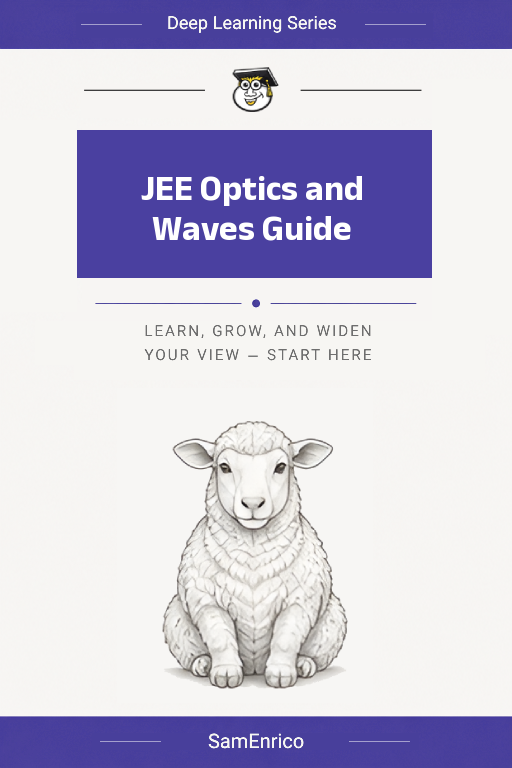
Non-FictionStudent's ShortcutOptics
JEE Optics and Waves Guide Audiobook
Understand ray optics, wave optics, sound waves, a
Understand ray optics, wave optics, sound waves, and Doppler effect with diagrams.
Formats
Free sample
Chapter 1: The Duality Riddle--–- What if you discovered that the very thing illuminating your world refuses to reveal its true identity? For over two thousand years, philosophers and physicists have argued about the nature of light. Is it a stream of tiny particles? A ripple in a mysterious ether? Or something far stranger?
The answer, as you will learn in this chapter, is not a choice between two options—it is an acceptance of both. This duality is not a weakness of physics; it is the key that unlocks everything from reflection in a mirror to the bending of starlight. Welcome to the beginning of your JEE journey through optics and waves, where understanding the question "What is light?" is the first step toward mastering every formula, diagram, and problem that follows.1.1 Two Centuries of War: Corpuscles Versus Waves Before you solve a single JEE problem involving mirrors, lenses, or prisms, you must understand why light behaves the way it does. The history of optics is not just a collection of dusty names—it is the intellectual battleground where modern physics was forged.Newton's Grand Arsenal: The Corpuscular Theory In the late 17th century, Sir Isaac Newton—already famous for his laws of motion and universal gravitation—proposed that light consists of tiny, fast-moving particles called corpuscles. This was not a wild guess.
It was a carefully constructed theory supported by experiments and mathematical reasoning.According to the corpuscular model:Light travels in straight lines (explaining why objects cast sharp shadows)Reflection occurs when particles bounce off a surface like perfectly elastic balls colliding with a wall Refraction (bending of light when entering water or glass) happens because particles speed up when entering a denser medium—they are supposedly "attracted" by the denser material Different colors correspond to particles of different sizes Newton's model was intuitive and mathematically elegant. It explained why light casts sharp shadows, why mirrors form clear images, and why a prism separates white light into colors (different-sized particles bend by different amounts). For over a century, the corpuscular theory dominated physics, largely because Newton's authority was so immense that questioning his ideas felt almost heretical.Why the corpuscular model ultimately failed: The fatal blow came when measurements showed that light travels slower in water and glass than in air—exactly the opposite of what Newton's model predicted. If particles are attracted into a denser medium, they should speed up. They do…
This is the end of the free sample. Get the Audiobook to keep going. Buy now
About this book
Details
- Author
- Cavazos Shantae
- Publisher
- SamEnrico
- Language
- English
- Genre
- Non-Fiction, Student's Shortcut, Optics
- Released
- 2026-06-01
- Pages (approx.)
- 151
- Available as
- eBook, Audiobook

Listen in the VoxFlicks app
Audiobooks and audio dramas wherever you go. Sign in with your SamEnrico account and press play.
More by Cavazos Shantae
 Medical Error DisclosureCavazos Shantae$11.99
 Ego Protection In ConflictCavazos Shantae$11.99
 Personal Brand and Job SearchCavazos Shantae$11.99
 Outpatient Alcohol Detox GuideCavazos Shantae$11.99
 The Remote Batch Processing GuideCavazos Shantae$11.99
 Working Memory Training For KidsCavazos Shantae$11.99
 Emotional Trigger IdentificationCavazos Shantae$11.99
 Equipment Breakdown ProtectionCavazos Shantae$11.99
 The Last Oracle of Delphi: When the Gods Spoke in RiddlesCavazos Shantae$11.99
 Cooperative Exit and Dissolution WorkbookCavazos Shantae$12.99
 How to Produce Fire AlarmsCavazos Shantae$11.99
 A Collector's Handbook to the Aston Martin Db6Cavazos Shantae$11.99
You may also like
 Hong Kong Handover 1997Dunn Johnnie$11.99
 Zumba For Postnatal Recovery CourseNeal Christian$11.99
 Zumba for BeginnersLadner Nikia$11.99
 YouTube Comment Mining GuideHumes Pandora$12.99
 Worry Box MeditationCarlin Rudy$11.99
 Workplace Stress MeditationNguyen Lynn$11.99
 Workplace Stress and Sleep RepairHawley Ivory$11.99
 Workplace Perfectionism CureDelaney Jeffry$11.99
 Workplace Injustice Anger GuideWallen Isabelle$11.99
 Work Addiction and Burnout LinkGreenwood Ester$11.99
 Women in Yoga and WellnessBeattie Galina$11.99
 Women in Stand Up ComedyChun Evangeline$11.99