
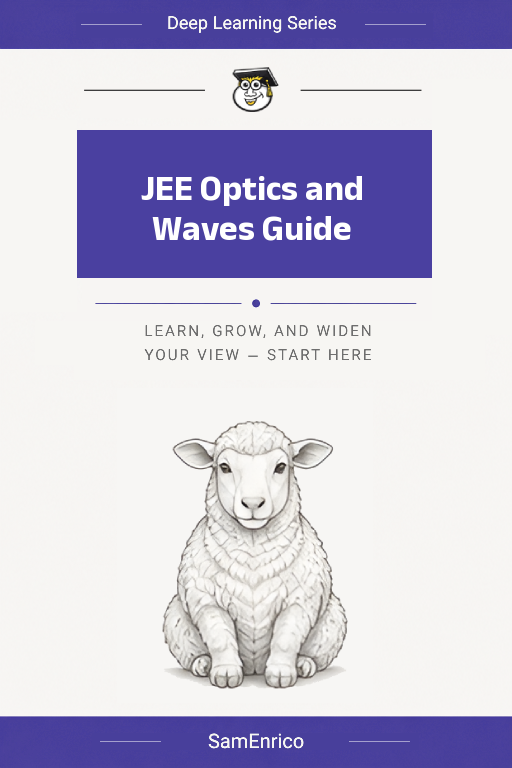
Non-FictionStudent's ShortcutOptics
JEE Optics and Waves Guide eBook
Understand ray optics, wave optics, sound waves, a
Understand ray optics, wave optics, sound waves, and Doppler effect with diagrams.
Formats
Free sample
Chapter 1: The Duality Riddle--–- What if you discovered that the very thing illuminating your world refuses to reveal its true identity? For over two thousand years, philosophers and physicists have argued about the nature of light. Is it a stream of tiny particles? A ripple in a mysterious ether? Or something far stranger?
The answer, as you will learn in this chapter, is not a choice between two options—it is an acceptance of both. This duality is not a weakness of physics; it is the key that unlocks everything from reflection in a mirror to the bending of starlight. Welcome to the beginning of your JEE journey through optics and waves, where understanding the question "What is light?" is the first step toward mastering every formula, diagram, and problem that follows.1.1 Two Centuries of War: Corpuscles Versus Waves Before you solve a single JEE problem involving mirrors, lenses, or prisms, you must understand why light behaves the way it does. The history of optics is not just a collection of dusty names—it is the intellectual battleground where modern physics was forged.Newton's Grand Arsenal: The Corpuscular Theory In the late 17th century, Sir Isaac Newton—already famous for his laws of motion and universal gravitation—proposed that light consists of tiny, fast-moving particles called corpuscles. This was not a wild guess.
It was a carefully constructed theory supported by experiments and mathematical reasoning.According to the corpuscular model:Light travels in straight lines (explaining why objects cast sharp shadows)Reflection occurs when particles bounce off a surface like perfectly elastic balls colliding with a wall Refraction (bending of light when entering water or glass) happens because particles speed up when entering a denser medium—they are supposedly "attracted" by the denser material Different colors correspond to particles of different sizes Newton's model was intuitive and mathematically elegant. It explained why light casts sharp shadows, why mirrors form clear images, and why a prism separates white light into colors (different-sized particles bend by different amounts). For over a century, the corpuscular theory dominated physics, largely because Newton's authority was so immense that questioning his ideas felt almost heretical.Why the corpuscular model ultimately failed: The fatal blow came when measurements showed that light travels slower in water and glass than in air—exactly the opposite of what Newton's model predicted. If particles are attracted into a denser medium, they should speed up. They do not.
The wave model, which predicted a decrease in speed, was correct.Huygens' Counterattack: The Wave Theory Christiaan Huygens, a brilliant Dutch contemporary of Newton, proposed an entirely different idea: light is a wave, analogous to ripples on a pond. In his 1690 masterpiece Treatise on Light, Huygens argued that light propagates through a hypothetical medium called the luminiferous ether (a substance that was later proven not to exist, but the wave idea survived independently).Huygens' key insight became known as Huygens' Principle (see Section 1.3), a tool so powerful that you will use it repeatedly throughout this book—in Chapter 3 for refraction, in Chapter 6 for interference, and in Chapter 7 for diffraction.What the wave model explained that particles could not:Interference: Two light waves can cancel each other out (destructive interference) or combine to produce a brighter wave (constructive interference). Particles cannot annihilate or amplify each other in this way.Diffraction: Light bends around obstacles and spreads out after passing through small openings. Particles would cast perfectly sharp shadows, but waves do not.Finite speed of light: Waves have measurable speed, and the wave model naturally accommodates this. (The speed of light was first measured by Ole Rømer in 1676 using Jupiter's moons—a story worth reading on your own.)Why the wave model was initially rejected: Huygens could not explain why light casts sharp shadows if it is a wave.
(Waves bend around obstacles—this is called diffraction—so shadows should be fuzzy. The reason we see sharp shadows is that the wavelength of light is extremely small, so diffraction is negligible in everyday situations. Huygens did not know this.)The Resolution: Wave-Particle Duality The debate was not settled until the 20th century, when quantum mechanics revealed that light—and indeed all matter—exhibits both wave-like and particle-like properties. For the JEE, you do not need quantum mechanics, but you do need to know when to use which model:Ray optics (Chapters 1–5): Treat light as straight-line rays. This works when the wavelength is much smaller than the size of optical elements (mirrors, lenses, prisms).Wave optics (Chapters 6–7): Treat light as waves.
This is required when light passes through small openings (diffraction) or when two light beams overlap (interference).JEE relevance: Problems involving shadows, mirrors, lenses, and optical instruments use ray optics. Problems involving Young's double-slit experiment, diffraction gratings, and polarization use wave optics. Knowing which model to apply is half the battle.1.2 Rectilinear Propagation and the Nature of Shadows The simplest and oldest fact about light is that it travels in straight lines in a uniform medium. This principle, called rectilinear propagation, is the foundation of ray optics. Without it, there would be no sharp shadows, no clear images, and no predictable paths for light rays.The Geometry of Shadows When an opaque object blocks light, it creates a shadow.
But not all shadows are created equal. The structure of a shadow reveals whether the light source is a point or an extended object.Umbra (Latin for "shadow"): The completely dark region where no direct light from the source reaches. If the light source is an infinitesimally small point, only umbra exists—the shadow has perfectly sharp edges.Penumbra (Latin for "almost shadow"): The partially shaded region where some but not all of the light from an extended source is blocked. This region has a gradual transition from darkness to full illumination.Diagram description (visualize or sketch this): Imagine an extended light source—a vertical line of light 2 cm tall—placed 10 cm above a circular opaque disc of radius 3 cm. A screen is placed 20 cm below the disc.
On the screen, you will see:A central dark circle (umbra) where the disc blocks all rays from every point on the source A surrounding ring (penumbra) where the disc blocks only part of the source—the top of the source may be visible while the bottom is blocked, or vice versa A fully illuminated region outside the penumbra Key formula for umbra radius:Rumbra=Robstacle−Rsource×(D−d)d R_{\text{umbra}} = R_{\text{obstacle}} - \frac{R_{\text{source}} \times (D - d)}{d}Rumbra=Robstacle−d Rsource×(D−d)where Rsource R_{\text{source}}Rsource is the radius of the extended source, Robstacle R_{\text{obstacle}}Robstacle is the radius of the opaque disc, ddd is the distance from source to obstacle, and DDD is the distance from source to screen. If this expression becomes zero or negative, no umbra exists (the shadow is entirely penumbral).Key formula for penumbra outer radius:Rpenumbra, outer=Robstacle+Rsource×(D−d)d R_{\text{penumbra, outer}} = R_{\text{obstacle}} + \frac{R_{\text{source}} \times (D - d)}{d}Rpenumbra, outer=Robstacle+d Rsource×(D−d)These formulas come from simple similar triangles. Draw the extreme rays: from the top edge of the source through the top edge of the obstacle (for penumbra) and from the bottom edge of the source through the top edge of the obstacle (for umbra). The geometry is identical to the similar-triangle problems you solved in high school.Real-World Examples You…
This is the end of the free sample. Get the eBook to keep going. Buy now
About this book
Details
- Author
- Cavazos Shantae
- Publisher
- SamEnrico
- Language
- English
- Genre
- Non-Fiction, Student's Shortcut, Optics
- Released
- 2026-06-01
- Pages (approx.)
- 151
- Available as
- eBook, Audiobook

Read better in the ZLOADR app
Your eBooks on your phone or tablet. Sign in with your SamEnrico account and start reading.
More by Cavazos Shantae
 Medical Error DisclosureCavazos Shantae$11.99
 Ego Protection In ConflictCavazos Shantae$11.99
 Personal Brand and Job SearchCavazos Shantae$11.99
 Outpatient Alcohol Detox GuideCavazos Shantae$11.99
 The Remote Batch Processing GuideCavazos Shantae$11.99
 Working Memory Training For KidsCavazos Shantae$11.99
 Emotional Trigger IdentificationCavazos Shantae$11.99
 Equipment Breakdown ProtectionCavazos Shantae$11.99
 The Last Oracle of Delphi: When the Gods Spoke in RiddlesCavazos Shantae$11.99
 Cooperative Exit and Dissolution WorkbookCavazos Shantae$12.99
 How to Produce Fire AlarmsCavazos Shantae$11.99
 A Collector's Handbook to the Aston Martin Db6Cavazos Shantae$11.99
You may also like
 Hong Kong Handover 1997Dunn Johnnie$11.99
 Zumba For Postnatal Recovery CourseNeal Christian$11.99
 Zumba for BeginnersLadner Nikia$11.99
 YouTube Comment Mining GuideHumes Pandora$12.99
 Worry Box MeditationCarlin Rudy$11.99
 Workplace Stress MeditationNguyen Lynn$11.99
 Workplace Stress and Sleep RepairHawley Ivory$11.99
 Workplace Perfectionism CureDelaney Jeffry$11.99
 Workplace Injustice Anger GuideWallen Isabelle$11.99
 Work Addiction and Burnout LinkGreenwood Ester$11.99
 Women in Yoga and WellnessBeattie Galina$11.99
 Women in Stand Up ComedyChun Evangeline$11.99