
Non-FictionBusiness BriefIP Guide
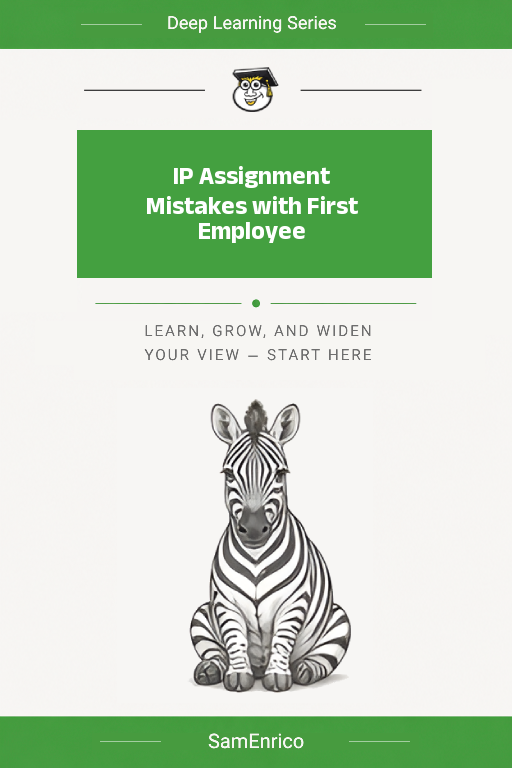
IP Assignment Mistakes with First Employee
Secure inventions, code, and creations with proper
Secure inventions, code, and creations with proper assignment clauses before they start working.
Formats
About this book
Free sample
Chapter 1: The $100 Million Text...--–- The Slack message arrived at 11:47 PM on a Tuesday. “Hey, quick question—remember that algorithm I built for the recommendation engine? I actually started it as a side project before I joined. Just wanted to clarify ownership. Let’s chat tomorrow?”The founder stared at the screen.
The company had raised $18 million. The recommendation engine was the core patent. And the employee—Hire Number One—had never signed an IP assignment agreement.Three months later, the startup was dead. Not because the product failed, not because the market shifted, but because one piece of paper was missing. The employee walked away with the algorithm.
The investors walked away with nothing. And the founder learned the most expensive lesson in startup law: paying a salary buys labor, but it does not buy ideas.The Lie That Destroys Startups Every founder believes the same thing. It feels like common sense, almost too obvious to question: “I paid their salary. They used my laptop. They sat in my office.
Of course I own what they built.”This is the most dangerous lie in entrepreneurship.It is not true. Not even close. And believing it has cost founders more money than bad hires, missed market opportunities, and failed product launches combined.Here is what the law actually says. In the United States, copyright law—which covers code, designs, writing, and creative works—generally gives employers ownership of “works made for hire” when the work is within the scope of employment. That sounds reassuring until you realize the massive exception: patent law, which covers inventions, processes, algorithms, and discoveries, operates on a completely different principle.Under patent law, the inventor personally owns their invention.
Not the company that paid them. Not the company that gave them a laptop. Not the company whose name is on the door. The individual human being whose mind produced the idea owns it—until and unless that individual signs a written document explicitly transferring ownership to the company.This is not a technicality. It is not a loophole that clever lawyers invented.
It is the default rule of American intellectual property law, and it has been for over two centuries.Consider what this…
This is the end of the free sample. Get the eBook to keep going. Buy now
Contents
- Chapter 1
- Chapter 2
- Chapter 3
- Chapter 4
- Chapter 5
- Chapter 6
- Chapter 7
- Chapter 8
- Chapter 9
- Chapter 10
- Chapter 11
- Chapter 12
Details
- Author
- Spinks Giselle
- Publisher
- SamEnrico
- Language
- English
- Genre
- Non-Fiction, Business Brief, IP Guide
- Released
- 2026-05-30
- Pages (approx.)
- 136
- Available as
- eBook, Audiobook

Read better in the ZLOADR app
Your eBooks on your phone or tablet. Sign in with your SamEnrico account and start reading.
More by Spinks Giselle
 Meditation for Creative BlocksSpinks Giselle$11.99
 Restaurant Gut Health GuideSpinks Giselle$11.99
 Breath Calming EmotionsSpinks Giselle$11.99
 Medication Taper SupportSpinks Giselle$11.99
 The Republic of Genius: Florence, Venice, and the Birth of Modern ThoughtSpinks Giselle$11.99
 How to Produce Butterfly HousesSpinks Giselle$11.99
 Furniture FinisherSpinks Giselle$11.99
 How to Start a Paper Bags (wholesale) Business (Beginners Guide)Spinks Giselle$11.99
You may also like
 Hong Kong Handover 1997Dunn Johnnie$11.99
 Zumba For Postnatal Recovery CourseNeal Christian$11.99
 Zumba for BeginnersLadner Nikia$11.99
 YouTube Comment Mining GuideHumes Pandora$12.99
 Worry Box MeditationCarlin Rudy$11.99
 Workplace Stress MeditationNguyen Lynn$11.99
 Workplace Stress and Sleep RepairHawley Ivory$11.99
 Workplace Perfectionism CureDelaney Jeffry$11.99
 Workplace Injustice Anger GuideWallen Isabelle$11.99
 Work Addiction and Burnout LinkGreenwood Ester$11.99
 Women in Yoga and WellnessBeattie Galina$11.99
 Women in Stand Up ComedyChun Evangeline$11.99