
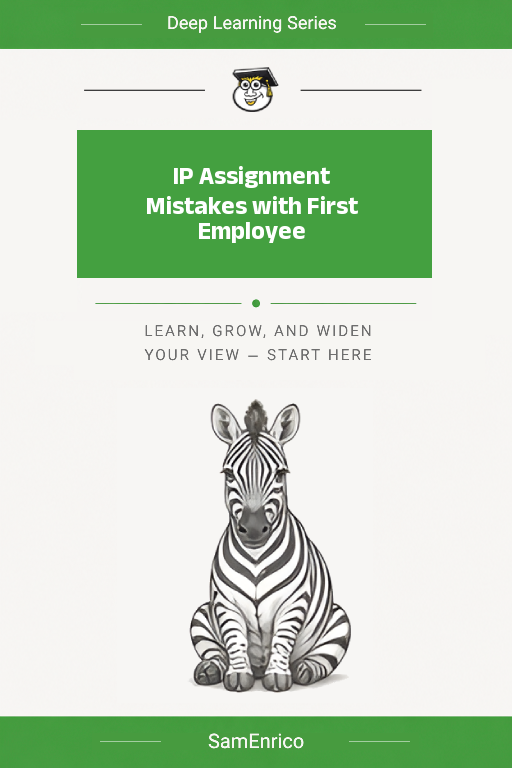
Non-FictionBusiness BriefIP Guide
IP Assignment Mistakes with First Employee eBook
Secure inventions, code, and creations with proper
Secure inventions, code, and creations with proper assignment clauses before they start working.
Formats
Free sample
Chapter 1: The $100 Million Text...--–- The Slack message arrived at 11:47 PM on a Tuesday. “Hey, quick question—remember that algorithm I built for the recommendation engine? I actually started it as a side project before I joined. Just wanted to clarify ownership. Let’s chat tomorrow?”The founder stared at the screen.
The company had raised $18 million. The recommendation engine was the core patent. And the employee—Hire Number One—had never signed an IP assignment agreement.Three months later, the startup was dead. Not because the product failed, not because the market shifted, but because one piece of paper was missing. The employee walked away with the algorithm.
The investors walked away with nothing. And the founder learned the most expensive lesson in startup law: paying a salary buys labor, but it does not buy ideas.The Lie That Destroys Startups Every founder believes the same thing. It feels like common sense, almost too obvious to question: “I paid their salary. They used my laptop. They sat in my office.
Of course I own what they built.”This is the most dangerous lie in entrepreneurship.It is not true. Not even close. And believing it has cost founders more money than bad hires, missed market opportunities, and failed product launches combined.Here is what the law actually says. In the United States, copyright law—which covers code, designs, writing, and creative works—generally gives employers ownership of “works made for hire” when the work is within the scope of employment. That sounds reassuring until you realize the massive exception: patent law, which covers inventions, processes, algorithms, and discoveries, operates on a completely different principle.Under patent law, the inventor personally owns their invention.
Not the company that paid them. Not the company that gave them a laptop. Not the company whose name is on the door. The individual human being whose mind produced the idea owns it—until and unless that individual signs a written document explicitly transferring ownership to the company.This is not a technicality. It is not a loophole that clever lawyers invented.
It is the default rule of American intellectual property law, and it has been for over two centuries.Consider what this means in practice. A developer joins your startup as the first employee. They spend six months writing every line of code for your minimum viable product. They do it on your laptop, during business hours, while you pay them a market salary. Then they quit.
If they never signed an assignment agreement, they legally own that code in several U.S. states—including New York and Texas. You own nothing but a memory.The laptop does not matter. The salary does not matter. The office does not matter.
Only the signature matters.The Anatomy of a Nightmare Let us walk through how this actually happens, because the path from “we’ll handle paperwork later” to “we just lost our company” is shorter than most founders imagine.Meet Sarah. She is a first-time founder with a background in product management but not engineering. She has a brilliant idea for a logistics optimization platform. She finds Tom, a brilliant backend engineer who recently left a big tech company. Tom is excited about the idea.
They agree that Tom will join as the first employee with a 10 percent equity stake and a modest salary.Sarah is organized. She sets up the corporation, opens a bank account, and drafts an offer letter. She even remembers to include a confidentiality clause. But the IP assignment—the document that would transfer ownership of Tom’s future inventions to the company—sits in her “legal templates” folder, untouched. She figures they can sign it on Tom’s first day.
Or maybe during his first week. Definitely before he starts building anything critical.Tom starts on Monday. He is productive immediately. By Wednesday, he has sketched the core data model. By the end of the first month, he has written the first working version of the matching algorithm.
Sarah is thrilled. The paperwork remains unsigned.Three months pass. The MVP is working. Sarah raises a seed round. Now there is pressure.
Investors want to see signed IP assignments from all employees. Sarah finally prints the agreement and asks Tom to sign it.Tom hesitates. He has been thinking about the algorithm he built. He realizes—correctly—that without a signed assignment, he personally owns that code. He also realizes that the company has no leverage.
They cannot launch without his code. They cannot raise money without clean IP. They cannot replace him overnight because he is the only person who understands the system.Tom asks for more equity. Not a little more—double his current stake. Sarah has no good options.
She can refuse and watch her company implode. She can negotiate and pay Tom more than he deserves. Or she can sue, which would take years and burn the remaining cash on lawyers.This is not a hypothetical. Variations of this story have played out in Y Combinator startups, venture-backed biotech firms, and bootstrapped software companies across the country. The details change, but the pattern is the same: a founder who believed that payment equals ownership, followed by a painful negotiation or a catastrophic loss.Why Your Instincts Are Wrong The belief that payment transfers ownership is not stupid.
It is intuitive. In almost every other area of commerce, when you pay for something, you own it. You buy a laptop, you own the laptop. You buy coffee, you own the coffee. You pay a plumber to fix a pipe, you own the fixed pipe.But intellectual property does not work like physical property.
An idea is not a laptop. An algorithm is not a coffee. And the law treats them differently for a reason that goes back centuries.In the nineteenth century, skilled workers—blacksmiths, weavers, machinists—owned their craft knowledge. When they moved from one shop to another, their skills and inventions moved with them. If a factory owner wanted to own a specific invention, they had to negotiate a separate assignment.
This was not an oversight. It was a deliberate choice rooted in the belief that human creativity should not automatically become the property of whoever signs the paychecks.The twentieth century changed this. Large corporations like Du Pont, General Electric, and Eastman Kodak fought legal battles to reverse the default rule. They argued that if an employee used company time, company materials, and company facilities, the resulting invention should belong to the company. Courts slowly agreed—but with a crucial condition.The condition was this: the transfer of ownership must be explicit.
It must be in writing. It must use clear, unambiguous language. And the employee must sign it before any ambiguity arises about who owns what.This is why modern courts are so strict about contract wording. They are not being pedantic. They are upholding a century-long tradition of protecting employee rights.
Judges assume that unless an employee signs a clear, unambiguous assignment, they retain ownership of their inventive genius. A missing comma can lose a startup its core asset. A passive verb can hand your patent to a competitor. This is not…
This is the end of the free sample. Get the eBook to keep going. Buy now
About this book
Details
- Author
- Spinks Giselle
- Publisher
- SamEnrico
- Language
- English
- Genre
- Non-Fiction, Business Brief, IP Guide
- Released
- 2026-05-30
- Pages (approx.)
- 136
- Available as
- eBook, Audiobook

Read better in the ZLOADR app
Your eBooks on your phone or tablet. Sign in with your SamEnrico account and start reading.
More by Spinks Giselle
 Meditation for Creative BlocksSpinks Giselle$11.99
 Restaurant Gut Health GuideSpinks Giselle$11.99
 Breath Calming EmotionsSpinks Giselle$11.99
 Medication Taper SupportSpinks Giselle$11.99
 The Republic of Genius: Florence, Venice, and the Birth of Modern ThoughtSpinks Giselle$11.99
 How to Produce Butterfly HousesSpinks Giselle$11.99
 Furniture FinisherSpinks Giselle$11.99
 How to Start a Paper Bags (wholesale) Business (Beginners Guide)Spinks Giselle$11.99
You may also like
 Hong Kong Handover 1997Dunn Johnnie$11.99
 Zumba For Postnatal Recovery CourseNeal Christian$11.99
 Zumba for BeginnersLadner Nikia$11.99
 YouTube Comment Mining GuideHumes Pandora$12.99
 Worry Box MeditationCarlin Rudy$11.99
 Workplace Stress MeditationNguyen Lynn$11.99
 Workplace Stress and Sleep RepairHawley Ivory$11.99
 Workplace Perfectionism CureDelaney Jeffry$11.99
 Workplace Injustice Anger GuideWallen Isabelle$11.99
 Work Addiction and Burnout LinkGreenwood Ester$11.99
 Women in Yoga and WellnessBeattie Galina$11.99
 Women in Stand Up ComedyChun Evangeline$11.99