
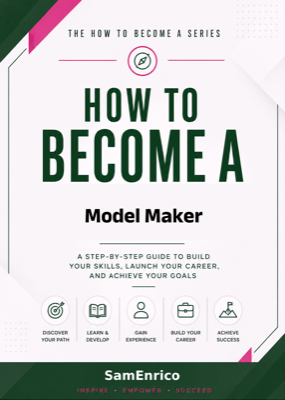
Non-FictionInformativeEducational
How to Become a Model Maker Paperback
How to Become a Model Maker
How to Become a Model Maker
Formats
Free sample
Chapter 1: The Invisible Profession...--It is a strange thing to spend eight hundred hours hand-painting individual scales onto a dragon that will appear on screen for exactly four seconds.The model maker at Weta Workshop who did this—let us call her Sarah, though her real name is under an NDA—remembers the moment she watched the film’s premiere. The dragon soared. The audience gasped. And then the scene cut. Four seconds.
Eight hundred hours. No one in the theater knew her name, knew that each scale had been airbrushed with three different shades of green to catch imaginary light, knew that she had sculpted the original clay maquette at 3 AM on a Sunday because the design had changed for the seventeenth time.She smiled in the dark. She was not bitter. She understood something that most people never will: the best model makers are invisible.Their work is everywhere. Every car you have ever sat in began as a foam model in a design studio, sculpted by hand and then digitized, tested, and refined.
Every medical device that has ever saved a life was prototyped in plastic and silicone, held by surgeons who said “move this button two millimeters to the left.” Every building that has ever made you look up—the swooping curves, the impossible cantilevers—was first a cardboard massing model on a table in a room full of tired architects. Every prop in every film you have ever loved was pulled from a shelf in a workshop that smells of glue and ambition.The model maker built all of it. And you have never heard of them.This book is about becoming one of those invisible people. Not because you want fame—you will not get it—but because you want to make things. Real things.
Things you can hold, photograph, break, fix, and improve. In an age when most design happens on screens, when entire products are rendered in pixels that never cast a shadow, the physical model remains the ultimate truth teller. CAD lies. Renderings lie. A foam block in your hand does not.This chapter is about why that matters.
It is about what model makers actually do, where they work, and how you will know if you have the right temperament for a profession that rewards patience, punishes ego, and demands that you learn to love sanding.The Great Deception: Why Physical Models Still Matter Let us begin with a heresy: digital design tools are not enough.This is a controversial statement in 2026. We have photorealistic rendering engines that simulate light, fabric, and wear. We have virtual reality headsets that let you “walk through” a building before a single brick is laid. We have generative AI that produces thousands of design variations in seconds. Surely, the physical model is obsolete?Tell that to the engineers at Dyson who, in the early 2010s, were developing a new vacuum cleaner—the one that would eventually become the V series cordless.
The digital model was beautiful. The renderings showed a sleek, ergonomic handle that fit perfectly in a human hand. The CAD files passed every digital tolerance check. The design team signed off. And then a model maker built a foam prototype.It took three hours.
It was ugly. The foam was blue, the seams were visible, and the handle had been roughly carved with a rasp and sandpaper. But when the lead engineer held it, something was wrong. His fingers overlapped in a way the renderings had not shown. The trigger fell under his second knuckle instead of his fingertip.
A digital model had missed this because digital models do not have hands. The foam block did.The handle was redesigned.…
This is the end of the free sample. Get the Paperback to keep going. Buy now
About this book
Details
- Author
- Landis Chanell
- Publisher
- SamEnrico
- Language
- English
- ISBN
- 9781505745023
- Genre
- Non-Fiction, Informative, Educational
- Released
- 2026-05-18
- Pages (approx.)
- 160
- Available as
- eBook, Paperback, Audiobook

Read better in the ZLOADR app
Your eBooks on your phone or tablet. Sign in with your SamEnrico account and start reading.
More by Landis Chanell
 Speaker Positive Rehearsal GuideLandis Chanell$11.99
 Twelve Step Facilitation Therapy GuideLandis Chanell$11.99
 Held in Hostage DarknessLandis Chanell$11.99
 Benzo Information for ProvidersLandis Chanell$11.99
 Murdoch British PM RelationshipsLandis Chanell$11.99
 The Enigma of the Zodiac’s Final Cipher: A Cryptographic Cold CaseLandis Chanell$11.99
 The Velvet Noose: A Victorian Serial Killer’s Silent ReignLandis Chanell$11.99
 Apparel AssociateLandis Chanell$11.99
 Understanding Bonneau–beaumont SyndromeLandis Chanell$17.99
 Amazon Work From Home InternshipLandis Chanell$12.99
 Kenyan Freelance vs Employee GuideLandis Chanell$12.99
You may also like
 Hong Kong Handover 1997Dunn Johnnie$11.99
 Zumba For Postnatal Recovery CourseNeal Christian$11.99
 Zumba for BeginnersLadner Nikia$11.99
 YouTube Comment Mining GuideHumes Pandora$12.99
 Worry Box MeditationCarlin Rudy$11.99
 Workplace Stress MeditationNguyen Lynn$11.99
 Workplace Stress and Sleep RepairHawley Ivory$11.99
 Workplace Perfectionism CureDelaney Jeffry$11.99
 Workplace Injustice Anger GuideWallen Isabelle$11.99
 Work Addiction and Burnout LinkGreenwood Ester$11.99
 Women in Yoga and WellnessBeattie Galina$11.99
 Women in Stand Up ComedyChun Evangeline$11.99