
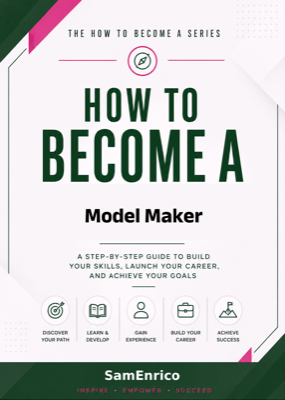
Non-FictionInformativeEducational
How to Become a Model Maker eBook
How to Become a Model Maker
How to Become a Model Maker
Formats
Free sample
Chapter 1: The Invisible Profession...--It is a strange thing to spend eight hundred hours hand-painting individual scales onto a dragon that will appear on screen for exactly four seconds.The model maker at Weta Workshop who did this—let us call her Sarah, though her real name is under an NDA—remembers the moment she watched the film’s premiere. The dragon soared. The audience gasped. And then the scene cut. Four seconds.
Eight hundred hours. No one in the theater knew her name, knew that each scale had been airbrushed with three different shades of green to catch imaginary light, knew that she had sculpted the original clay maquette at 3 AM on a Sunday because the design had changed for the seventeenth time.She smiled in the dark. She was not bitter. She understood something that most people never will: the best model makers are invisible.Their work is everywhere. Every car you have ever sat in began as a foam model in a design studio, sculpted by hand and then digitized, tested, and refined.
Every medical device that has ever saved a life was prototyped in plastic and silicone, held by surgeons who said “move this button two millimeters to the left.” Every building that has ever made you look up—the swooping curves, the impossible cantilevers—was first a cardboard massing model on a table in a room full of tired architects. Every prop in every film you have ever loved was pulled from a shelf in a workshop that smells of glue and ambition.The model maker built all of it. And you have never heard of them.This book is about becoming one of those invisible people. Not because you want fame—you will not get it—but because you want to make things. Real things.
Things you can hold, photograph, break, fix, and improve. In an age when most design happens on screens, when entire products are rendered in pixels that never cast a shadow, the physical model remains the ultimate truth teller. CAD lies. Renderings lie. A foam block in your hand does not.This chapter is about why that matters.
It is about what model makers actually do, where they work, and how you will know if you have the right temperament for a profession that rewards patience, punishes ego, and demands that you learn to love sanding.The Great Deception: Why Physical Models Still Matter Let us begin with a heresy: digital design tools are not enough.This is a controversial statement in 2026. We have photorealistic rendering engines that simulate light, fabric, and wear. We have virtual reality headsets that let you “walk through” a building before a single brick is laid. We have generative AI that produces thousands of design variations in seconds. Surely, the physical model is obsolete?Tell that to the engineers at Dyson who, in the early 2010s, were developing a new vacuum cleaner—the one that would eventually become the V series cordless.
The digital model was beautiful. The renderings showed a sleek, ergonomic handle that fit perfectly in a human hand. The CAD files passed every digital tolerance check. The design team signed off. And then a model maker built a foam prototype.It took three hours.
It was ugly. The foam was blue, the seams were visible, and the handle had been roughly carved with a rasp and sandpaper. But when the lead engineer held it, something was wrong. His fingers overlapped in a way the renderings had not shown. The trigger fell under his second knuckle instead of his fingertip.
A digital model had missed this because digital models do not have hands. The foam block did.The handle was redesigned. The change cost two thousand dollars in modeling time instead of two million dollars in injection mold tooling. That foam prototype—which was thrown in a bin the next week—saved the company more money than most executives earn in a year.This is the great deception of the digital age. We believe that because we can simulate reality, we no longer need to touch it.
But simulation is not reality. It is a map, not the territory. And maps have an embarrassing habit of being wrong exactly where you need them most.The Four Tribes of Models Professional model makers speak a secret language. When they say “breadboard,” they do not mean a cutting board for sandwiches. When they say “look-and-feel,” they are not talking about a date.
Before you can become a model maker, you need to learn the taxonomy of what you will build. There are four primary types of models, and each serves a different master.Breadboard Models: The Ugly Truth A breadboard model is a functional test of electronics or mechanics. It is called a breadboard because the earliest versions were literally built on wooden breadboards—a practice that survives in the name of prototyping circuit boards. These models are almost always ugly. They are made of whatever is at hand: cardboard, hot glue, zip ties, dead batteries held in place with tape.
A breadboard model exists to answer one question: does it work?If you are building a new type of drone propeller, you do not care what the propeller looks like. You care whether it generates enough thrust. Your breadboard model will be a mess of wires and mismatched parts, and it will be the most beautiful mess you have ever made because it will tell you the truth.The secret of breadboard models is that they separate amateur designers from professionals. Amateurs want to skip to the pretty part. Professionals know that a breadboard that fails is a gift—it failed in the shop, not in the customer’s hands.Look-and-Feel Models: The Deception of Appearance A look-and-feel model exists to answer a different question: does it look right?These are aesthetic studies, built in foam, clay, or 3D-printed plastic.
They have no internal components. The buttons do not press. The screen does not light up. But the curves are perfect, the proportions are exact, and the surface finish is flawless. A look-and-feel model is a lie, but it is a useful lie.
It lets executives hold the future in their hands. It lets focus groups react to a design before millions of dollars are committed to manufacturing.The most famous look-and-feel model in history might be the original Macintosh computer. Steve Jobs demanded that the case have a subtle curve—a “teardrop” shape that was almost invisible but made the computer feel friendly rather than industrial. The engineering team said it was impossible to manufacture. Jobs had a model maker carve the curve into a block of foam.
He put that foam block on the engineers’ table and said, “Make this.” They did.Functional Prototypes: The Honest Middle A functional prototype is exactly what it sounds like: a model that works. The buttons press. The hinge bends. The speaker makes sound. Unlike a breadboard, a functional prototype is usually built with attention to appearance.
Unlike a look-and-feel model, it actually does what the final product will do.Functional prototypes are the most expensive models to build because they require working parts, often machined or…
This is the end of the free sample. Get the eBook to keep going. Buy now
About this book
Details
- Author
- Landis Chanell
- Publisher
- SamEnrico
- Language
- English
- ISBN
- 9781505745023
- Genre
- Non-Fiction, Informative, Educational
- Released
- 2026-05-18
- Pages (approx.)
- 160
- Available as
- eBook, Paperback, Audiobook

Read better in the ZLOADR app
Your eBooks on your phone or tablet. Sign in with your SamEnrico account and start reading.
More by Landis Chanell
 Speaker Positive Rehearsal GuideLandis Chanell$11.99
 Twelve Step Facilitation Therapy GuideLandis Chanell$11.99
 Held in Hostage DarknessLandis Chanell$11.99
 Benzo Information for ProvidersLandis Chanell$11.99
 Murdoch British PM RelationshipsLandis Chanell$11.99
 The Enigma of the Zodiac’s Final Cipher: A Cryptographic Cold CaseLandis Chanell$11.99
 The Velvet Noose: A Victorian Serial Killer’s Silent ReignLandis Chanell$11.99
 Apparel AssociateLandis Chanell$11.99
 Understanding Bonneau–beaumont SyndromeLandis Chanell$17.99
 Amazon Work From Home InternshipLandis Chanell$12.99
 Kenyan Freelance vs Employee GuideLandis Chanell$12.99
You may also like
 Hong Kong Handover 1997Dunn Johnnie$11.99
 Zumba For Postnatal Recovery CourseNeal Christian$11.99
 Zumba for BeginnersLadner Nikia$11.99
 YouTube Comment Mining GuideHumes Pandora$12.99
 Worry Box MeditationCarlin Rudy$11.99
 Workplace Stress MeditationNguyen Lynn$11.99
 Workplace Stress and Sleep RepairHawley Ivory$11.99
 Workplace Perfectionism CureDelaney Jeffry$11.99
 Workplace Injustice Anger GuideWallen Isabelle$11.99
 Work Addiction and Burnout LinkGreenwood Ester$11.99
 Women in Yoga and WellnessBeattie Galina$11.99
 Women in Stand Up ComedyChun Evangeline$11.99