
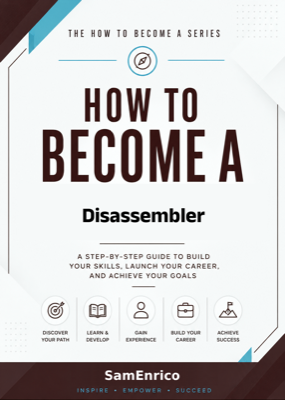
Non-FictionInformativeEducational
How to Become a Disassembler Audiobook
How to Become a Disassembler
How to Become a Disassembler
Formats
Free sample
Chapter 1: The Silicon Detective...--If you have ever looked at a piece of software and wondered, “What is this thing really doing?” — you have already taken the first step toward becoming a disassembler. Not the kind who takes apart engines or old watches, but the kind who looks at a compiled program — a file of raw machine code — and translates it back into something a human can read, understand, and ultimately change. This book is not about guessing or black-box magic. It is about methodical, patient, and deeply satisfying detective work.Reverse engineering — the art and science of taking finished software and working backward to uncover its design, logic, and secrets — is one of the most powerful skills in the modern technology landscape. It sits at the intersection of programming, cybersecurity, puzzle-solving, and even law.
And yet, for decades, it has been shrouded in mystery, treated as either an arcane craft reserved for elite security researchers or something vaguely illicit hiding in underground forums. Neither is true.This chapter begins your journey from curious beginner to competent disassembler. You will learn what reverse engineering actually is (and what it is not), why it matters in industries ranging from malware analysis to legacy software preservation, and — critically — where the legal and ethical boundaries lie. By the end of this chapter, you will have a clear mental framework for approaching every reverse engineering task, a professional-grade ethical compass, and the excitement of knowing that you are about to learn a skill that very few people possess.So let us start with a simple question: What does a disassembler actually do?The Core Definitions: Disassembly, Decompilation, and Debugging Before you can become a disassembler, you need to understand the precise meaning of that term. Confusion between disassembly, decompilation, and debugging is one of the most common stumbling blocks for beginners — and even some experienced engineers use these words incorrectly.
That ends here.Disassembly is the process of taking a compiled binary (a .exe, .dll, .so, or even firmware image) and translating the machine code instructions — the raw bytes that the CPU executes — into assembly language mnemonics. Machine code is a stream of numbers that the processor understands directly; it looks like B8 05 00 00 00 to the human eye. Disassembly turns that into mov eax, 5. You are not changing the program. You are not running it.
You are simply rendering its instructions in a human-readable form. That is the core act of a disassembler.Decompilation is a…
This is the end of the free sample. Get the Audiobook to keep going. Buy now
About this book
Details
- Author
- Charles Danika
- Publisher
- SamEnrico
- Language
- English
- ISBN
- 9781505749069
- Genre
- Non-Fiction, Informative, Educational
- Released
- 2026-05-11
- Pages (approx.)
- 141
- Available as
- eBook, Paperback, Audiobook

Listen in the VoxFlicks app
Audiobooks and audio dramas wherever you go. Sign in with your SamEnrico account and press play.
More by Charles Danika
 Overlanding the Tibetan PlateauCharles Danika$11.99
 EQ Relationship Building ManualCharles Danika$11.99
 Cybersecurity Incident Responder StressCharles Danika$11.99
 Bedtime Story MeditationCharles Danika$11.99
 The Exhausted Caregiver Recovery GuideCharles Danika$11.99
 The Rum Rebellion: How a Caribbean Distillery Defied an EmpireCharles Danika$11.99
 The Siren’s Gambit: How a Mythical Song Lured an Empire to Its DoomCharles Danika$11.99
 Remote Crucial ConversationsCharles Danika$12.99
 Naval Ravikant Angel ManualCharles Danika$12.99
 Understanding FibromaCharles Danika$17.99
 Strategic Renewals Account ManagerCharles Danika$11.99
You may also like
 Hong Kong Handover 1997Dunn Johnnie$11.99
 Zumba For Postnatal Recovery CourseNeal Christian$11.99
 Zumba for BeginnersLadner Nikia$11.99
 YouTube Comment Mining GuideHumes Pandora$12.99
 Worry Box MeditationCarlin Rudy$11.99
 Workplace Stress MeditationNguyen Lynn$11.99
 Workplace Stress and Sleep RepairHawley Ivory$11.99
 Workplace Perfectionism CureDelaney Jeffry$11.99
 Workplace Injustice Anger GuideWallen Isabelle$11.99
 Work Addiction and Burnout LinkGreenwood Ester$11.99
 Women in Yoga and WellnessBeattie Galina$11.99
 Women in Stand Up ComedyChun Evangeline$11.99