
Non-FictionInformativeEducational
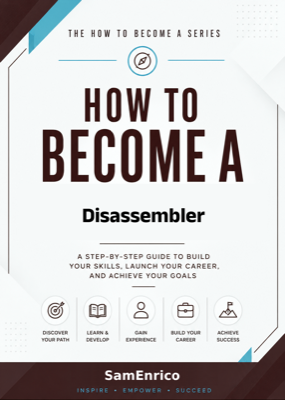
How to Become a Disassembler eBook
How to Become a Disassembler
How to Become a Disassembler
Formats
Free sample
Chapter 1: The Silicon Detective...--If you have ever looked at a piece of software and wondered, “What is this thing really doing?” — you have already taken the first step toward becoming a disassembler. Not the kind who takes apart engines or old watches, but the kind who looks at a compiled program — a file of raw machine code — and translates it back into something a human can read, understand, and ultimately change. This book is not about guessing or black-box magic. It is about methodical, patient, and deeply satisfying detective work.Reverse engineering — the art and science of taking finished software and working backward to uncover its design, logic, and secrets — is one of the most powerful skills in the modern technology landscape. It sits at the intersection of programming, cybersecurity, puzzle-solving, and even law.
And yet, for decades, it has been shrouded in mystery, treated as either an arcane craft reserved for elite security researchers or something vaguely illicit hiding in underground forums. Neither is true.This chapter begins your journey from curious beginner to competent disassembler. You will learn what reverse engineering actually is (and what it is not), why it matters in industries ranging from malware analysis to legacy software preservation, and — critically — where the legal and ethical boundaries lie. By the end of this chapter, you will have a clear mental framework for approaching every reverse engineering task, a professional-grade ethical compass, and the excitement of knowing that you are about to learn a skill that very few people possess.So let us start with a simple question: What does a disassembler actually do?The Core Definitions: Disassembly, Decompilation, and Debugging Before you can become a disassembler, you need to understand the precise meaning of that term. Confusion between disassembly, decompilation, and debugging is one of the most common stumbling blocks for beginners — and even some experienced engineers use these words incorrectly.
That ends here.Disassembly is the process of taking a compiled binary (a .exe, .dll, .so, or even firmware image) and translating the machine code instructions — the raw bytes that the CPU executes — into assembly language mnemonics. Machine code is a stream of numbers that the processor understands directly; it looks like B8 05 00 00 00 to the human eye. Disassembly turns that into mov eax, 5. You are not changing the program. You are not running it.
You are simply rendering its instructions in a human-readable form. That is the core act of a disassembler.Decompilation is a more ambitious transformation. While a disassembler gives you assembly language — still quite low-level and tied to the CPU architecture — a decompiler attempts to recover a high-level language representation, typically C-like pseudocode. Instead of seeing mov eax, 5; add eax, 2, the decompiler might show int x = 5; x = x + 2;. Decompilation is lossy; information about original variable names, comments, and code structure is almost never preserved.
But it can dramatically speed up analysis, especially for large binaries. Modern tools like Ghidra (which you will install in Chapter 4) include powerful decompilers.Debugging is something else entirely. A disassembler or decompiler works statically — on the file at rest, without executing it. A debugger, by contrast, runs the program in a controlled environment, allowing you to pause execution, inspect memory and registers, change data on the fly, and watch how the program behaves step by step. Static analysis (disassembly and decompilation) answers the question, “What could this program do?” Dynamic analysis (debugging) answers the question, “What is this program actually doing right now, with this specific input?”You need all three.
A professional reverse engineer moves fluidly between disassembly, decompilation, and debugging. That fluidity is one of the primary skills this book will build.Why Become a Disassembler? The Many Applications of Reverse Engineering It is fair to ask, “Why should I invest dozens or hundreds of hours learning this skill?” The answer depends on your goals. Reverse engineering is not a single career path — it is a force multiplier across multiple domains.Malware Analysis is the most visible application. Security researchers receive suspicious files — ransomware, banking trojans, spyware — and must determine what they do, how they spread, and whether they have a kill switch.
Without reverse engineering, malware analysis is limited to behavioral observation (what files does it create? what network connections does it make?), which can be evaded or misleading. With reverse engineering, you can see the actual logic: the decryption routine, the command-and-control domain generation algorithm, the anti-debugging tricks. Chapter 9 is dedicated entirely to the malware analyst’s approach.Vulnerability Research and Exploit Development is another major field. When a security researcher finds a crash in a piece of software, reverse engineering reveals whether that crash is exploitable, what conditions are required, and how to build a proof-of-concept.
Bug bounty hunters regularly use disassembly to understand how a target application validates input, where memory corruption might occur, and whether security mitigations like ASLR or DEP are bypassable.Legacy Software Maintenance sounds less glamorous but is enormously valuable. Countless organizations run critical software written decades ago, for which the source code has been lost or the original developers have retired. When a bug appears or a new operating system update breaks compatibility, reverse engineering is the only way to understand and modify the binary. This is not theoretical — major financial institutions, manufacturing plants, and government agencies rely on reverse engineers to keep ancient but vital systems operational.Interoperability and File Format Reverse Engineering is the legal, commercially vital cousin of vulnerability research. When a company needs to read a proprietary file format for which documentation does not exist (or for which the vendor wants to charge exorbitant fees), reverse engineering provides a clean-room alternative.
This was at the heart of Sega v. Accolade, a landmark case you will read about in the legal section below. The same principles apply to network protocols, device drivers, and even save-file formats.Security Product Evaluation and Red Teaming is a growing field. Organizations that build firewalls, antivirus software, or intrusion detection systems must ensure their products can withstand reverse engineering attempts. They hire disassemblers to attack their own software — to find weaknesses before malicious actors do.
Similarly, red teams (authorized attackers who test an organization’s defenses) use reverse engineering to understand custom in-house applications that off-the-shelf exploits cannot touch.Competitive Intelligence (Within Legal Boundaries) is controversial but real. Understanding how a competitor’s hardware or software works can inform your own design decisions, as long as you operate within the bounds of clean-room reverse engineering and avoid intellectual property theft. Many successful technology companies have built interoperable products this way.Finally, there is sheer intellectual satisfaction. Reverse engineering is a puzzle with real-world stakes. Each binary is a mystery: What does this function do?
Why does this program crash when given a 17-character input? How did that malware evade detection? Solving these puzzles produces a dopamine hit that few other technical activities can match.The Legal and Ethical Sandbox: What You Can and Cannot Do No book about reverse engineering would be responsible without a thorough, practical discussion of the law. Ignorance is not a defense, and the consequences of illegal reverse engineering can include civil lawsuits, crippling fines, and even criminal prosecution. At the same time, fear…
This is the end of the free sample. Get the eBook to keep going. Buy now
About this book
Details
- Author
- Charles Danika
- Publisher
- SamEnrico
- Language
- English
- ISBN
- 9781505749069
- Genre
- Non-Fiction, Informative, Educational
- Released
- 2026-05-11
- Pages (approx.)
- 141
- Available as
- eBook, Paperback, Audiobook

Read better in the ZLOADR app
Your eBooks on your phone or tablet. Sign in with your SamEnrico account and start reading.
More by Charles Danika
 Overlanding the Tibetan PlateauCharles Danika$11.99
 EQ Relationship Building ManualCharles Danika$11.99
 Cybersecurity Incident Responder StressCharles Danika$11.99
 Bedtime Story MeditationCharles Danika$11.99
 The Exhausted Caregiver Recovery GuideCharles Danika$11.99
 The Rum Rebellion: How a Caribbean Distillery Defied an EmpireCharles Danika$11.99
 The Siren’s Gambit: How a Mythical Song Lured an Empire to Its DoomCharles Danika$11.99
 Remote Crucial ConversationsCharles Danika$12.99
 Naval Ravikant Angel ManualCharles Danika$12.99
 Understanding FibromaCharles Danika$17.99
 Strategic Renewals Account ManagerCharles Danika$11.99
You may also like
 Hong Kong Handover 1997Dunn Johnnie$11.99
 Zumba For Postnatal Recovery CourseNeal Christian$11.99
 Zumba for BeginnersLadner Nikia$11.99
 YouTube Comment Mining GuideHumes Pandora$12.99
 Worry Box MeditationCarlin Rudy$11.99
 Workplace Stress MeditationNguyen Lynn$11.99
 Workplace Stress and Sleep RepairHawley Ivory$11.99
 Workplace Perfectionism CureDelaney Jeffry$11.99
 Workplace Injustice Anger GuideWallen Isabelle$11.99
 Work Addiction and Burnout LinkGreenwood Ester$11.99
 Women in Yoga and WellnessBeattie Galina$11.99
 Women in Stand Up ComedyChun Evangeline$11.99