
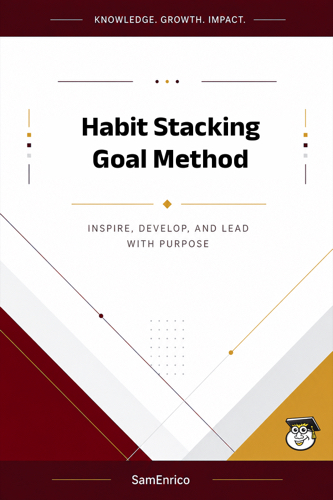
Non-FictionSelf-HelpHabit Stacking
Habit Stacking Goal Method eBook
Attach new goals to existing habits using this pra
by Stearns Yang
Attach new goals to existing habits using this practical behavior change workbook.
Formats
Free sample
Chapter 1: The Motivation Lie--–- You have been lied to. Not by a malicious source, but by an entire industry built on a seductive falsehood. The lie sounds beautiful: You just need to find your motivation. It appears on inspirational posters, in locker room speeches, and across the covers of thousands of self-help books. The implication is that somewhere inside you—buried under laziness, fear, or distraction—there is a magical lever labeled “Motivation.” If you could just find that lever and pull it, everything would change.
You would wake up early, eat the right foods, exercise consistently, build that business, write that book, and become the person you have always wanted to be.The problem is that the lever does not exist.This chapter will dismantle the motivation myth using research from behavioral economics and cognitive neuroscience. You will learn why willpower is a depleting resource, why your brain is wired to resist change, and why the most successful people on the planet do not rely on motivation at all. Then you will be introduced to the concept that actually works: the Free Energy Principle. By the end of this chapter, you will understand that you do not have a motivation problem, a discipline problem, or a time management problem. You have a trigger blindness problem.
And once you see your triggers, you can never unsee them.The Expensive Failure of Goal Setting Let us begin with an uncomfortable truth. Every year, approximately 40 percent of Americans make New Year’s resolutions. Within one week, 25 percent have abandoned them. By February, 80 percent have failed. These are not lazy people.
These are doctors, lawyers, teachers, parents, and entrepreneurs who genuinely want to improve their lives. They set specific goals: lose twenty pounds, save ten thousand dollars, run a marathon, read fifty books. They feel motivated. They buy the gym membership, the budgeting app, the running shoes, the stack of books. And then, somewhere between January 15th and February 1st, something breaks.Why?The standard answer—the one you have heard a thousand times—is that they lacked willpower.
But this answer is both lazy and wrong. Research from psychologist Roy Baumeister and his colleagues has demonstrated that willpower is not a character trait; it is a finite cognitive resource. In a famous series of experiments, participants who were asked to resist eating fresh-baked cookies (while sitting in a room filled with the smell of warm chocolate) performed significantly worse on subsequent puzzle-solving tasks than participants who were allowed to eat the cookies. The act of resisting depleted their willpower. Baumeister called this ego depletion.Here is what this means for you: every time you use willpower to force yourself to do something—get out of bed, avoid the donut, start that difficult email—you are drawing from a shared pool of mental energy.
By 3:00 PM, that pool is often empty. This is why diets fail at night, why New Year’s resolutions die in February, and why your motivation always seems to evaporate exactly when you need it most. You are not weak. You are simply fighting against the fundamental architecture of your own brain.The Neuroscience of Resistance To understand why willpower fails, you must understand how your brain makes decisions. Deep within your skull, buried beneath the wrinkly cortex that makes humans “smart,” lies a small almond-shaped cluster of neurons called the amygdala.
The amygdala does not care about your goals. It does not care about your five-year plan, your dream body, or your savings account. The amygdala cares about one thing and one thing only: survival. And survival, in neural terms, means conserving energy.Your brain consumes approximately 20 percent of your body’s calories while representing only 2 percent of your body’s mass. It is an expensive organ to run.
Evolution solved this problem by creating automaticity—the ability to perform repeated behaviors without conscious thought. When you first learned to drive, your prefrontal cortex (the “thinking brain”) was fully engaged. Every turn, every brake, every mirror check required effort. But after enough repetitions, driving became automatic. Your basal ganglia—a region associated with habit formation—took over.
Now you can drive home from work and realize you do not remember the last ten minutes of the journey. You were on autopilot.This autopilot is not a design flaw. It is a feature. Your brain automates behaviors to free up cognitive resources for novel threats and opportunities. The problem is that your brain does not care which behaviors it automates.
It will just as readily automate scrolling through your phone for two hours as it will automate exercising. And once a behavior is automated, it becomes free energy—a habit that runs with zero willpower cost.Here is the insight that changes everything: you cannot fight free energy. You can only redirect it.The Free Energy Principle Explained The Free Energy Principle was developed by neuroscientist Karl Friston, and it is one of the most powerful frameworks for understanding behavior ever proposed. In simple terms, the principle states that all living systems—from single-celled organisms to human beings—are driven to minimize surprise by maintaining a stable internal environment. For your brain, minimizing surprise means reducing prediction error—the gap between what you expect to happen and what actually happens.When you try to start a new habit using willpower alone, you create massive prediction error.
Your brain expects you to continue doing what you have always done. When you suddenly try to wake up at 5:00 AM or go for a run after work, your brain registers this as a surprise. And surprise, in neural terms, is expensive. It requires the prefrontal cortex to override the basal ganglia. This override burns willpower.
And because willpower is finite, you eventually exhaust it and return to your old patterns.But there is a loophole.If you attach a new behavior to an existing automatic habit, you bypass the prediction error entirely. Your brain does not register surprise because the trigger—the cue that initiates the behavior—is already familiar. The new behavior piggybacks on the free energy of the old one. This is the core mechanism of habit stacking, and it is why the method works when willpower fails.Let me give you a concrete example. Imagine you want to start flossing your teeth.
If you rely on motivation alone, you will tell yourself, “I will floss every night before bed.” For three nights, you might remember. On the fourth night, you are tired. Your brain says, “Not tonight.” By the fifth night, the habit is dead. This is not a failure of character. It is a failure of engineering.Now imagine you attach flossing to an existing automatic habit: brushing your teeth.
You do not need to remember to floss because brushing your teeth is already automatic. You finish brushing, and the floss is sitting right next to the toothbrush. The cue—finishing brushing—triggers the next action. Within two weeks, “brush then floss” becomes a single automatic chain. You have spent zero willpower on the flossing habit because you harnessed the free energy of the brushing habit.This is the difference between Goal Setting and Habit Stacking.
Goal setting feels good. You write down your aspirations, you imagine your future self, you feel a rush of dopamine.…
This is the end of the free sample. Get the eBook to keep going. Buy now
About this book
Details
- Author
- Stearns Yang
- Publisher
- SamEnrico
- Language
- English
- Genre
- Non-Fiction, Self-Help, Habit Stacking
- Released
- 2026-06-09
- Pages (approx.)
- 143
- Available as
- eBook, Audiobook

Read better in the ZLOADR app
Your eBooks on your phone or tablet. Sign in with your SamEnrico account and start reading.
More by Stearns Yang
 Phobia Catastrophic ThinkingStearns Yang$11.99
 Snapchat Spotlight ComparisonStearns Yang$11.99
 The Assertive ApologyStearns Yang$11.99
 The Alcohol Freedom Evening RoutineStearns Yang$11.99
 The Vanishing Act of the Blackbeard’s ShadowStearns Yang$11.99
 A Beginners Guide to Blokus (Volume 1)Stearns Yang$11.99
 Understanding Intercellular Cholesterol Esterification DiseaseStearns Yang$17.99
 Desk Escape Movement PlanStearns Yang$12.99
 Experiential Spending Trends GuideStearns Yang$12.99
 CoronerStearns Yang$11.99
You may also like
 Hong Kong Handover 1997Dunn Johnnie$11.99
 Zumba For Postnatal Recovery CourseNeal Christian$11.99
 Zumba for BeginnersLadner Nikia$11.99
 YouTube Comment Mining GuideHumes Pandora$12.99
 Worry Box MeditationCarlin Rudy$11.99
 Workplace Stress MeditationNguyen Lynn$11.99
 Workplace Stress and Sleep RepairHawley Ivory$11.99
 Workplace Perfectionism CureDelaney Jeffry$11.99
 Workplace Injustice Anger GuideWallen Isabelle$11.99
 Work Addiction and Burnout LinkGreenwood Ester$11.99
 Women in Yoga and WellnessBeattie Galina$11.99
 Women in Stand Up ComedyChun Evangeline$11.99