
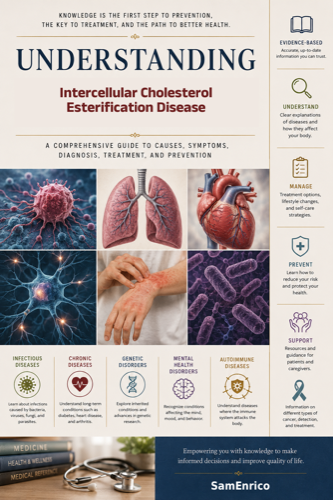
Understanding Intercellular Cholesterol Esterification Disease
This disease publication, published by SamEnrico,
by Stearns Yang
This disease publication, published by SamEnrico, covers Understanding Intercellular Cholesterol Esterification Disease
Formats
About this book
Free sample
Chapter 1: The Cellular Paradox...--In the quiet universe of the human cell, a molecule of profound contradiction orchestrates a daily drama of survival and destruction. This molecule is cholesterol, a substance so essential that without it, our cells would collapse into formless chaos, yet so dangerous that when mishandled, it becomes an agent of insidious disease. The paradox that defines cholesterol—life-giving in proper balance, lethal in excess—is not merely a poetic observation but a fundamental biological reality that lies at the heart of some of the most devastating disorders known to medicine. Understanding this paradox is the first step toward grasping why the process of cholesterol esterification, the focus of this book, is not a minor biochemical detail but a critical determinant of human health.The Architecture of a Double-Edged Molecule To appreciate why cholesterol presents such a challenge to cellular survival, we must first understand what cholesterol is at the molecular level. Cholesterol belongs to a class of molecules called sterols—complex ring structures derived from a common biochemical precursor.
Its chemical formula, C27H46O, belies an elegance of design that has evolved over hundreds of millions of years. The molecule consists of four fused hydrocarbon rings (labeled A, B, C, and D in chemical nomenclature), a rigid planar structure that gives cholesterol its unique physical properties. Attached to this ring system is a hydrocarbon tail that varies in flexibility and an 8-carbon side chain that protrudes from the molecule like a rudder.What makes cholesterol truly remarkable, however, is the single hydroxyl group (-OH) attached to carbon 3 of the A ring. This tiny chemical modification, a single oxygen atom bonded to a hydrogen, transforms the molecule from purely hydrophobic (water-fearing) to amphipathic—possessing both water-loving and water-fearing regions. The hydroxyl group creates a polar head that interacts favorably with water molecules, while the remainder of the molecule remains nonpolar and seeks to avoid water at all costs.This amphipathic nature is the secret to cholesterol's essential functions in the cell membrane.
Cell membranes are composed primarily of phospholipids—molecules with polar heads and fatty acid tails—arranged in a bilayer with heads facing…
This is the end of the free sample. Get the eBook to keep going. Buy now
Contents
- Chapter 1
- Chapter 2
- Chapter 3
- Chapter 4
- Chapter 5
- Chapter 6
- Chapter 7
- Chapter 8
- Chapter 9
- Chapter 10
- Chapter 11
- Chapter 12
Details
- Author
- Stearns Yang
- Publisher
- SamEnrico
- Language
- English
- Genre
- Non-Fiction, Informative, Educational
- Released
- 2026-06-02
- Pages (approx.)
- 147
- Available as
- eBook, Audiobook

Read better in the ZLOADR app
Your eBooks on your phone or tablet. Sign in with your SamEnrico account and start reading.
More by Stearns Yang
 Phobia Catastrophic ThinkingStearns Yang$11.99
 Habit Stacking Goal MethodStearns Yang$11.99
 Snapchat Spotlight ComparisonStearns Yang$11.99
 The Assertive ApologyStearns Yang$11.99
 The Alcohol Freedom Evening RoutineStearns Yang$11.99
 The Vanishing Act of the Blackbeard’s ShadowStearns Yang$11.99
 A Beginners Guide to Blokus (Volume 1)Stearns Yang$11.99
 Desk Escape Movement PlanStearns Yang$12.99
 Experiential Spending Trends GuideStearns Yang$12.99
 CoronerStearns Yang$11.99