
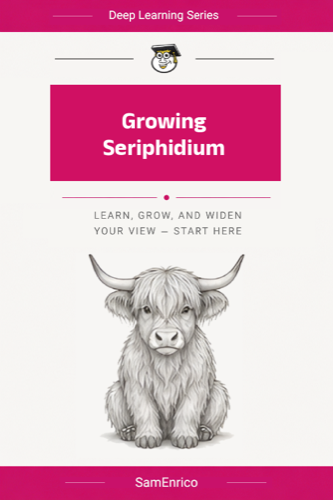
Non-FictionInformativeEducational
Growing Seriphidium Audiobook
This publication, published by SamEnrico, covers G
This publication, published by SamEnrico, covers Growing Seriphidium
Formats
Free sample
Chapter 1: The Silver Survivor--Every garden has its graveyard—that bare patch where expensive plants go to expire, where optimistic transplants turn to brittle twigs, where the hose reaches but hope does not. For most gardeners, this is simply the cost of cultivation. But what if that bare patch could become the most resilient, beautiful, and low-maintenance corner of your entire property? What if the plant that laughs at drought, ignores poor soil, and asks for nothing could be the centerpiece of a landscape that thrives on neglect? This is the promise of Seriphidium—a genus so perfectly adapted to harsh conditions that it doesn't just survive where others fail; it flourishes.Most gardeners have never heard of Seriphidium.
They know sagebrush—the ubiquitous silver shrub of Western films and high desert vistas—but they don't know that what they're looking at is likely misidentified. For decades, botanists lumped Seriphidium species into the larger genus Artemisia, alongside wormwood and tarragon. Only relatively recently has DNA evidence confirmed what observant field botanists long suspected: these plants are different. They are not merely a type of sagebrush; they are a distinct evolutionary lineage with unique characteristics that matter enormously to anyone trying to grow them.The distinction is not academic pedantry. It is the difference between success and failure in your garden.What Exactly Is Seriphidium?Let us begin with clarity.
The genus Seriphidium belongs to the Asteraceae family—the sunflower family, one of the largest and most successful plant families on Earth. Within this family, Seriphidium occupies a specialized niche: arid and semi-arid regions with cold winters, hot summers, and unpredictable precipitation. Its closest relatives are indeed Artemisia species, but the differences are consistent and meaningful.The most obvious distinction lies in the flower heads. Artemisia species typically produce heterogamous flower heads—meaning each head contains both female and bisexual florets, often arranged in specific patterns. Seriphidium, by contrast, produces homogamous flower heads: every floret within a single head is bisexual and fertile.
This might sound like a minor botanical detail, but it affects everything from pollination success rates to seed production to the plant's ability to colonize new territory. Homogamous heads are more efficient at self-pollination when insect visitors are scarce—a crucial adaptation in wind-scoured steppes where bees are rare.The growth habit differs as well. Seriphidium species are uniformly shrubby, often forming dense, rounded mounds of silvery foliage that can reach…
This is the end of the free sample. Get the Audiobook to keep going. Buy now
About this book
Details
- Author
- Spellman Ruthanne
- Publisher
- SamEnrico
- Language
- English
- Genre
- Non-Fiction, Informative, Educational
- Released
- 2026-06-03
- Pages (approx.)
- 153
- Available as
- eBook, Audiobook

Listen in the VoxFlicks app
Audiobooks and audio dramas wherever you go. Sign in with your SamEnrico account and press play.
More by Spellman Ruthanne
 The Performing Teen GuideSpellman Ruthanne$11.99
 Snapchat Streak Comparison TrapSpellman Ruthanne$11.99
 Carson Presidential MedalSpellman Ruthanne$11.99
 TikTok Highlight Reel RecoverySpellman Ruthanne$11.99
 The Childhood Worth Wound WorkbookSpellman Ruthanne$11.99
 Gratitude Habit GuideSpellman Ruthanne$11.99
 Wild Card Mentality GuideSpellman Ruthanne$11.99
 Self Doubt Destroyer GuideSpellman Ruthanne$11.99
 Commute Burnout ReductionSpellman Ruthanne$11.99
 The Last Broadcast: When the Radio DiedSpellman Ruthanne$11.99
 The Silent Storm: How a Forgotten Admiral Won the Cold War at SeaSpellman Ruthanne$11.99
 UK Employee Stock Options Tax GuideSpellman Ruthanne$12.99
You may also like
 Hong Kong Handover 1997Dunn Johnnie$11.99
 Zumba For Postnatal Recovery CourseNeal Christian$11.99
 Zumba for BeginnersLadner Nikia$11.99
 YouTube Comment Mining GuideHumes Pandora$12.99
 Worry Box MeditationCarlin Rudy$11.99
 Workplace Stress MeditationNguyen Lynn$11.99
 Workplace Stress and Sleep RepairHawley Ivory$11.99
 Workplace Perfectionism CureDelaney Jeffry$11.99
 Workplace Injustice Anger GuideWallen Isabelle$11.99
 Work Addiction and Burnout LinkGreenwood Ester$11.99
 Women in Yoga and WellnessBeattie Galina$11.99
 Women in Stand Up ComedyChun Evangeline$11.99