
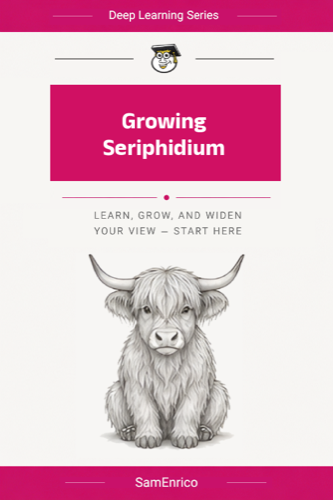
Non-FictionInformativeEducational
Growing Seriphidium eBook
This publication, published by SamEnrico, covers G
This publication, published by SamEnrico, covers Growing Seriphidium
Formats
Free sample
Chapter 1: The Silver Survivor--Every garden has its graveyard—that bare patch where expensive plants go to expire, where optimistic transplants turn to brittle twigs, where the hose reaches but hope does not. For most gardeners, this is simply the cost of cultivation. But what if that bare patch could become the most resilient, beautiful, and low-maintenance corner of your entire property? What if the plant that laughs at drought, ignores poor soil, and asks for nothing could be the centerpiece of a landscape that thrives on neglect? This is the promise of Seriphidium—a genus so perfectly adapted to harsh conditions that it doesn't just survive where others fail; it flourishes.Most gardeners have never heard of Seriphidium.
They know sagebrush—the ubiquitous silver shrub of Western films and high desert vistas—but they don't know that what they're looking at is likely misidentified. For decades, botanists lumped Seriphidium species into the larger genus Artemisia, alongside wormwood and tarragon. Only relatively recently has DNA evidence confirmed what observant field botanists long suspected: these plants are different. They are not merely a type of sagebrush; they are a distinct evolutionary lineage with unique characteristics that matter enormously to anyone trying to grow them.The distinction is not academic pedantry. It is the difference between success and failure in your garden.What Exactly Is Seriphidium?Let us begin with clarity.
The genus Seriphidium belongs to the Asteraceae family—the sunflower family, one of the largest and most successful plant families on Earth. Within this family, Seriphidium occupies a specialized niche: arid and semi-arid regions with cold winters, hot summers, and unpredictable precipitation. Its closest relatives are indeed Artemisia species, but the differences are consistent and meaningful.The most obvious distinction lies in the flower heads. Artemisia species typically produce heterogamous flower heads—meaning each head contains both female and bisexual florets, often arranged in specific patterns. Seriphidium, by contrast, produces homogamous flower heads: every floret within a single head is bisexual and fertile.
This might sound like a minor botanical detail, but it affects everything from pollination success rates to seed production to the plant's ability to colonize new territory. Homogamous heads are more efficient at self-pollination when insect visitors are scarce—a crucial adaptation in wind-scoured steppes where bees are rare.The growth habit differs as well. Seriphidium species are uniformly shrubby, often forming dense, rounded mounds of silvery foliage that can reach anywhere from eighteen inches to six feet in height, depending on species and growing conditions. They branch from the base, producing multiple woody stems that emerge directly from the root crown. Artemisia species, in contrast, include many herbaceous perennials that die back to the ground each winter, as well as sprawling or rhizomatous forms that spread aggressively.For the gardener, this means predictability.
A Seriphidium planted in the right location will maintain a defined shape, stay where you put it, and never require the kind of invasive control measures needed for spreading Artemisia species like wormwood. You are planting a shrub, not a potential weed.Where Seriphidium Comes From Understanding a plant's native habitat is the single best predictor of how to grow it successfully. Seriphidium species evolved in some of the most challenging environments on Earth, and their adaptations reflect specific responses to specific stresses.The Eurasian steppes form one center of Seriphidium diversity. This vast grassland ecosystem stretches from the Caspian Sea eastward through Kazakhstan, Uzbekistan, and into Mongolia and northern China. Winters here are brutally cold, with temperatures dropping to -30°F or lower.
Summers are hot and dry, with rainfall averaging only ten to sixteen inches annually—and that rain falls mostly in spring and early summer, followed by a months-long dry season. Snow cover is unreliable, meaning plants must tolerate both extreme cold and exposure to drying winter winds. Seriphidium species native to this region, such as S. herba-album (white wormwood) and S. cinum, developed deep taproots that access groundwater, cuticular waxes that reduce water loss, and cold tolerance that allows survival through winters without insulating snow.The North American high deserts form a second center of diversity, though the taxonomy here remains somewhat contested.
The classic big sagebrush of the American West—the plant that defines the Great Basin landscape from the Sierra Nevada to the Rockies—was long called Artemisia tridentata. Recent evidence suggests that some populations, particularly those in the most arid and alkaline sites, belong instead to Seriphidium tridentatum sensu stricto. These plants grow in basins and plateaus at elevations between 4,000 and 7,000 feet, where annual precipitation ranges from seven to eighteen inches, mostly as snow and spring rain. Summer temperatures routinely exceed 95°F, and afternoon humidity often drops below twenty percent. The growing season is short—barely ninety days between the last spring frost and the first autumn freeze.Other Seriphidium species occupy semi-arid plateaus in the Middle East, Central Asia, and the Mediterranean fringe.
Each population has adapted to local conditions, but all share common traits: they expect sun, they expect drainage, and they do not expect pampering.The Hardiness Reality Before you fall in love with the idea of growing Seriphidium, you need to know whether your climate can support it. This book provides guidance for USDA Hardiness Zones 5 through 9. If you garden in Zone 4—where winter minimums range from -30°F to -20°F—you can still grow Seriphidium, but only with specific mitigation strategies that we will cover in Chapter 12. If you garden in Zone 10 or above, where winter minimums stay above 30°F, most Seriphidium species will struggle; they require a winter dormancy period triggered by cold temperatures, and without it, they decline over two to three years.Zone 5 gardeners (minimum -20°F to -10°F) should choose the hardiest species, typically S. tridentatum from high-elevation seed sources or S.
herba-album from northern steppe populations. These plants tolerate extreme cold as long as the soil drains completely. Snow cover helps, but it is not required. Zone 6 and 7 gardeners (-10°F to 10°F minimum) have the widest selection of species and cultivars; most Seriphidium thrive in these conditions. Zone 8 and 9 gardeners (10°F to 30°F minimum) must ensure adequate summer heat—Seriphidium requires hot summers to complete its growth cycle—and should avoid the very coldest-hardy species, which may decline if winters are too mild.What about rainfall?
Seriphidium does not require arid conditions; it tolerates arid conditions. Plants grown in regions with summer rainfall—the eastern United States, for example, or western Europe—will survive and even thrive, but only if the soil drains perfectly. The problem is never too little water; it is water that lingers. A Seriphidium planted in heavy clay that stays wet for three days after a rain will develop root rot regardless of how much sun it receives. We will spend considerable time in Chapters 5 and 6 on soil modification and watering systems precisely because drainage is the difference between a twenty-year plant and a two-year corpse.Key Species for Gardeners and Landscapers Not all Seriphidium species are created equal for cultivation purposes.
Some are garden-worthy; others are strictly for restoration projects or botanical collections. Here are the species you are most likely to encounter and grow successfully.Seriphidium tridentatum (Three-Tip Sagebrush) –…
This is the end of the free sample. Get the eBook to keep going. Buy now
About this book
Details
- Author
- Spellman Ruthanne
- Publisher
- SamEnrico
- Language
- English
- Genre
- Non-Fiction, Informative, Educational
- Released
- 2026-06-03
- Pages (approx.)
- 153
- Available as
- eBook, Audiobook

Read better in the ZLOADR app
Your eBooks on your phone or tablet. Sign in with your SamEnrico account and start reading.
More by Spellman Ruthanne
 The Performing Teen GuideSpellman Ruthanne$11.99
 Snapchat Streak Comparison TrapSpellman Ruthanne$11.99
 Carson Presidential MedalSpellman Ruthanne$11.99
 TikTok Highlight Reel RecoverySpellman Ruthanne$11.99
 The Childhood Worth Wound WorkbookSpellman Ruthanne$11.99
 Gratitude Habit GuideSpellman Ruthanne$11.99
 Wild Card Mentality GuideSpellman Ruthanne$11.99
 Self Doubt Destroyer GuideSpellman Ruthanne$11.99
 Commute Burnout ReductionSpellman Ruthanne$11.99
 The Last Broadcast: When the Radio DiedSpellman Ruthanne$11.99
 The Silent Storm: How a Forgotten Admiral Won the Cold War at SeaSpellman Ruthanne$11.99
 UK Employee Stock Options Tax GuideSpellman Ruthanne$12.99
You may also like
 Hong Kong Handover 1997Dunn Johnnie$11.99
 Zumba For Postnatal Recovery CourseNeal Christian$11.99
 Zumba for BeginnersLadner Nikia$11.99
 YouTube Comment Mining GuideHumes Pandora$12.99
 Worry Box MeditationCarlin Rudy$11.99
 Workplace Stress MeditationNguyen Lynn$11.99
 Workplace Stress and Sleep RepairHawley Ivory$11.99
 Workplace Perfectionism CureDelaney Jeffry$11.99
 Workplace Injustice Anger GuideWallen Isabelle$11.99
 Work Addiction and Burnout LinkGreenwood Ester$11.99
 Women in Yoga and WellnessBeattie Galina$11.99
 Women in Stand Up ComedyChun Evangeline$11.99