
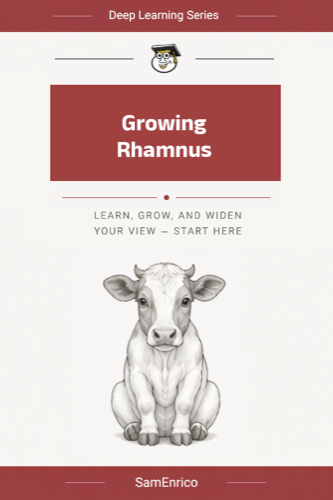
Growing Rhamnus
This publication, published by SamEnrico, covers G
This publication, published by SamEnrico, covers Growing Rhamnus
Formats
About this book
Free sample
Chapter 1: The Accidental Invasive...--I planted my first buckthorn because a landscaping catalog said it would create “impenetrable privacy in just three years.” I was twenty-four, had just bought my first house with a yard that overlooked a busy road, and I wanted a green wall—fast. The plant arrived as a bare-root stick with a few nubs that the instructions promised would become “vigorous growth.” Vigorous turned out to be an understatement. Within five years, that single plant had produced thousands of berries, and my neighbor’s wooded lot had become a monoculture of glossy, thorny stems choking out every native wildflower that used to bloom there. I didn’t know I had done anything wrong until a local conservation officer knocked on my door and handed me a pamphlet titled “Do Not Plant: Common Buckthorn.”That moment—the sickening realization that my attempt to improve my property had caused ecological harm—is the reason this book exists. I spent the next decade learning everything about the genus Rhamnus: which species are heroes, which are villains, and how to tell them apart before you make the same mistake I did.
This chapter is the warning I wish I had received before I ever opened that catalog.The Genus That Contains Both Enemy and Ally The plant family Rhamnaceae includes over fifty genera and nearly a thousand species worldwide, but the one that matters most to gardeners and land managers in North America and Europe is the genus Rhamnus (and its close relative Frangula, a taxonomic distinction we will untangle shortly). What makes this genus so unusual—and so dangerous for the uninformed gardener—is that it contains species that are among the most beneficial native plants you can grow and species that are among the most destructive invasive plants on the continent.Here is the core truth of this book, stated plainly: Rhamnus is not good or bad. Rhamnus is a family of plants with different behaviors, different native ranges, and different ecological impacts. The California coffeeberry that supports migrating thrushes in the Sierra Nevada foothills is the same genus as the common…
This is the end of the free sample. Get the eBook to keep going. Buy now
Contents
- Chapter 1
- Chapter 2
- Chapter 3
- Chapter 4
- Chapter 5
- Chapter 6
- Chapter 7
- Chapter 8
- Chapter 9
- Chapter 10
- Chapter 11
- Chapter 12
Details
- Author
- Spearman Pamala
- Publisher
- SamEnrico
- Language
- English
- Genre
- Non-Fiction, Informative, Educational
- Released
- 2026-06-02
- Pages (approx.)
- 145
- Available as
- eBook, Audiobook

Read better in the ZLOADR app
Your eBooks on your phone or tablet. Sign in with your SamEnrico account and start reading.
More by Spearman Pamala
 Rhyming Peg System GuideSpearman Pamala$11.99
 Road Rage Confrontation De escalationSpearman Pamala$11.99
 Cocaine Recovery for PerformersSpearman Pamala$11.99
 Diamond Heist Copycat CrimesSpearman Pamala$11.99
 The Team Brainwriting HandbookSpearman Pamala$11.99
 RMD Estate Planning GuideSpearman Pamala$11.99
 Cigarette Budget Freedom PlanSpearman Pamala$11.99
 RLS Kidney Disease LinkSpearman Pamala$11.99
 The River That Broke Them: The Forgotten Tragedy of the Congo ExpeditionsSpearman Pamala$11.99
 Magnesium For PMS GuideSpearman Pamala$11.99
 Crown & Controversy: How King Charles III Redefined the Monarchy in His First YearSpearman Pamala$11.99
 The Mathematicians of the Nile: Unlocking the Secrets of Ancient Egyptian GeometrySpearman Pamala$11.99