
Non-FictionInformativeEducational
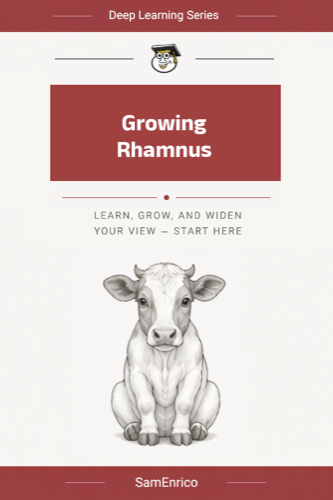
Growing Rhamnus eBook
This publication, published by SamEnrico, covers G
This publication, published by SamEnrico, covers Growing Rhamnus
Formats
Free sample
Chapter 1: The Accidental Invasive...--I planted my first buckthorn because a landscaping catalog said it would create “impenetrable privacy in just three years.” I was twenty-four, had just bought my first house with a yard that overlooked a busy road, and I wanted a green wall—fast. The plant arrived as a bare-root stick with a few nubs that the instructions promised would become “vigorous growth.” Vigorous turned out to be an understatement. Within five years, that single plant had produced thousands of berries, and my neighbor’s wooded lot had become a monoculture of glossy, thorny stems choking out every native wildflower that used to bloom there. I didn’t know I had done anything wrong until a local conservation officer knocked on my door and handed me a pamphlet titled “Do Not Plant: Common Buckthorn.”That moment—the sickening realization that my attempt to improve my property had caused ecological harm—is the reason this book exists. I spent the next decade learning everything about the genus Rhamnus: which species are heroes, which are villains, and how to tell them apart before you make the same mistake I did.
This chapter is the warning I wish I had received before I ever opened that catalog.The Genus That Contains Both Enemy and Ally The plant family Rhamnaceae includes over fifty genera and nearly a thousand species worldwide, but the one that matters most to gardeners and land managers in North America and Europe is the genus Rhamnus (and its close relative Frangula, a taxonomic distinction we will untangle shortly). What makes this genus so unusual—and so dangerous for the uninformed gardener—is that it contains species that are among the most beneficial native plants you can grow and species that are among the most destructive invasive plants on the continent.Here is the core truth of this book, stated plainly: Rhamnus is not good or bad. Rhamnus is a family of plants with different behaviors, different native ranges, and different ecological impacts. The California coffeeberry that supports migrating thrushes in the Sierra Nevada foothills is the same genus as the common buckthorn that has overtaken millions of acres of Midwestern forest. Your job—and this book will teach you how to do it—is to know which is which before you plant.This duality creates a strange problem for gardeners and even for professional horticulturists.
Most gardening books either ignore Rhamnus entirely (too controversial) or treat it as a single, monolithic group (dangerously misleading). Some native plant guides celebrate coffeeberry without ever mentioning that its cousin is a noxious weed. Conversely, invasive species manuals demonize common buckthorn without acknowledging that other species in the same genus are native, valuable, and worth planting.This chapter bridges that gap. You will learn the taxonomy, the history, the identification basics, and—most critically—the legal and ethical responsibilities that come with growing any member of this genus. By the end of this chapter, you will know whether Rhamnus belongs in your landscape, and if so, exactly which species to choose.Taxonomy Made Simple: Rhamnus vs.
Frangula Before you can identify which Rhamnus you are dealing with, you need to understand a taxonomic controversy that has confused botanists for over two hundred years. The genus was first described by Carl Linnaeus in 1753, who grouped all buckthorns and coffeeberries under the single name Rhamnus. In the nineteenth century, botanists began noticing consistent differences in flower structure, leaf venation, and fruit development. Some species had flowers with five petals and leaves with prominent, parallel side veins. Others had four-petaled flowers and leaves where the side veins curved upward toward the tip.By the early twentieth century, a split had been proposed: keep the name Rhamnus for the spiny, five-petaled species (like common buckthorn), and create a new genus called Frangula for the spineless, four-petaled species (like alder buckthorn and California coffeeberry).
This split was never universally accepted. If you consult a botanical manual published in Europe, you will likely see Frangula treated as a separate genus. If you consult a manual published in North America, you are more likely to see all species still grouped under Rhamnus.Here is what you need to know as a gardener: the split matters less for cultivation than it does for identification. The characteristics that separate Frangula from Rhamnus are exactly the characteristics you will use to tell the good species from the bad. So let us set aside the academic debate and focus on the practical distinctions.All members of this group share certain family traits: simple, alternate or opposite leaves (more on that in a moment); small, inconspicuous flowers that range from greenish-yellow to white; and berry-like drupes that start green, turn red, and finally ripen to dark purple or black.
The drupe is botanically interesting—it is a fleshy fruit with a hard stone inside containing one to four seeds—but for identification purposes, the berry’s color progression is less reliable than leaf and stem characteristics.The three species you are most likely to encounter—whether in a nursery, a garden center, or invading your backyard—are common buckthorn (Rhamnus cathartica), alder buckthorn (Frangula alnus, also sold as Rhamnus frangula), and California coffeeberry (Frangula californica, also sold as Rhamnus californica). A fourth species, Carolina buckthorn (Rhamnus caroliniana), is an underappreciated native alternative for Eastern gardens, and we will cover it in depth in Chapter 8.Common Buckthorn: The Villain Rhamnus cathartica—common buckthorn, European buckthorn, or purging buckthorn—is the species that gives the entire genus a bad name. It is native to Europe, western Asia, and northern Africa, where it grows in hedgerows, forest edges, and calcareous soils. In its native range, it is kept in check by a suite of insects, fungal pathogens, and competing plants that evolved alongside it. When European settlers brought it to North America in the nineteenth century—for hedgerows, wildlife habitat, and windbreaks—they left those natural controls behind.The result has been catastrophic.
Common buckthorn now infests an estimated fifteen million acres in the United States and Canada, with the heaviest concentrations in the Great Lakes region, the Northeast, and the upper Midwest. It forms dense, impenetrable thickets that shade out native tree seedlings, herbaceous plants, and wildflowers. It produces chemicals—a phenomenon called allelopathy—that inhibit the germination of other plants in the soil beneath it. It leafs out earlier in the spring and holds its leaves later in the fall than almost any native species, giving it a longer growing season and a competitive advantage.I want you to look closely at the name: cathartica. It comes from the Greek kathartikos, meaning cleansing or purging.
The name refers to the berries, which contain emodin and other anthraquinones that are powerfully laxative. Birds eat the berries with no apparent ill effects—their digestive systems process the compounds differently—but a human who consumes more than a few berries will experience severe gastrointestinal distress. The purging property was valued in traditional medicine, where the berries were used as a drastic purgative. It also means that the seeds pass quickly through birds, often being deposited far from the parent plant in a ready-made packet of natural fertilizer.This dispersal strategy…
This is the end of the free sample. Get the eBook to keep going. Buy now
About this book
Details
- Author
- Spearman Pamala
- Publisher
- SamEnrico
- Language
- English
- Genre
- Non-Fiction, Informative, Educational
- Released
- 2026-06-02
- Pages (approx.)
- 145
- Available as
- eBook, Audiobook

Read better in the ZLOADR app
Your eBooks on your phone or tablet. Sign in with your SamEnrico account and start reading.
More by Spearman Pamala
 Rhyming Peg System GuideSpearman Pamala$11.99
 Road Rage Confrontation De escalationSpearman Pamala$11.99
 Cocaine Recovery for PerformersSpearman Pamala$11.99
 Diamond Heist Copycat CrimesSpearman Pamala$11.99
 The Team Brainwriting HandbookSpearman Pamala$11.99
 RMD Estate Planning GuideSpearman Pamala$11.99
 Cigarette Budget Freedom PlanSpearman Pamala$11.99
 RLS Kidney Disease LinkSpearman Pamala$11.99
 The River That Broke Them: The Forgotten Tragedy of the Congo ExpeditionsSpearman Pamala$11.99
 Magnesium For PMS GuideSpearman Pamala$11.99
 Crown & Controversy: How King Charles III Redefined the Monarchy in His First YearSpearman Pamala$11.99
 The Mathematicians of the Nile: Unlocking the Secrets of Ancient Egyptian GeometrySpearman Pamala$11.99
You may also like
 Hong Kong Handover 1997Dunn Johnnie$11.99
 Zumba For Postnatal Recovery CourseNeal Christian$11.99
 Zumba for BeginnersLadner Nikia$11.99
 YouTube Comment Mining GuideHumes Pandora$12.99
 Worry Box MeditationCarlin Rudy$11.99
 Workplace Stress MeditationNguyen Lynn$11.99
 Workplace Stress and Sleep RepairHawley Ivory$11.99
 Workplace Perfectionism CureDelaney Jeffry$11.99
 Workplace Injustice Anger GuideWallen Isabelle$11.99
 Work Addiction and Burnout LinkGreenwood Ester$11.99
 Women in Yoga and WellnessBeattie Galina$11.99
 Women in Stand Up ComedyChun Evangeline$11.99