
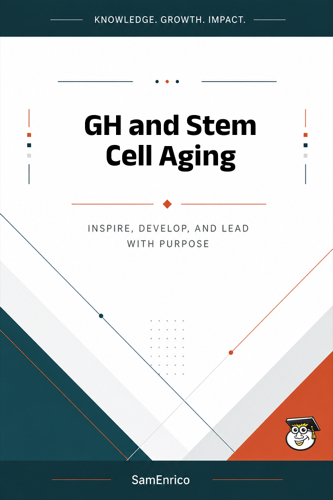
Non-FictionHealth & Wellness / Regenerative
GH and Stem Cell Aging
Explores growth hormone's influence on stem cell p
by Vue Hulda
Explores growth hormone's influence on stem cell pools and tissue regeneration.
Formats
About this book
Free sample
Chapter 1: The Master Switch--In the center of your skull, tucked behind your eyes and beneath the folded tissue of your frontal lobes, sits a gland the size of a pea. Its name is the pituitary, and despite its negligible real estate, it is arguably the most powerful endocrine organ in your body. This pea-sized structure produces not one but several hormones that control growth, metabolism, stress response, and reproduction. Among these, one stands out for its profound and paradoxical influence on how we age: Growth Hormone. To understand why a child's fingertip can regenerate while an elderly person's wound leaves a scar, we must first understand this master switch—how it works, what controls it, and why its signal changes everything about the stem cells that keep us alive.This chapter provides the essential primer for the entire book.
Without a clear map of the Growth Hormone/IGF-1 axis, the chapters that follow—on stem cell niches, molecular pathways, the Somatopause, and the trade-off between regeneration and cancer—will remain abstract. By the end of this chapter, you will understand the basic anatomy and physiology of the system, the crucial distinction between two different pools of IGF-1 (a distinction that will reappear in nearly every subsequent chapter), and the historical context that has led to both the hype and the caution surrounding GH as an anti-aging intervention. More importantly, you will see why GH is not a magic bullet but rather a master regulator—a conductor, not a soloist.The Anatomy of Control: From Brain to Blood The story of Growth Hormone begins not in the pituitary itself but one level higher, in a region of the brain called the hypothalamus. The hypothalamus is the body's thermostat, but instead of regulating only temperature, it regulates hunger, thirst, sleep, sex drive, and hormone release. It does this by sensing internal conditions—blood sugar levels, inflammatory signals, stress hormones, and nutrient availability—and then sending commands to the pituitary via a specialized portal blood system.The specific command for GH comes in two flavors: stimulatory and inhibitory.
The hypothalamus releases Growth Hormone-Releasing Hormone (GHRH) , which tells the pituitary to produce and secrete GH. Simultaneously, it can…
This is the end of the free sample. Get the eBook to keep going. Buy now
Contents
- Chapter 1
- Chapter 2
- Chapter 3
- Chapter 4
- Chapter 5
- Chapter 6
- Chapter 7
- Chapter 8
- Chapter 9
- Chapter 10
- Chapter 11
- Chapter 12
Details
- Author
- Vue Hulda
- Publisher
- SamEnrico
- Language
- English
- Genre
- Non-Fiction, Health & Wellness / Regenerative
- Released
- 2026-06-06
- Pages (approx.)
- 136
- Available as
- eBook, Audiobook

Read better in the ZLOADR app
Your eBooks on your phone or tablet. Sign in with your SamEnrico account and start reading.
More by Vue Hulda
 Mindfulness for Beginner High AchieversVue Hulda$11.99
 Chunking Project TasksVue Hulda$11.99
 The Hearst Hollywood YearsVue Hulda$11.99
 The Silent Slaughter: The Case of Frederick Seddon and the Poisoned InheritanceVue Hulda$11.99
 How to Become a Batch FreezerVue Hulda$11.99
 Customer Support RepresentativeVue Hulda$11.99
 Small Parcel Shipping from China to Both NationsVue Hulda$12.99
 How to Produce Brayer RollersVue Hulda$11.99
You may also like
 Hong Kong Handover 1997Dunn Johnnie$11.99
 Zumba For Postnatal Recovery CourseNeal Christian$11.99
 Zumba for BeginnersLadner Nikia$11.99
 YouTube Comment Mining GuideHumes Pandora$12.99
 Worry Box MeditationCarlin Rudy$11.99
 Workplace Stress MeditationNguyen Lynn$11.99
 Workplace Stress and Sleep RepairHawley Ivory$11.99
 Workplace Perfectionism CureDelaney Jeffry$11.99
 Workplace Injustice Anger GuideWallen Isabelle$11.99
 Work Addiction and Burnout LinkGreenwood Ester$11.99
 Women in Yoga and WellnessBeattie Galina$11.99
 Women in Stand Up ComedyChun Evangeline$11.99