
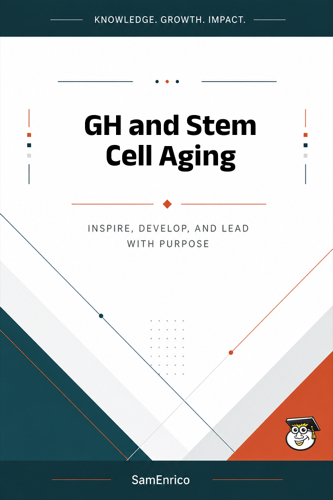
Non-FictionHealth & Wellness / Regenerative
GH and Stem Cell Aging eBook
Explores growth hormone's influence on stem cell p
by Vue Hulda
Explores growth hormone's influence on stem cell pools and tissue regeneration.
Formats
Free sample
Chapter 1: The Master Switch--In the center of your skull, tucked behind your eyes and beneath the folded tissue of your frontal lobes, sits a gland the size of a pea. Its name is the pituitary, and despite its negligible real estate, it is arguably the most powerful endocrine organ in your body. This pea-sized structure produces not one but several hormones that control growth, metabolism, stress response, and reproduction. Among these, one stands out for its profound and paradoxical influence on how we age: Growth Hormone. To understand why a child's fingertip can regenerate while an elderly person's wound leaves a scar, we must first understand this master switch—how it works, what controls it, and why its signal changes everything about the stem cells that keep us alive.This chapter provides the essential primer for the entire book.
Without a clear map of the Growth Hormone/IGF-1 axis, the chapters that follow—on stem cell niches, molecular pathways, the Somatopause, and the trade-off between regeneration and cancer—will remain abstract. By the end of this chapter, you will understand the basic anatomy and physiology of the system, the crucial distinction between two different pools of IGF-1 (a distinction that will reappear in nearly every subsequent chapter), and the historical context that has led to both the hype and the caution surrounding GH as an anti-aging intervention. More importantly, you will see why GH is not a magic bullet but rather a master regulator—a conductor, not a soloist.The Anatomy of Control: From Brain to Blood The story of Growth Hormone begins not in the pituitary itself but one level higher, in a region of the brain called the hypothalamus. The hypothalamus is the body's thermostat, but instead of regulating only temperature, it regulates hunger, thirst, sleep, sex drive, and hormone release. It does this by sensing internal conditions—blood sugar levels, inflammatory signals, stress hormones, and nutrient availability—and then sending commands to the pituitary via a specialized portal blood system.The specific command for GH comes in two flavors: stimulatory and inhibitory.
The hypothalamus releases Growth Hormone-Releasing Hormone (GHRH) , which tells the pituitary to produce and secrete GH. Simultaneously, it can release somatostatin, which tells the pituitary to stop. The final output of GH is therefore not a steady drip but a pulsatile rhythm—bursts of secretion followed by quiet periods. These pulses occur primarily during deep slow-wave sleep and in response to exercise, fasting, or stress. This pulsatility matters.
As we will see in Chapter 11, disrupting sleep or circadian rhythms blunts these pulses and impairs stem cell function.Once GH is released into the bloodstream, it travels throughout the body. Unlike many hormones that act directly on a single target organ, GH is promiscuous. It binds to receptors on the liver, bone, muscle, fat, and even the brain. The most well-studied target is the liver. When GH binds to its receptor on liver cells, it triggers a cascade of events that leads to the production and secretion of Insulin-like Growth Factor 1 (IGF-1) .
Most of the IGF-1 circulating in your blood—roughly 75%—comes from the liver. However, and this is critical, almost every tissue in the body can produce its own local IGF-1 independently of the liver. This distinction between endocrine IGF-1 (liver-derived, circulating) and autocrine/paracrine IGF-1 (locally produced, acting within the same tissue) is one of the most underappreciated concepts in endocrinology, and it is central to resolving many apparent contradictions in the field.To visualize this system, imagine a chain of command. The hypothalamus is the general, issuing orders via GHRH. The pituitary is the colonel, releasing GH into the bloodstream.
The liver is the major supply depot, producing endocrine IGF-1 that circulates to distant tissues. But individual tissues—muscle, bone, fat—are also field units that can manufacture their own local IGF-1 on demand, without waiting for orders from above. This redundancy explains why exercise can build muscle even in people with very low circulating GH, and why blocking liver-derived IGF-1 does not completely abolish tissue repair.The 1990s Hype: When a Pea-Sized Gland Became a Billion-Dollar Industry No discussion of GH is complete without understanding how it became the subject of both scientific fascination and dangerous pseudoscience. In 1990, the New England Journal of Medicine published a study that would change the public perception of aging forever. The researchers, led by Dr.
Daniel Rudman, injected 12 healthy men aged 61 to 81 with synthetic GH for six months. Compared to a control group, the treated men showed an 8.8% increase in lean body mass, a 14.4% decrease in adipose tissue, and a 1.6% increase in lumbar spine bone density. The conclusion, as reported by the media, was explosive: GH reversed some signs of aging.What the headlines did not mention was equally important. The study was small—only 12 treated men. The "lean body mass" increase was largely water and connective tissue, not functional muscle.
Strength did not improve. And there were significant side effects: carpal tunnel syndrome, gynecomastia, and insulin resistance. Nevertheless, the genie was out of the bottle. Clinics offering "anti-aging" HGH injections proliferated. Professional athletes, Hollywood actors, and Silicon Valley executives began using GH as a performance-enhancing and aesthetic drug.
By the early 2000s, the market for synthetic GH exceeded several billion dollars annually, much of it for off-label use.The scientific backlash was swift. Systematic reviews and meta-analyses consistently found that GH in healthy older adults produced modest changes in body composition but no improvement in strength, endurance, or quality of life, while significantly increasing the risk of adverse events. A landmark 2007 review in the Annals of Internal Medicine concluded that "the benefits of GH in healthy elderly individuals are not sufficient to outweigh the risks and costs." The FDA never approved GH for anti-aging, and it remains illegal to prescribe it for that purpose in most countries.But the hype left a lasting legacy. It created a public perception that GH is a "fountain of youth" hormone, a perception that persists despite decades of contradictory evidence. More insidiously, it obscured a more nuanced truth: GH is not good or bad; it is context-dependent.
High GH in youth drives growth and tissue building. High GH in old age, chronically elevated, fuels cancer and accelerates cellular aging. The key, as we will see throughout this book, is not to maximize or minimize GH but to understand the Goldilocks Zone—and to know when to boost and when to block.The Critical Distinction: Endocrine vs. Autocrine/Paracrine IGF-1Because this distinction will reappear in Chapters 7, 8, and 11, it deserves its own section. Endocrine IGF-1 is produced primarily by the liver in response to GH.
It enters the bloodstream and acts on distant tissues, including bone, muscle, and fat. Its levels can be measured with a simple blood test, which is why most clinical studies use serum IGF-1 as a marker of GH activity. High endocrine IGF-1 is associated with taller stature, faster wound healing, and—crucially—higher risk of several cancers, including breast, prostate, and colon. This is because endocrine IGF-1 suppresses apoptosis (programmed cell death) and promotes cell proliferation throughout the body. Chapter 8 will explore this cancer connection in depth.Autocrine/paracrine IGF-1, by contrast, is produced locally within individual tissues.…
This is the end of the free sample. Get the eBook to keep going. Buy now
About this book
Details
- Author
- Vue Hulda
- Publisher
- SamEnrico
- Language
- English
- Genre
- Non-Fiction, Health & Wellness / Regenerative
- Released
- 2026-06-06
- Pages (approx.)
- 136
- Available as
- eBook, Audiobook

Read better in the ZLOADR app
Your eBooks on your phone or tablet. Sign in with your SamEnrico account and start reading.
More by Vue Hulda
 Mindfulness for Beginner High AchieversVue Hulda$11.99
 Chunking Project TasksVue Hulda$11.99
 The Hearst Hollywood YearsVue Hulda$11.99
 The Silent Slaughter: The Case of Frederick Seddon and the Poisoned InheritanceVue Hulda$11.99
 How to Become a Batch FreezerVue Hulda$11.99
 Customer Support RepresentativeVue Hulda$11.99
 Small Parcel Shipping from China to Both NationsVue Hulda$12.99
 How to Produce Brayer RollersVue Hulda$11.99
You may also like
 Hong Kong Handover 1997Dunn Johnnie$11.99
 Zumba For Postnatal Recovery CourseNeal Christian$11.99
 Zumba for BeginnersLadner Nikia$11.99
 YouTube Comment Mining GuideHumes Pandora$12.99
 Worry Box MeditationCarlin Rudy$11.99
 Workplace Stress MeditationNguyen Lynn$11.99
 Workplace Stress and Sleep RepairHawley Ivory$11.99
 Workplace Perfectionism CureDelaney Jeffry$11.99
 Workplace Injustice Anger GuideWallen Isabelle$11.99
 Work Addiction and Burnout LinkGreenwood Ester$11.99
 Women in Yoga and WellnessBeattie Galina$11.99
 Women in Stand Up ComedyChun Evangeline$11.99