
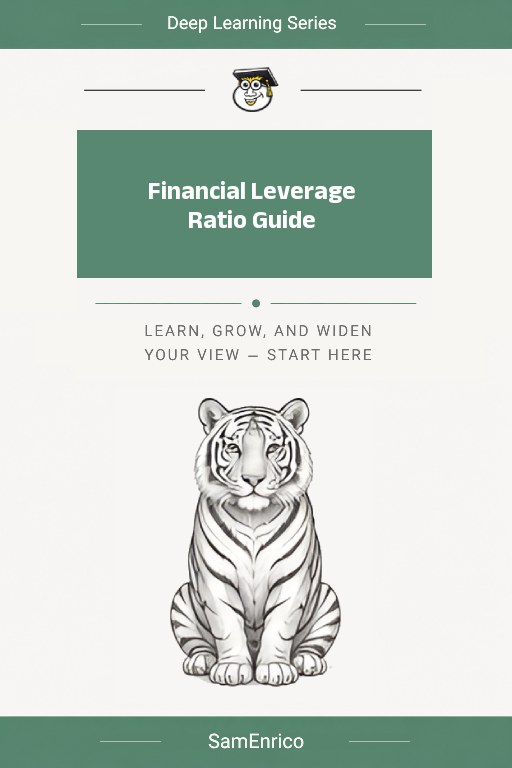
Non-FictionStudent's ShortcutFinancial Analysis
Financial Leverage Ratio Guide eBook
Calculate debt to equity, times interest earned, a
by Biddle Lauri
Calculate debt to equity, times interest earned, and equity multiplier ratios. Apply formulas to analyze company capital structure and risk.
Formats
Free sample
Chapter 1: The Double-Edged Sword--–- The email arrived at 11:47 PM on a Tuesday. Marcus, a CFO with twenty-three years of experience, had just closed his laptop when his phone buzzed with a subject line that stopped his heart: "Covenant Waiver Request – Immediate Attention Required." His company, a mid-sized industrial parts manufacturer called Omni Met, had missed its interest coverage covenant by 0.3x. Not much. Just 0.3. But in the world of financial leverage, 0.3x was the difference between another ordinary quarter and the beginning of the end.
Within ninety days, Omni Met's lenders had seized control of its cash accounts. Within six months, the CEO was fired. Within eighteen months, a company that had operated for forty-seven years filed for Chapter 11. The post-mortem analysis revealed something astonishing: Omni Met's leverage ratios had been flashing warning signs for three full years before anyone in the C-suite noticed. The signs were there, buried in the financial statements, ignored because no one had been taught to see them.
This book exists to ensure that you are not Marcus.The Paradox That Destroys and Creates Fortunes Financial leverage is the single most misunderstood concept in all of corporate finance. Ask a hundred business owners what leverage means, and ninety will say "debt" or "borrowing." They are wrong. Debt is a liability. Leverage is an amplifier. The distinction is not semantic; it is the difference between building wealth and losing everything you have built.Consider two identical companies.
Both start with 1millioninequity.Bothinvestinaprojectthatearnsa101 million in equity. Both invest in a project that earns a 10% return. But Company A uses no debt. Company B borrows 1millioninequity.Bothinvestinaprojectthatearnsa104 million at 5% interest, putting down 1millionofitsownequity.Inagoodyear,Company Aearns1 million of its own equity. In a good year, Company A earns 1millionofitsownequity.Inagoodyear,Company Aearns100,000, a respectable 10% return on equity.
Company B earns 400,000onitsproject(10400,000 on its project (10% of 400,000onitsproject(105 million in assets), pays 200,000ininterest(5200,000 in interest (5% of 200,000ininterest(54 million), and pockets 200,000inprofit—a20200,000 in profit—a 20% return on its 200,000inprofit—a201 million equity. Leverage doubled the return. This is the magic that has made fortunes in real estate, private equity, and leveraged buyouts.But the magic has a dark mirror. In a bad year, the same project earns negative 10%. Company A loses 100,000—painfulbutsurvivable.Company Bloses100,000—painful but survivable.
Company B loses 100,000—painfulbutsurvivable.Company Bloses500,000 on its project, pays 200,000ininterest,andsuffersatotallossof200,000 in interest, and suffers a total loss of 200,000ininterest,andsuffersatotallossof700,000—a 70% loss on its original $1 million equity. Leverage magnified the loss by seven times. This is the trap that has destroyed Enron, Lehman Brothers, and thousands of smaller companies whose names never made the news.The asymmetry is brutal. Leverage multiplies gains on the way up and losses on the way down, but it multiplies losses more painfully because of a cruel mathematical fact: a 50% loss requires a 100% gain just to break even. When leverage turns against you, it does not forgive.Why Every Business Owner and Investor Must Understand Leverage Ratios If leverage were simply a matter of choosing how much to borrow, finance would be easy.
But leverage is not a choice you make once and forget. It is a dynamic force that interacts with every aspect of your business—revenue volatility, interest rates, customer behavior, supplier relationships, and employee morale. The three ratios that form the backbone of this book—Debt to Equity, Times Interest Earned, and the Equity Multiplier—are not academic exercises. They are vital signs, like blood pressure, heart rate, and temperature for a human patient. You would not trust a doctor who ignored your vital signs.
You should not trust a business owner or investor who ignores these ratios.Consider what each ratio tells you. Debt to Equity (D/E) answers a deceptively simple question: for every dollar of owner capital, how many dollars of debt has the company taken on? But beneath that simplicity lies profound insight. A rising D/E can mean aggressive growth, but it can also mean a company is bleeding equity from losses while debt remains constant. The ratio alone cannot tell you which—but without the ratio, you will not even know to ask the question.Times Interest Earned (TIE) answers a different question: how many times over can the company pay its annual interest bill from its operating earnings?
This is the ratio that revealed Omni Met's hidden cancer. The company's TIE had drifted from 4.2x to 2.8x to 1.9x over three years, but because revenue was growing, management assumed everything was fine. They missed the slow erosion of coverage until it was too late.The Equity Multiplier (EM) answers a third question: for every dollar of equity, how many dollars of assets does the company control? This ratio is the key to understanding return on equity (ROE). A high ROE can come from genuine operational excellence—high margins, efficient use of assets—or it can come from extreme leverage.
The Equity Multiplier tells you which. A company with an EM of 5.0 (meaning 80% debt financing) can show the same ROE as a company with an EM of 1.5 (33% debt), but their risk profiles are worlds apart.The Stakeholder Divide: Why Creditors and Shareholders See Leverage Differently One of the most important insights in this book is that there is no single "correct" view of leverage. Different stakeholders have different incentives, and understanding those incentives is essential to interpreting any leverage ratio.Creditors—banks, bondholders, and other lenders—want one thing above all else: to be repaid with interest. They do not participate in the upside when the company does well; they receive only their fixed interest payments. But they bear the full downside risk if the company fails.
This asymmetry makes creditors inherently conservative. They prefer low leverage because low leverage means a larger equity cushion to absorb losses before creditors are at risk. When a creditor looks at your D/E ratio, they are not thinking about your growth potential. They are thinking: "If things go wrong, how much of the creditors' money is protected by owner capital?"This is why creditors impose covenants—contractual limits on leverage ratios. A typical bank loan might require that D/E stay below 3.0x and TIE stay above 2.5x.
These are not arbitrary numbers. They are the creditor's way of saying: "We trust you to run the business, but we do not trust you enough to give you unlimited rope."Shareholders have the opposite orientation. They own the upside. If the company doubles in value, shareholders double their money. But they also bear the downside—their investment can go to zero.
Because shareholders have limited liability (they cannot lose more than they invested), they have an incentive to take more risk than creditors would prefer. A shareholder might be perfectly happy with D/E of 5.0x if the potential return justifies the risk. This is not irrational. It is a rational response to the asymmetric payoff structure of equity.The tension between creditors and shareholders is healthy. It creates discipline.
The best-managed companies do not simply maximize leverage or minimize it. They find a balance that satisfies both stakeholders—providing enough leverage to generate attractive returns for shareholders while maintaining enough safety to keep creditors comfortable.The Debt vs. Equity Decision…
This is the end of the free sample. Get the eBook to keep going. Buy now
About this book
Details
- Author
- Biddle Lauri
- Publisher
- SamEnrico
- Language
- English
- Genre
- Non-Fiction, Student's Shortcut, Financial Analysis
- Released
- 2026-06-01
- Pages (approx.)
- 150
- Available as
- eBook, Audiobook

Read better in the ZLOADR app
Your eBooks on your phone or tablet. Sign in with your SamEnrico account and start reading.
More by Biddle Lauri
 Model Child Star ExploitationBiddle Lauri$11.99Model Child Star ExploitationBiddle Lauri$11.99
 Assertive Communication for ManagersBiddle Lauri$11.99
 Fiverr Seller Level StrategyBiddle Lauri$11.99
 Walmart Neighborhood MarketBiddle Lauri$11.99
 Scott Peterson Appeal ArgumentsBiddle Lauri$11.99
 Permissive ScriptingBiddle Lauri$11.99
 Citation Rules Quick Reference GuideBiddle Lauri$11.99
 Indian GST Input Tax Credit First Claim GuideBiddle Lauri$11.99
 Cicero's Six Part SpeechBiddle Lauri$11.99
 The Iron Phalanx: The Birth of Armored Warfare in Ancient ChinaBiddle Lauri$11.99
 The Ghosts of Operation Cyclone: How the CIA Armed the MujahideenBiddle Lauri$11.99
You may also like
 Hong Kong Handover 1997Dunn Johnnie$11.99
 Zumba For Postnatal Recovery CourseNeal Christian$11.99
 Zumba for BeginnersLadner Nikia$11.99
 YouTube Comment Mining GuideHumes Pandora$12.99
 Worry Box MeditationCarlin Rudy$11.99
 Workplace Stress MeditationNguyen Lynn$11.99
 Workplace Stress and Sleep RepairHawley Ivory$11.99
 Workplace Perfectionism CureDelaney Jeffry$11.99
 Workplace Injustice Anger GuideWallen Isabelle$11.99
 Work Addiction and Burnout LinkGreenwood Ester$11.99
 Women in Yoga and WellnessBeattie Galina$11.99
 Women in Stand Up ComedyChun Evangeline$11.99