
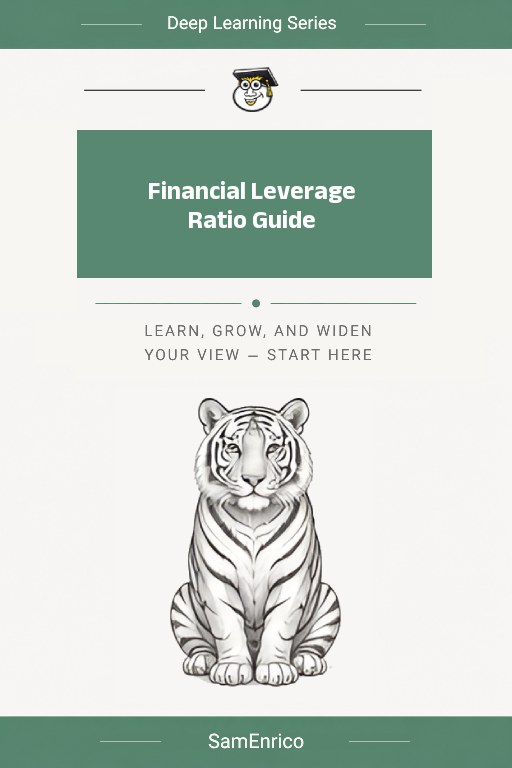
Non-FictionStudent's ShortcutFinancial Analysis
Financial Leverage Ratio Guide Audiobook
Calculate debt to equity, times interest earned, a
by Biddle Lauri
Calculate debt to equity, times interest earned, and equity multiplier ratios. Apply formulas to analyze company capital structure and risk.
Formats
Free sample
Chapter 1: The Double-Edged Sword--–- The email arrived at 11:47 PM on a Tuesday. Marcus, a CFO with twenty-three years of experience, had just closed his laptop when his phone buzzed with a subject line that stopped his heart: "Covenant Waiver Request – Immediate Attention Required." His company, a mid-sized industrial parts manufacturer called Omni Met, had missed its interest coverage covenant by 0.3x. Not much. Just 0.3. But in the world of financial leverage, 0.3x was the difference between another ordinary quarter and the beginning of the end.
Within ninety days, Omni Met's lenders had seized control of its cash accounts. Within six months, the CEO was fired. Within eighteen months, a company that had operated for forty-seven years filed for Chapter 11. The post-mortem analysis revealed something astonishing: Omni Met's leverage ratios had been flashing warning signs for three full years before anyone in the C-suite noticed. The signs were there, buried in the financial statements, ignored because no one had been taught to see them.
This book exists to ensure that you are not Marcus.The Paradox That Destroys and Creates Fortunes Financial leverage is the single most misunderstood concept in all of corporate finance. Ask a hundred business owners what leverage means, and ninety will say "debt" or "borrowing." They are wrong. Debt is a liability. Leverage is an amplifier. The distinction is not semantic; it is the difference between building wealth and losing everything you have built.Consider two identical companies.
Both start with 1millioninequity.Bothinvestinaprojectthatearnsa101 million in equity. Both invest in a project that earns a 10% return. But Company A uses no debt. Company B borrows 1millioninequity.Bothinvestinaprojectthatearnsa104 million at 5% interest, putting down 1millionofitsownequity.Inagoodyear,Company Aearns1 million of its own equity. In a good year, Company A earns 1millionofitsownequity.Inagoodyear,Company Aearns100,000, a respectable 10% return on equity.
Company B earns 400,000onitsproject(10400,000 on its project (10% of 400,000onitsproject(105 million in assets), pays 200,000ininterest(5200,000 in interest (5% of 200,000ininterest(54 million), and pockets 200,000inprofit—a20200,000 in profit—a 20% return on its 200,000inprofit—a201 million equity. Leverage doubled the return. This is the magic that has made fortunes in real estate, private equity, and leveraged buyouts.But the magic has a dark mirror. In a bad year, the same project earns negative 10%. Company A loses 100,000—painfulbutsurvivable.Company Bloses100,000—painful but survivable.
Company B loses 100,000—painfulbutsurvivable.Company Bloses500,000 on its project, pays 200,000ininterest,andsuffersatotallossof200,000 in interest, and suffers a total loss of 200,000ininterest,andsuffersatotallossof700,000—a 70% loss on…
This is the end of the free sample. Get the Audiobook to keep going. Buy now
About this book
Details
- Author
- Biddle Lauri
- Publisher
- SamEnrico
- Language
- English
- Genre
- Non-Fiction, Student's Shortcut, Financial Analysis
- Released
- 2026-06-01
- Pages (approx.)
- 150
- Available as
- eBook, Audiobook

Listen in the VoxFlicks app
Audiobooks and audio dramas wherever you go. Sign in with your SamEnrico account and press play.
More by Biddle Lauri
 Model Child Star ExploitationBiddle Lauri$11.99Model Child Star ExploitationBiddle Lauri$11.99
 Assertive Communication for ManagersBiddle Lauri$11.99
 Fiverr Seller Level StrategyBiddle Lauri$11.99
 Walmart Neighborhood MarketBiddle Lauri$11.99
 Scott Peterson Appeal ArgumentsBiddle Lauri$11.99
 Permissive ScriptingBiddle Lauri$11.99
 Citation Rules Quick Reference GuideBiddle Lauri$11.99
 Indian GST Input Tax Credit First Claim GuideBiddle Lauri$11.99
 Cicero's Six Part SpeechBiddle Lauri$11.99
 The Iron Phalanx: The Birth of Armored Warfare in Ancient ChinaBiddle Lauri$11.99
 The Ghosts of Operation Cyclone: How the CIA Armed the MujahideenBiddle Lauri$11.99
You may also like
 Hong Kong Handover 1997Dunn Johnnie$11.99
 Zumba For Postnatal Recovery CourseNeal Christian$11.99
 Zumba for BeginnersLadner Nikia$11.99
 YouTube Comment Mining GuideHumes Pandora$12.99
 Worry Box MeditationCarlin Rudy$11.99
 Workplace Stress MeditationNguyen Lynn$11.99
 Workplace Stress and Sleep RepairHawley Ivory$11.99
 Workplace Perfectionism CureDelaney Jeffry$11.99
 Workplace Injustice Anger GuideWallen Isabelle$11.99
 Work Addiction and Burnout LinkGreenwood Ester$11.99
 Women in Yoga and WellnessBeattie Galina$11.99
 Women in Stand Up ComedyChun Evangeline$11.99