
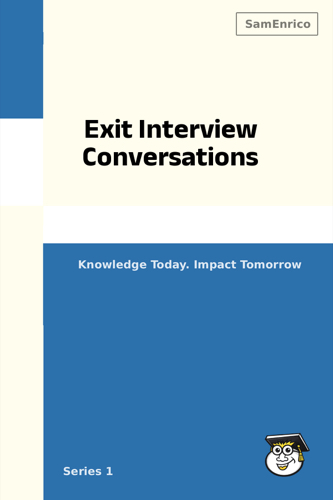
Exit Interview Conversations eBook
Leave a job gracefully while sharing honest feedba
by Milam Bula
Leave a job gracefully while sharing honest feedback with HR.
Formats
Free sample
Chapter 1: The Silent Betrayal--The moment the HR representative says, “We’d love to hear your honest feedback,” most people make a choice they don’t even realize is a choice. They either clam up and say everything was fine, or they unleash months of pent-up frustration like a shaken soda bottle. Both instincts are wrong. Both destroy value—for you, for your former colleagues, and even for the company you’re leaving. And both come from the same source: a misunderstanding of what an exit interview actually is.Let me tell you about Maria.Maria was a senior product manager at a mid-sized tech company.
She had spent three years building a team from scratch, working weekends, missing family dinners, and absorbing endless stress from a boss who changed priorities weekly. When she finally resigned, she felt nothing but relief. Her exit interview was scheduled for the following Tuesday.She had two options, as she saw them. Option one: be polite, say “everything was great,” and walk away clean. Option two: finally tell HR what was really going on—the chaos, the favoritism, the impossible deadlines.
She chose option two.“My boss is a nightmare,” Maria said. “She’s disorganized, she plays favorites, and she has no idea how to run a team. I’m leaving because of her.”The HR representative nodded, took notes, and thanked Maria for her time. Three weeks later, Maria’s former boss was promoted. The company hired a replacement for Maria at a lower salary.
And when Maria applied for a leadership role at another company six months later, her reference check came back with a note: “Would not rehire. Concerns about professionalism.”Maria had no idea why. She had told the truth. She had finally spoken up. And she had burned every bridge without even knowing there was a match in her hand.This book exists because Maria’s story happens thousands of times every day.
And it happens because most people enter exit interviews with one of two fatal strategies: silence or venting. Neither works. Silence allows bad managers to thrive and harms the colleagues you leave behind. Venting makes you look unprofessional and ensures your feedback is dismissed as emotional noise.There is a third way. It is called Strategic Candor.Strategic Candor means delivering honest, specific, behavior-based feedback without emotion.
It means telling HR what they actually need to hear—not what feels good to say. It means protecting your future reputation while still helping the company improve for the people who stay. And it starts with understanding what an exit interview really is.The Exit Interview Is Not What You Think It Is Most people believe the exit interview exists to help them. That is incorrect. The exit interview exists to help the company.
HR is not your therapist, your friend, or your ally. HR is a risk management function. Their job is to identify patterns that could lead to lawsuits, turnover spikes, or productivity losses. They are not there to validate your feelings or punish your boss.This is not cynicism. This is reality.The exit interview is a data-collection tool.
HR wants to know: Why did you leave? Was it something we could have controlled? Are there legal risks? Is there a pattern we need to address? That is the full scope of their interest.
They do not care about your emotional journey. They do not care about your personal grievances unless those grievances connect to business risk.Understanding this changes everything. Once you accept that HR is not there for you, you stop expecting them to act like they are. And once you stop expecting emotional validation, you can start delivering strategic value.The Two Fatal Strategies (And Why Both Fail)Let me walk you through the two dominant approaches to exit interviews, as taught by the most popular career books and online forums. Both are wrong.
Both are based on incomplete assumptions.Strategy One: The Silent Exit The first strategy says: say nothing. Keep your head down. Tell HR that everything was fine, you’re leaving for personal reasons, and you have no feedback. This approach is popular among people who believe that “burning bridges” is the worst possible outcome.The logic seems reasonable. If you don’t say anything negative, no one can hold it against you.
You leave clean. You get a neutral reference. You move on.Here is what actually happens when you stay silent.HR writes down: “No issues cited. Employee left for personal reasons.” That note goes into a file. A month later, when three more people quit the same team, HR looks back at those notes.
Your silence becomes evidence that nothing was wrong. The toxic manager keeps their job. Your former colleagues continue suffering. And you have abandoned them.Worse, your silence does not even protect you. A neutral reference is not a good reference.
When future employers call, your former company will confirm your dates of employment and title, and then say nothing else. That is the industry standard for “we would not rehire this person.” You have earned a black mark without even realizing it.Silence is not safety. Silence is abandonment.Strategy Two: The Venting Exit The second strategy says: tell them everything. Dump it all out. This is your one chance to be heard.
Finally, HR will understand what you’ve been through. Finally, someone will do something.This is the Maria approach. And it fails for three reasons.First, HR is trained to dismiss emotional feedback. When you say “my boss is mean,” HR hears “this person is angry.” They do not hear actionable data. They hear noise.
The moment you raise your voice, cry, or use emotional language, you have lost credibility.Second, venting names names. The moment you say “my boss,” you have created a record that will be shared. Your manager will eventually read your feedback. They will remember it. And when a future employer calls for a reference, your manager will be the one answering the phone.Third, venting does not produce change.
HR cannot act on “my boss is a nightmare.” They can only act on specific, observable, pattern-based data. Your venting feels good for thirty seconds and then destroys your reputation for years.The one exception to the “don’t vent” rule is serious illegality. If you have witnessed harassment, fraud, or safety violations, do not vent in an exit interview. Shut up. Call a lawyer.
Exit interviews are not protected legal proceedings. Anything you say can be used against you. That is Chapter 7 territory, but it bears repeating here: for illegal behavior, silence is not abandonment. Silence is survival.But for the vast majority of situations—bad management, poor culture, broken processes—venting is suicide.The Third Way: Strategic Candor Strategic Candor is the alternative to silence and venting. It has four components.First, Strategic Candor is honest.
You do not lie. You do not say “everything was fine” when it was not. Lying helps no one. It abandons your colleagues, and it trains HR to believe problems do not exist.Second, Strategic Candor is specific. You do not say “my manager is bad.” You say “my…
This is the end of the free sample. Get the eBook to keep going. Buy now
About this book
Details
- Author
- Milam Bula
- Publisher
- SamEnrico
- Language
- English
- Genre
- Non-Fiction, Self-Help, Career Transition
- Released
- 2026-06-08
- Pages (approx.)
- 122
- Available as
- eBook, Audiobook

Read better in the ZLOADR app
Your eBooks on your phone or tablet. Sign in with your SamEnrico account and start reading.
More by Milam Bula
 High School Study GuideMilam Bula$11.99
 Shift Work and Digestive DisordersMilam Bula$11.99
 Fear of Failure in CreativesMilam Bula$11.99
 Weight Loss Calorie CreepMilam Bula$11.99
 The Mother's Faked DeathMilam Bula$11.99
 CPR for National ParksMilam Bula$11.99
 Odysseus Unbound: The Cunning King’s Last LessonMilam Bula$11.99
 The Cosmic Visionaries of Meroë: Astronomers of the NileMilam Bula$11.99
 How to Produce Printer, Copier and Fax Machine Circuit BoardsMilam Bula$11.99
 Palm Kernel Oil: Palm Kernel NutMilam Bula$11.99
 Export Financing for Shea & CoffeeMilam Bula$12.99
 Alibaba Sample Order vs Amazon Test Buy WorkbookMilam Bula$12.99
You may also like
 The Academic to Corporate GuideRenteria Angle$11.99
 Networking for Career ChangersBright Malisa$11.99
 Layoff Financial Survival PlanSterling Myrtis$11.99
 The Career Change Self Esteem GuidePond Lavette$11.99
 Self Worth After Job LossGonzalez Dale$11.99
 Retirement Identity ShiftGallant Jone$11.99
 Fear Of Failure After Job LossHuey Ilda$11.99
 Affirmations for New GraduatesLeroy Chiquita$11.99
 Role Transition Imposter GuideMorley Mathilde$11.99
 Job Loss Financial Coping HandbookAguilar Janet$11.99
 Job Loss Couple Recovery PlanThorne Christopher$11.99
 Mindset For Career ChangeAtkinson Nickole$11.99