
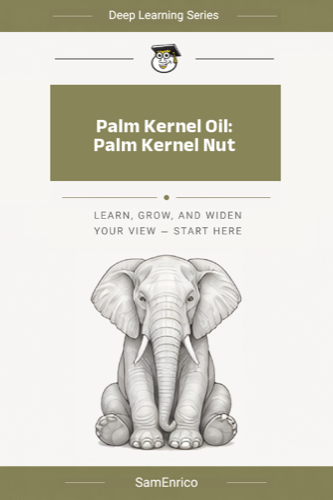
Palm Kernel Oil: Palm Kernel Nut
This harvesting publication, published by SamEnric
by Milam Bula
This harvesting publication, published by SamEnrico, covers Palm Kernel Oil: Palm Kernel Nut
Formats
About this book
Free sample
Chapter 1: Two Oils, One Fruit--–- The first time I held a palm kernel in my hand, I had no idea what it was. The fruit that surrounded it—a glossy, reddish-orange oval the size of a small olive—looked like any other tropical drupe. I squeezed it, expecting juice or soft flesh. Instead, my fingernail struck something that felt like stone. The field manager beside me laughed.
“That’s what you’re really after,” he said, pointing to the invisible seed inside. “The pulp is for volume. The kernel is for value.” That moment of confusion is where this book begins—and where most of the world still lives. We see palm oil everywhere: in our packaged foods, our biodiesel, our politics. But we almost never see the kernel, the hard white seed that hides inside the fruit, waiting to become the foam in our shampoo, the cream in our soap, the melt in our chocolate.
This chapter is an act of separation. It will teach you to see one fruit as two completely different oils—and why that distinction matters more than you think.The Anatomy of a Single Fruit To understand palm kernel oil, you must first unlearn what you think you know about palm oil. They come from the same tree, the same bunch, even the same individual fruit. But from that point forward, their stories diverge completely.The oil palm, Elaeis guineensis, produces bunches that weigh between ten and forty kilograms each. A single bunch contains anywhere from one thousand to three thousand individual fruits.
Each fruit is a botanical marvel of compartmentalization. The outer skin, or exocarp, is smooth and waxy, ranging in color from deep purple to orange-red as it ripens. Beneath that lies the mesocarp—the fleshy, fibrous layer that gives us crude palm oil (CPO). When you hear about the environmental controversies of palm oil, this is the layer under discussion. CPO is red because it is rich in carotenoids (the same compounds that make carrots and tomatoes red), and it flows freely at tropical temperatures.
It is the workhorse fat of the global food industry, found in everything from margarine to instant noodles.But buried inside…
This is the end of the free sample. Get the eBook to keep going. Buy now
Contents
- Chapter 1
- Chapter 2
- Chapter 3
- Chapter 4
- Chapter 5
- Chapter 6
- Chapter 7
- Chapter 8
- Chapter 9
- Chapter 10
- Chapter 11
- Chapter 12
Details
- Author
- Milam Bula
- Publisher
- SamEnrico
- Language
- English
- Genre
- Non-Fiction, Informative, Educational
- Released
- 2026-06-02
- Pages (approx.)
- 141
- Available as
- eBook, Audiobook

Read better in the ZLOADR app
Your eBooks on your phone or tablet. Sign in with your SamEnrico account and start reading.
More by Milam Bula
 High School Study GuideMilam Bula$11.99
 Shift Work and Digestive DisordersMilam Bula$11.99
 Fear of Failure in CreativesMilam Bula$11.99
 Exit Interview ConversationsMilam Bula$11.99
 Weight Loss Calorie CreepMilam Bula$11.99
 The Mother's Faked DeathMilam Bula$11.99
 CPR for National ParksMilam Bula$11.99
 Odysseus Unbound: The Cunning King’s Last LessonMilam Bula$11.99
 The Cosmic Visionaries of Meroë: Astronomers of the NileMilam Bula$11.99
 How to Produce Printer, Copier and Fax Machine Circuit BoardsMilam Bula$11.99
 Export Financing for Shea & CoffeeMilam Bula$12.99
 Alibaba Sample Order vs Amazon Test Buy WorkbookMilam Bula$12.99