
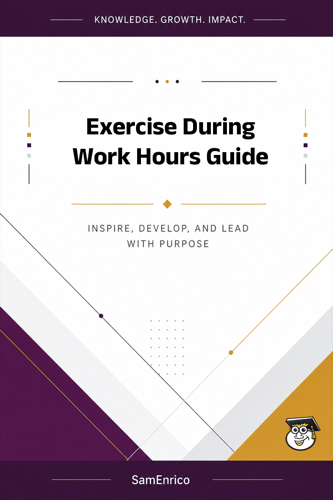
Exercise During Work Hours Guide eBook
Fit movement into your day with desk stretches, wa
Fit movement into your day with desk stretches, walking meetings, and lunch workouts.
Formats
Free sample
Chapter 1: The Sitting Disease--–- By the time you finish reading this paragraph, you will have been sitting for fifteen seconds longer than your spine was designed to handle. By the time you finish this chapter, your hip flexors will be shorter than they were when you started. And by the time you retire—if you work a typical desk job—you will have spent roughly one hundred thousand hours in a chair. That is enough time to earn three Ph Ds, learn five languages fluently, or raise two children to adulthood. Instead, for most office workers, those one hundred thousand hours result in chronic back pain, metabolic dysfunction, a brain that fires at half speed, and a body that has forgotten how to move.This is not hyperbole.
This is the quiet epidemic no one is talking about—not because it is invisible, but because it has become normal. We have confused the absence of immediate pain with the presence of health. We have accepted that work requires suffering, that discomfort is the price of productivity, and that feeling stiff, tired, and foggy by 3:00 PM is simply what it means to have a job. But what if every single one of those assumptions is wrong? What if the chair you are sitting in right now is not a neutral tool but an active antagonist—a piece of furniture that has been quietly shortening your lifespan, shrinking your cognitive capacity, and stealing your energy one hour at a time?This chapter exists to wake you up.
Not with fear, but with facts. Not to make you paranoid, but to make you powerful. Because once you understand what sitting actually does to your body and brain, you will never look at your office chair the same way again. And more importantly, you will finally have the motivation to do something about it.The Silent Pandemic Nobody Diagnoses Let us start with a question that sounds absurd but is entirely serious: If a disease affected ninety percent of the working population, caused measurable brain damage, increased the risk of early death by forty percent, and was entirely preventable by standing up every hour—would we call it a public health crisis? Of course we would.
We would pour billions into research, launch awareness campaigns, and redesign every workplace in the country. But because the symptoms of sitting disease arrive slowly—a little stiffness here, some brain fog there, a few extra pounds that seem to appear from nowhere—we have never given it a proper name, let alone treated it like the emergency it is.The medical literature calls it "sedentary behavior syndrome," but that clinical label hides the true danger. Sitting for more than six hours per day fundamentally changes your physiology. Your hip flexors shorten and tighten, pulling your pelvis into a forward tilt that flattens the natural curve of your lower back. Your gluteal muscles—the largest and most powerful muscles in your body—literally "fall asleep," a phenomenon researchers call gluteal amnesia.
When your glutes stop firing, your lower back and hamstrings take over the work they were never designed to do, leading to chronic pain, disc compression, and eventually herniations. Your cervical spine, designed to support a head weighing ten to twelve pounds when aligned properly, now strains forward at a forty-five-degree angle, effectively increasing the load to nearly sixty pounds. That is like carrying a small child on your neck for eight hours a day, every day, for decades.And that is just the musculoskeletal damage. Beneath the surface, something even more insidious is happening.Your Brain on a Chair For decades, we assumed that sitting was a musculoskeletal problem—bad for the back, bad for the posture, but ultimately a mechanical issue. Then came the research that changed everything.
In 2015, a landmark study from UCLA found that sedentary behavior was directly correlated with thinning in the medial temporal lobe, the brain region responsible for memory formation. More sitting meant less brain tissue. Not slower performance. Not temporary fatigue. Permanent, measurable atrophy.Follow-up studies have been even more alarming.
After just two hours of uninterrupted sitting, blood flow to the brain decreases by up to fifteen percent. Your brain, which represents only two percent of your body weight but consumes twenty percent of your oxygen, begins to starve—not dramatically, not enough to cause fainting, but enough to impair cognitive flexibility, working memory, and creative problem-solving. This is why you struggle to find the right word in afternoon meetings. This is why your best ideas always come in the shower or on a walk, never at your desk. This is why you feel "foggy" even though you slept well and ate a decent lunch.The mechanism is surprisingly simple.
Your brain runs on glucose and oxygen, both delivered via blood flow. When you sit, your largest blood vessels—particularly those in your legs and hips—become compressed or kinked. Your heart has to work harder to pump blood against gravity, but the real problem is on the return journey. Blood returning to your heart relies on muscle contractions in your legs to push it upward, a system known as the "skeletal muscle pump." When your leg muscles are inactive for hours at a time, that pump stalls. Blood pools in your lower extremities.
Less oxygen reaches your brain. And your cognitive performance plummets.The cruelest part of this physiology is that you cannot feel it happening. Unlike hunger or thirst or exhaustion, the gradual suffocation of your brain produces no obvious alarm signal. You just feel a little slower, a little less sharp, a little more irritable. You blame it on the email from your boss, the project deadline, the poor sleep you got last night.
But the real culprit is the chair.The Metabolic Trap If the cognitive effects of sitting were the only problem, that would be bad enough. But sitting disease also hijacks your metabolism in ways that directly contribute to weight gain, insulin resistance, and metabolic syndrome—even if you exercise.This is the part that surprises most people. Surely, if you go to the gym for an hour before work or run three miles after dinner, you have earned the right to sit during the day, right? Wrong. The research is unequivocal: exercise does not cancel out sitting.
They are two separate variables, like diet and sleep. You cannot outrun a bad diet, and you cannot out-exercise a sedentary workday.Here is why. When you sit for extended periods, your body enters a state of metabolic shutdown. The enzyme lipoprotein lipase (LPL), which is responsible for breaking down fat in the bloodstream, decreases by up to ninety percent within hours of sitting. LPL is activated by the mechanical stress of standing and moving.
When you sit, the signal stops. Your body quite literally stops processing fat efficiently. At the same time, your muscle cells become less sensitive to insulin, meaning your pancreas has to pump out more of the hormone to move glucose out of your bloodstream and into your cells. Over months and years, this insulin resistance can progress to prediabetes, then to type 2 diabetes, all while you are…
This is the end of the free sample. Get the eBook to keep going. Buy now
About this book
Details
- Author
- Snowden Jenifer
- Publisher
- SamEnrico
- Language
- English
- Genre
- Non-Fiction, Self-Help, Workplace Fitness
- Released
- 2026-06-10
- Pages (approx.)
- 142
- Available as
- eBook, Audiobook

Read better in the ZLOADR app
Your eBooks on your phone or tablet. Sign in with your SamEnrico account and start reading.
More by Snowden Jenifer
 HGH And Cortisol BalanceSnowden Jenifer$11.99
 Diamond Dealer Bankruptcy AftermathSnowden Jenifer$11.99
 TM for TherapistsSnowden Jenifer$11.99
 Smokeless Tobacco Cessation PlanSnowden Jenifer$11.99
 HGH Hair Growth ConnectionSnowden Jenifer$11.99
 Interview Answer SystemSnowden Jenifer$11.99
 Idea Speed Dating For TeamsSnowden Jenifer$11.99
 Swedish Green Tax HandbookSnowden Jenifer$11.99Swedish Green Tax HandbookSnowden Jenifer$11.99
 The Vanishing of Flight 447: A Cry in the DarkSnowden Jenifer$11.99
 The Last Whisper of the Crystal CavesSnowden Jenifer$11.99
 The Healing Hands of the Nile: The Forgotten Physicians of Ancient EgyptSnowden Jenifer$11.99