
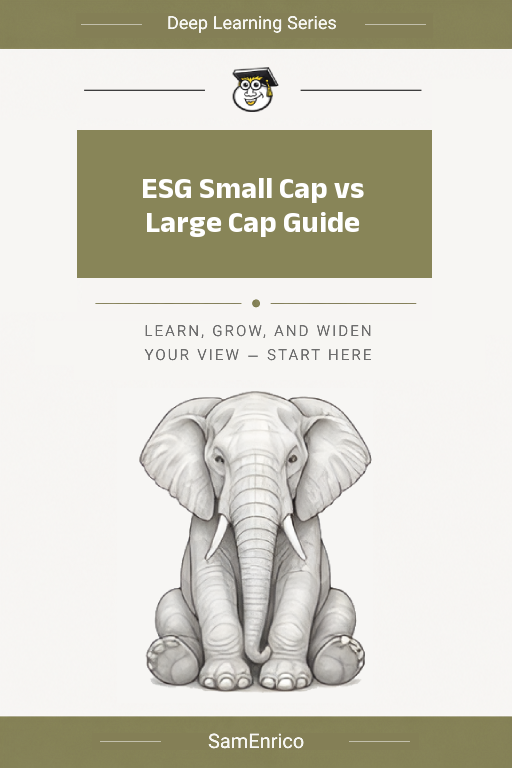
Non-FictionStrategic AtlasMarket Cap Analysis
ESG Small Cap vs Large Cap Guide
Compare ESG resource allocation, reporting quality
Compare ESG resource allocation, reporting quality, and scores between small-cap and large-cap public firms.
Formats
About this book
Free sample
Chapter 1: The Scoring Mirage--–- The first lie the ESG industry tells you is written in plain sight, buried in the fine print of every rating agency's methodology document. It reads something like this: "Where data is not reported by the company, we estimate using industry averages, peer benchmarks, or proprietary models." To the casual reader, this sounds like prudent statistical rigor. To the institutional investor who has spent twenty years analyzing financial statements, it should sound like an alarm klaxon. Imagine applying the same logic to corporate debt. You ask a small manufacturing firm for its audited financials.
It provides none. So you simply assume its debt-to-equity ratio is the same as the industry average—and then you issue a bond rating based on that assumption. You would be fired. You might be sued. Yet in ESG investing, this is not only accepted; it is standard practice.The problem is not merely technical.
It is structural, philosophical, and deeply misleading. The architecture of ESG ratings contains a hidden size bias that systematically penalizes smaller companies for the sin of being small, not for the sin of being unsustainable. This chapter dismantles that architecture, exposes the statistical illusions it creates, and provides a framework for seeing through the scoring mirage.The Black Box of Disclosure-Weighted Scoring To understand why small caps are systematically under-scored, you must first understand how rating agencies actually calculate ESG scores. Despite the veneer of quantitative rigor, most major vendors—MSCI, Sustainalytics, Refinitiv, and others—operate on a fundamental principle that is rarely disclosed to end investors: disclosure quantity is weighted more heavily than disclosure quality.Consider two hypothetical companies. Company A is a large-cap oil major with a 200billionmarketcapitalization.Itemploysaforty−personsustainabilityteam,publishesa300−pageannualsustainabilityreportalignedwith GRI,SASB,and TCFD,andrespondstoeveryvoluntarydisclosurerequestfrom CDP,Bloomberg,and Refinitiv.Company Bisasmall−capgeothermalenergyfirmwitha200 billion market capitalization.
It employs a forty-person sustainability team, publishes a 300-page annual sustainability report aligned with GRI, SASB, and TCFD, and responds to every voluntary disclosure request from CDP, Bloomberg, and Refinitiv. Company B is a small-cap geothermal energy firm with a 200billionmarketcapitalization.Itemploysaforty−personsustainabilityteam,publishesa300−pageannualsustainabilityreportalignedwith GRI,SASB,and TCFD,andrespondstoeveryvoluntarydisclosurerequestfrom CDP,Bloomberg,and Refinitiv.Company Bisasmall−capgeothermalenergyfirmwitha500 million…
This is the end of the free sample. Get the eBook to keep going. Buy now
Contents
- Chapter 1
- Chapter 2
- Chapter 3
- Chapter 4
- Chapter 5
- Chapter 6
- Chapter 7
- Chapter 8
- Chapter 9
- Chapter 10
- Chapter 11
- Chapter 12
Details
- Author
- Donovan Velda
- Publisher
- SamEnrico
- Language
- English
- Genre
- Non-Fiction, Strategic Atlas, Market Cap Analysis
- Released
- 2026-05-30
- Pages (approx.)
- 150
- Available as
- eBook, Audiobook

Read better in the ZLOADR app
Your eBooks on your phone or tablet. Sign in with your SamEnrico account and start reading.
More by Donovan Velda
 New Parent Social IsolationDonovan Velda$11.99
 Free Creator Research Stack GuideDonovan Velda$11.99
 Order Solar Temple Rosicrucian Roots CourseDonovan Velda$11.99
 LBO Modeling Certification GuideDonovan Velda$11.99
 Mindfulness for Parenting StressDonovan Velda$11.99
 The Unseen Brushstrokes: How Frida Kahlo’s Pain Became Her MasterpieceDonovan Velda$11.99
 Echoes of the Underground: The Secret Railroad That Saved a GenerationDonovan Velda$11.99
 Understanding Cerebellar Hypoplasia Tapetoretinal DegenerationDonovan Velda$17.99
 How to Start a Poster Publishing Business (Beginners Guide)Donovan Velda$11.99
 Ramadan And Cultural GuideDonovan Velda$12.99
 Associate Trial AttorneyDonovan Velda$11.99
You may also like
 Hong Kong Handover 1997Dunn Johnnie$11.99
 Zumba For Postnatal Recovery CourseNeal Christian$11.99
 Zumba for BeginnersLadner Nikia$11.99
 YouTube Comment Mining GuideHumes Pandora$12.99
 Worry Box MeditationCarlin Rudy$11.99
 Workplace Stress MeditationNguyen Lynn$11.99
 Workplace Stress and Sleep RepairHawley Ivory$11.99
 Workplace Perfectionism CureDelaney Jeffry$11.99
 Workplace Injustice Anger GuideWallen Isabelle$11.99
 Work Addiction and Burnout LinkGreenwood Ester$11.99
 Women in Yoga and WellnessBeattie Galina$11.99
 Women in Stand Up ComedyChun Evangeline$11.99