
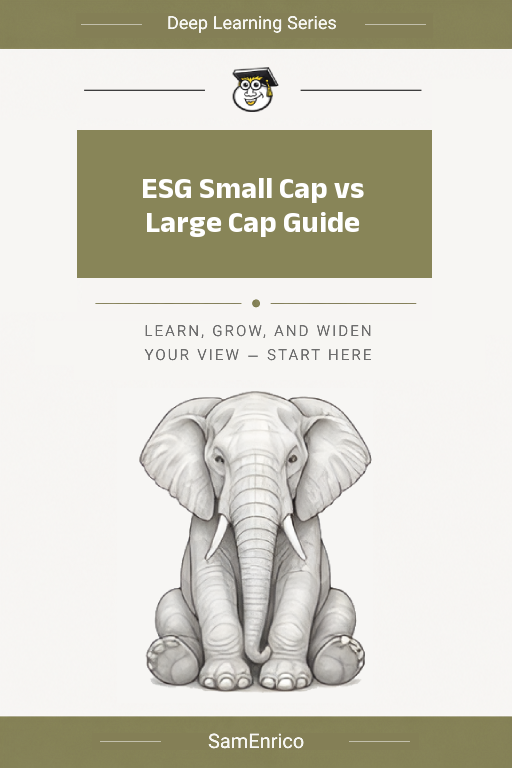
Non-FictionStrategic AtlasMarket Cap Analysis
ESG Small Cap vs Large Cap Guide eBook
Compare ESG resource allocation, reporting quality
Compare ESG resource allocation, reporting quality, and scores between small-cap and large-cap public firms.
Formats
Free sample
Chapter 1: The Scoring Mirage--–- The first lie the ESG industry tells you is written in plain sight, buried in the fine print of every rating agency's methodology document. It reads something like this: "Where data is not reported by the company, we estimate using industry averages, peer benchmarks, or proprietary models." To the casual reader, this sounds like prudent statistical rigor. To the institutional investor who has spent twenty years analyzing financial statements, it should sound like an alarm klaxon. Imagine applying the same logic to corporate debt. You ask a small manufacturing firm for its audited financials.
It provides none. So you simply assume its debt-to-equity ratio is the same as the industry average—and then you issue a bond rating based on that assumption. You would be fired. You might be sued. Yet in ESG investing, this is not only accepted; it is standard practice.The problem is not merely technical.
It is structural, philosophical, and deeply misleading. The architecture of ESG ratings contains a hidden size bias that systematically penalizes smaller companies for the sin of being small, not for the sin of being unsustainable. This chapter dismantles that architecture, exposes the statistical illusions it creates, and provides a framework for seeing through the scoring mirage.The Black Box of Disclosure-Weighted Scoring To understand why small caps are systematically under-scored, you must first understand how rating agencies actually calculate ESG scores. Despite the veneer of quantitative rigor, most major vendors—MSCI, Sustainalytics, Refinitiv, and others—operate on a fundamental principle that is rarely disclosed to end investors: disclosure quantity is weighted more heavily than disclosure quality.Consider two hypothetical companies. Company A is a large-cap oil major with a 200billionmarketcapitalization.Itemploysaforty−personsustainabilityteam,publishesa300−pageannualsustainabilityreportalignedwith GRI,SASB,and TCFD,andrespondstoeveryvoluntarydisclosurerequestfrom CDP,Bloomberg,and Refinitiv.Company Bisasmall−capgeothermalenergyfirmwitha200 billion market capitalization.
It employs a forty-person sustainability team, publishes a 300-page annual sustainability report aligned with GRI, SASB, and TCFD, and responds to every voluntary disclosure request from CDP, Bloomberg, and Refinitiv. Company B is a small-cap geothermal energy firm with a 200billionmarketcapitalization.Itemploysaforty−personsustainabilityteam,publishesa300−pageannualsustainabilityreportalignedwith GRI,SASB,and TCFD,andrespondstoeveryvoluntarydisclosurerequestfrom CDP,Bloomberg,and Refinitiv.Company Bisasmall−capgeothermalenergyfirmwitha500 million market capitalization. It has no sustainability team. Its CEO handles investor relations personally. It publishes a four-page annual report that includes a single sentence: "Our geothermal plants produced 1.2 million MWh of renewable energy this year, displacing an estimated 600,000 tons of CO2."Which company receives a higher ESG score?
In a rational world—one that cared about real-world environmental impact—Company B would score dramatically higher. Its entire business model is a climate solution. Company A, despite its renewables investments, remains fundamentally an extractive fossil fuel business. But the rating agencies do not operate in a rational world. They operate in a data-availability world.
Company A provides hundreds of data points; Company B provides one. The scoring algorithm, weighted toward disclosure, hands Company A an A rating and Company B a C rating. The market then allocates capital accordingly.This is not a hypothetical. Source 4 documents empirical evidence showing that smaller firms receive systematically lower ESG scores not due to poor performance, but due to lack of reporting infrastructure. A 2023 study of over 4,000 global firms found that controlling for actual environmental performance, a one-standard-deviation decrease in market capitalization predicted a 0.4-standard-deviation decrease in ESG score—solely because of missing data points.
In plain English: if you take two identical companies in every respect except size, the smaller one will score lower on ESG metrics for no reason other than its reduced capacity to produce sustainability reports.The mechanism is simple. Most rating agencies use a "percentage of data points reported" as an implicit input. MSCI, for example, scores companies on 37 key issues, but a company only receives a score on an issue if the agency has sufficient data. For large caps, data is available on 30+ issues. For small caps, data is often available on fewer than ten.
The missing issues default to the worst possible score or to an estimated value based on industry peers. In either case, the small cap is penalized.The Agency Problem: Who Estimates, Who Reports?The bias deepens when we examine how data is sourced. Large caps, as detailed in the next chapter, have entire departments dedicated to voluntary disclosure. They respond to CDP questionnaires. They issue SASB-aligned reports.
They hire third-party assurance providers to audit their emissions data. When a rating agency ingests this data, it is labeled as "reported"—the highest quality tier.Small caps, by contrast, are rarely on the radar of these voluntary frameworks. A CDP questionnaire requires dozens of hours of staff time to complete. A SASB report requires specialized expertise. A small-cap CEO running a lean operation cannot justify diverting engineering talent to fill out sustainability surveys.
So the rating agencies do what they say they will do in their methodologies: they estimate.Source 1 provides a detailed analysis of this "agency problem." The term is borrowed from corporate finance, where it describes the conflict of interest between principals (shareholders) and agents (managers). Here, the agency problem is between investors (who want accurate ESG data) and rating agencies (who want to sell a product covering all companies, regardless of data availability). The agencies cannot admit that they lack data on thousands of small caps—that would destroy their value proposition. So they estimate. And they do not disclose, in any systematic way, which data points are reported and which are estimated.Consider carbon emissions.
For a large cap, the rating agency will use reported Scope 1 and Scope 2 emissions, often audited by a third party. For a small cap with no reported emissions, the agency will use an estimation model. Typically, these models work as follows: the agency determines the company's industry classification (e.g., "industrial machinery"), looks at the average emissions intensity (tons of CO2 per million dollars of revenue) for that industry, and multiplies by the company's revenue. If the industry is dirty—say, cement manufacturing—a clean small cap innovating in low-carbon cement will be assigned the dirty industry average. The model cannot distinguish innovation from stagnation.
It only knows the category.The result is a systematic bias against innovative small caps operating in traditionally high-emission sectors. A small company developing green steel receives the same estimated emissions profile as a legacy steel mill. A small battery recycler receives the same estimated profile as a generic materials company. The estimation model, by design, assumes that all companies in a sector are identical. This assumption is convenient for the rating agency but catastrophic for capital allocation.Quantifying the Bias: What the Data Shows The size bias is not a theoretical concern.
It is measurable, persistent, and large. Source 4 presents a comprehensive analysis of ESG scores across market capitalizations, controlling for sector, geography, and actual environmental performance. The findings are stark.First, the coverage gap: while over 95% of large-cap companies (top 300 by market cap) have ESG ratings from at least two major agencies, only 35% of small-cap companies (bottom 2,000) have any rating at all. For micro-caps (below $300 million), coverage drops below 10%. This means that the vast majority of small public companies are simply invisible to passive ESG strategies.
An ETF that screens for ESG scores is not excluding these companies because they are bad; it is excluding them…
This is the end of the free sample. Get the eBook to keep going. Buy now
About this book
Details
- Author
- Donovan Velda
- Publisher
- SamEnrico
- Language
- English
- Genre
- Non-Fiction, Strategic Atlas, Market Cap Analysis
- Released
- 2026-05-30
- Pages (approx.)
- 150
- Available as
- eBook, Audiobook

Read better in the ZLOADR app
Your eBooks on your phone or tablet. Sign in with your SamEnrico account and start reading.
More by Donovan Velda
 New Parent Social IsolationDonovan Velda$11.99
 Free Creator Research Stack GuideDonovan Velda$11.99
 Order Solar Temple Rosicrucian Roots CourseDonovan Velda$11.99
 LBO Modeling Certification GuideDonovan Velda$11.99
 Mindfulness for Parenting StressDonovan Velda$11.99
 The Unseen Brushstrokes: How Frida Kahlo’s Pain Became Her MasterpieceDonovan Velda$11.99
 Echoes of the Underground: The Secret Railroad That Saved a GenerationDonovan Velda$11.99
 Understanding Cerebellar Hypoplasia Tapetoretinal DegenerationDonovan Velda$17.99
 How to Start a Poster Publishing Business (Beginners Guide)Donovan Velda$11.99
 Ramadan And Cultural GuideDonovan Velda$12.99
 Associate Trial AttorneyDonovan Velda$11.99
You may also like
 Hong Kong Handover 1997Dunn Johnnie$11.99
 Zumba For Postnatal Recovery CourseNeal Christian$11.99
 Zumba for BeginnersLadner Nikia$11.99
 YouTube Comment Mining GuideHumes Pandora$12.99
 Worry Box MeditationCarlin Rudy$11.99
 Workplace Stress MeditationNguyen Lynn$11.99
 Workplace Stress and Sleep RepairHawley Ivory$11.99
 Workplace Perfectionism CureDelaney Jeffry$11.99
 Workplace Injustice Anger GuideWallen Isabelle$11.99
 Work Addiction and Burnout LinkGreenwood Ester$11.99
 Women in Yoga and WellnessBeattie Galina$11.99
 Women in Stand Up ComedyChun Evangeline$11.99