
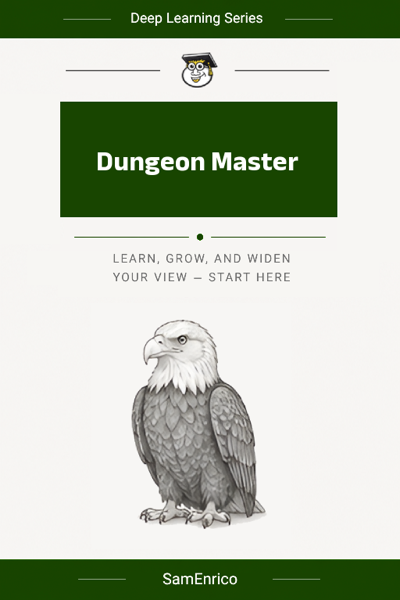
Dungeon Master
A Coursebook on Dungeon Master
A Coursebook on Dungeon Master
Formats
About this book
Free sample
Chapter 1: The Empty Throne...--–- You have been handed the dungeon master’s screen. Perhaps it was a gift. Perhaps you volunteered after your last DM burned out. Perhaps you are staring at a blank notebook, three dice, and a sinking feeling that you have no idea what you are doing. Good.
That feeling means you care.This chapter is not about rules. It is not about dice probabilities or monster stat blocks. This chapter is about one question and one question only: What does a Dungeon Master actually do?Most new DMs believe they are storytellers. They imagine themselves as novelists, writing a plot that the players will act out. This is the single most destructive misconception in the hobby.
It leads to railroading, frustration, and burnout. It leads to DMs saying “no” because a player’s idea would “ruin” the planned story. It leads to tables collapsing.You are not a storyteller.You are something far more interesting.The Three Hats of the Dungeon Master Every DM wears three hats simultaneously. The best DMs know which hat to tip forward at which moment. The worst DMs wear the wrong hat at the wrong time.Hat One: The Referee The referee is neutral.
The referee does not want the players to win or lose. The referee wants the rules to be applied consistently so that player choices have predictable consequences. When a player says “I leap across the chasm,” the referee says “Roll Athletics, DC 15.” When the dice come up a 6, the referee says “You fall. Take 2d6 bludgeoning damage.”The referee’s voice is calm. The referee does not gloat when a player fails.
The referee does not fudge dice to save a player. The referee is the law – not because the DM is authoritarian, but because a game without consistent rules is not a game. It is pretend.Most new DMs are afraid of the referee hat. They worry that enforcing rules makes them “mean.” The opposite is true. Players cannot make meaningful choices if the rules are applied arbitrarily.
Imagine playing chess where the opponent decides mid-game whether knights move in L-shapes. You would stop playing. Players need consistency…
This is the end of the free sample. Get the eBook to keep going. Buy now
Contents
- Chapter 1
- Chapter 2
- Chapter 3
- Chapter 4
- Chapter 5
- Chapter 6
- Chapter 7
- Chapter 8
- Chapter 9
- Chapter 10
- Chapter 11
- Chapter 12
Details
- Author
- Whatley Nancie
- Publisher
- SamEnrico
- Language
- English
- Genre
- Non-Fiction, Informative, Educational
- Released
- 2026-05-09
- Pages (approx.)
- 116
- Available as
- eBook, Audiobook

Read better in the ZLOADR app
Your eBooks on your phone or tablet. Sign in with your SamEnrico account and start reading.
More by Whatley Nancie
 Gifted Child Burnout Recovery PlanWhatley Nancie$11.99
 Time Blocking For Students WorkbookWhatley Nancie$11.99
 Loving Kindness for Religious TraumaWhatley Nancie$11.99
 Writing Comparison on Social MediaWhatley Nancie$11.99
 Stretching for Dancers GuideWhatley Nancie$11.99
 The Iron Horse of Arabia: The Unbreakable Record of the 1932 Cairo MarathonWhatley Nancie$11.99
 Citation Rules for Philosophy PapersWhatley Nancie$12.99
 Project Management Impact MetricsWhatley Nancie$12.99
 Understanding Nanism Due to Growth Hormone ResistanceWhatley Nancie$17.99
 How to Start a Chintz Glazing Business (Beginners Guide)Whatley Nancie$11.99