
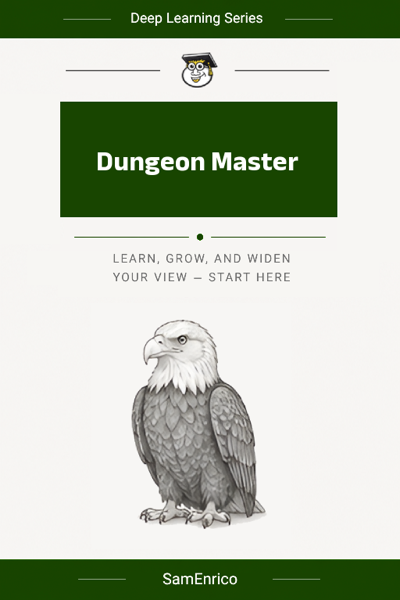
Non-FictionInformativeEducational
Dungeon Master eBook
A Coursebook on Dungeon Master
A Coursebook on Dungeon Master
Formats
Free sample
Chapter 1: The Empty Throne...--–- You have been handed the dungeon master’s screen. Perhaps it was a gift. Perhaps you volunteered after your last DM burned out. Perhaps you are staring at a blank notebook, three dice, and a sinking feeling that you have no idea what you are doing. Good.
That feeling means you care.This chapter is not about rules. It is not about dice probabilities or monster stat blocks. This chapter is about one question and one question only: What does a Dungeon Master actually do?Most new DMs believe they are storytellers. They imagine themselves as novelists, writing a plot that the players will act out. This is the single most destructive misconception in the hobby.
It leads to railroading, frustration, and burnout. It leads to DMs saying “no” because a player’s idea would “ruin” the planned story. It leads to tables collapsing.You are not a storyteller.You are something far more interesting.The Three Hats of the Dungeon Master Every DM wears three hats simultaneously. The best DMs know which hat to tip forward at which moment. The worst DMs wear the wrong hat at the wrong time.Hat One: The Referee The referee is neutral.
The referee does not want the players to win or lose. The referee wants the rules to be applied consistently so that player choices have predictable consequences. When a player says “I leap across the chasm,” the referee says “Roll Athletics, DC 15.” When the dice come up a 6, the referee says “You fall. Take 2d6 bludgeoning damage.”The referee’s voice is calm. The referee does not gloat when a player fails.
The referee does not fudge dice to save a player. The referee is the law – not because the DM is authoritarian, but because a game without consistent rules is not a game. It is pretend.Most new DMs are afraid of the referee hat. They worry that enforcing rules makes them “mean.” The opposite is true. Players cannot make meaningful choices if the rules are applied arbitrarily.
Imagine playing chess where the opponent decides mid-game whether knights move in L-shapes. You would stop playing. Players need consistency to feel that their choices matter.Hat Two: The Narrator The narrator builds worlds with words. The narrator describes the smell of the goblin warren (wet fur and sour milk), the sound of distant dripping water, the texture of moss-slick stone beneath the party’s boots. The narrator sets pacing – when to linger on a description, when to cut abruptly to the next scene, when to say “Later that day…” because the shopping trip is dragging.The narrator has no stake in the outcome.
The narrator is not trying to “win” the description. The narrator is trying to make the world feel real enough that players forget they are sitting around a table.Most new DMs under-use the narrator hat. They say “You see a cave” and stop. They describe only what is visible, forgetting smell, sound, temperature, and movement. They rush to the dice because they are nervous.
A dungeon master who wears only the referee hat runs a spreadsheet, not a roleplaying game.Hat Three: The Fan The fan is the most surprising hat. The fan wants the players to succeed. Not because the fan will cheat for them, but because the fan genuinely celebrates player ingenuity. When a player figures out a clever solution that bypasses three hours of your prep, the fan cheers. When a player rolls a critical hit on the boss, the fan pumps their fist.The fan is the opposite of the adversarial DM.
The adversarial DM sees the players as enemies to be defeated. The fan sees the players as protagonists whose story deserves a thrilling, earned victory.Most new DMs are afraid to be fans because they think it makes them “soft.” It does not. You can be a fan and still kill a player character. You can cheer for a player’s brilliant plan and still have the dice go against them. Being a fan means you are on the players’ side, not the monsters’ side.
The monsters are just obstacles. The players are the reason you are here.The Spectrum: Game Engine vs. Storyteller Every DM falls somewhere on a spectrum between two extremes.At one extreme: the Pure Referee. This DM runs the game as a neutral engine. They describe the dungeon, roll dice openly, and let the cards fall where they may.
They do not fudge. They do not improvise plot. They present a world and let the players interact with it. This style is common in old-school dungeon crawls and OSR (Old-School Renaissance) games. Players who love this style enjoy the purity of consequence.
Every victory is earned. Every death is fair.At the other extreme: the Pure Improviser. This DM treats rules as suggestions. They prioritize story and “the rule of cool” above all else. They rarely say no.
They build the world reactively, based on what players do. This style is common in storygame systems like Fiasco or Dungeon World. Players who love this style enjoy collaborative storytelling and hate being constrained by rules that feel arbitrary.Most D&D tables live in the middle.The course of this book assumes you will live in the middle too – but the exact spot is yours to choose. Some DMs lean toward referee (more tactical combat, more lethal consequences, more open rolling). Some DMs lean toward improviser (more player-driven plots, more rule bending, more cinematic moments).
Neither is wrong. The only wrong answer is refusing to know where you stand.Your First Exercise: Finding Your Spot Before you read further, take sixty seconds. Close your eyes. Imagine a perfect session of D&D – the kind of session you would love to run. Answer these three questions silently:Do the players face genuine risk of death?
If yes, you lean referee. If no, you lean improviser.Do you prepare detailed maps and encounter math ahead of time? If yes, you lean referee. If no, you lean improviser.Do you sometimes ignore a rule because it would spoil a cool moment? If yes, you lean improviser.
If no, you lean referee.There are no wrong answers. Write your answers in the margin of this book. They will change over time. That is fine.A Word on "The Rule of Cool"The Rule of Cool is simple: if a player wants to do something that is physically possible (barely) and incredibly awesome, let them try. Set a high DC.
Let the dice decide.The Rule of Cool is not a license to ignore the rules entirely. It is a tool for those rare moments when a player’s creativity outruns the rulebook. The paladin wants to slide down the bannister, swing on the chandelier, and kick the goblin king in the face. The rules have no mechanics for bannister-sliding. Here, the DM says: “Roll Acrobatics, DC 18.
If you succeed, you get advantage on your attack roll. If you fail, you crash into the drinks tray and land prone.”That is the Rule of Cool. It says “yes” but adds a cost. It rewards creativity without breaking…
This is the end of the free sample. Get the eBook to keep going. Buy now
About this book
Details
- Author
- Whatley Nancie
- Publisher
- SamEnrico
- Language
- English
- Genre
- Non-Fiction, Informative, Educational
- Released
- 2026-05-09
- Pages (approx.)
- 116
- Available as
- eBook, Audiobook

Read better in the ZLOADR app
Your eBooks on your phone or tablet. Sign in with your SamEnrico account and start reading.
More by Whatley Nancie
 Gifted Child Burnout Recovery PlanWhatley Nancie$11.99
 Time Blocking For Students WorkbookWhatley Nancie$11.99
 Loving Kindness for Religious TraumaWhatley Nancie$11.99
 Writing Comparison on Social MediaWhatley Nancie$11.99
 Stretching for Dancers GuideWhatley Nancie$11.99
 The Iron Horse of Arabia: The Unbreakable Record of the 1932 Cairo MarathonWhatley Nancie$11.99
 Citation Rules for Philosophy PapersWhatley Nancie$12.99
 Project Management Impact MetricsWhatley Nancie$12.99
 Understanding Nanism Due to Growth Hormone ResistanceWhatley Nancie$17.99
 How to Start a Chintz Glazing Business (Beginners Guide)Whatley Nancie$11.99
You may also like
 Hong Kong Handover 1997Dunn Johnnie$11.99
 Zumba For Postnatal Recovery CourseNeal Christian$11.99
 Zumba for BeginnersLadner Nikia$11.99
 YouTube Comment Mining GuideHumes Pandora$12.99
 Worry Box MeditationCarlin Rudy$11.99
 Workplace Stress MeditationNguyen Lynn$11.99
 Workplace Stress and Sleep RepairHawley Ivory$11.99
 Workplace Perfectionism CureDelaney Jeffry$11.99
 Workplace Injustice Anger GuideWallen Isabelle$11.99
 Work Addiction and Burnout LinkGreenwood Ester$11.99
 Women in Yoga and WellnessBeattie Galina$11.99
 Women in Stand Up ComedyChun Evangeline$11.99