
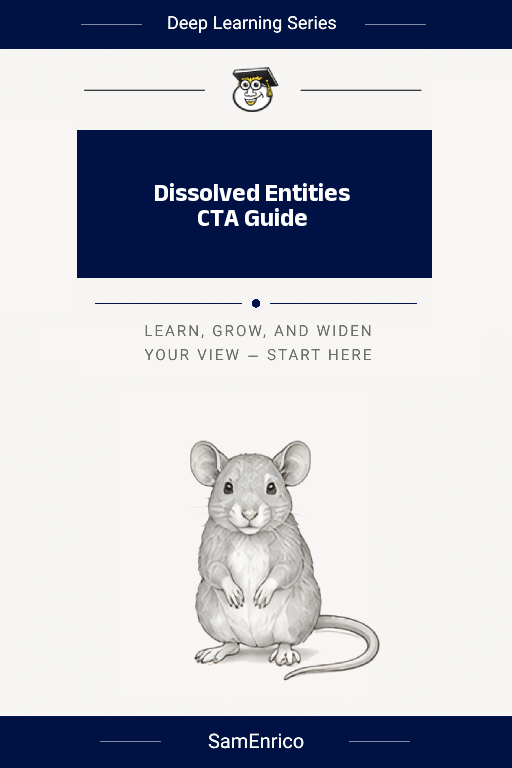
Non-FictionAnnual CheckupDissolutionInactive
Dissolved Entities CTA Guide eBook
Understand CTA reporting for entities that dissolv
Understand CTA reporting for entities that dissolved before effective date or during reporting period.
Formats
Free sample
Chapter 1: The Walking Dead–- It was a Tuesday morning in March 2025 when Mark received the letter that would unravel three years of careful planning. He had closed his consulting LLC in December 2023—filed the final tax return, paid the last state fees, even threw away the corporate seal. He had done everything right. Or so he believed. The letter, bearing the seal of the Financial Crimes Enforcement Network (Fin CEN), informed Mark that his "dead" company owed $87,500 in penalties for failing to file a Beneficial Ownership Information (BOI) report under the Corporate Transparency Act (CTA).
The company had dissolved before the law even took effect, Mark thought. How could it owe anything to anyone? The answer, as this chapter will reveal, lies in one of the most misunderstood and dangerous provisions in modern business law: the CTA's treatment of entities that cease to exist.Mark is not alone. Thousands of business owners, corporate attorneys, and CPAs are discovering that the assumption of "death" for a closed business has no meaning under the CTA unless specific, often misunderstood conditions are met. The law creates a category of entities that are neither fully alive nor fully dead—what practitioners have come to call "walking dead" entities.
These are companies that have stopped operating, closed their bank accounts, and faded from memory, yet remain legally alive for purposes of federal reporting. And the penalties for ignoring them are staggering: up to $500 per day, every day, with no statutory cap.This chapter introduces the central paradox of the CTA as it applies to dissolved entities. It explains why your assumption about what it means to "close" a business is almost certainly wrong, how the CTA creates traps for unwary former business owners, and why understanding the distinction between "ceasing operations" and "ceasing to exist" could save you from financial ruin. By the end of this chapter, you will understand why a company that has no bank account, no employees, and no revenue may still be required to file reports with the federal government—and why failing to do so can follow you for years after you thought your business was dead.The Great Misunderstanding: What "Dissolved" Actually Means Most business owners believe that dissolution is a single event—a moment when the state stamps a piece of paper and the company vanishes from existence. This belief is reinforced by common language: we say a company "dissolved" as if it evaporated overnight.
But the law sees dissolution very differently, and this gap between common understanding and legal reality is where the CTA's trap is set.In state corporate law, dissolution is not an event but a process. When you file articles of dissolution with your secretary of state, you initiate a winding-up period during which the company continues to exist for the limited purpose of liquidating assets, paying creditors, and distributing remaining property to owners. During this period—which can last months or even years—the company is still a legal entity. It can sue and be sued. It can own property.
And, as the CTA makes clear, it can be a "reporting company" required to file BOI reports.The critical distinction, which will recur throughout this book, is between winding up and ceasing to exist. A company that is winding up is still alive for federal law purposes. Only when the winding-up process is complete, all assets have been distributed, all debts paid, and the state has issued a final certificate of termination—only then has the company truly ceased to exist.This distinction matters because the CTA defines a "reporting company" as any entity created by filing a document with a secretary of state. That definition makes no exception for entities that are in the process of dissolving. It makes no exception for entities that have stopped operating.
It makes no exception for entities that have no bank accounts, no employees, and no revenue. If your company was formed by filing a document—and almost every LLC and corporation in America was—then it is a reporting company until the moment it ceases to exist as a legal entity. Not when you stop using it. Not when you close the bank account. Not when you tell your accountant you're done.
Only when the state says it no longer exists.The Birth of the Corporate Transparency Act: Why Congress Created This Trap To understand why dissolved entities are treated so harshly under the CTA, you need to understand what Congress was trying to accomplish. The Corporate Transparency Act, enacted in 2021 as part of the National Defense Authorization Act, was designed to combat money laundering, tax fraud, and terrorist financing by closing a gaping hole in American corporate law: the ability to form anonymous shell companies.Before the CTA, anyone could form an LLC or corporation in most states without disclosing who actually owned or controlled the business. This anonymity made the United States a haven for illicit finance. Drug cartels formed shell companies to launder money. Foreign oligarchs hid assets behind anonymous LLCs.
Fraudsters set up empty corporations to evade taxes and creditors. Congress responded with the CTA, which for the first time required most entities to report their "beneficial owners"—the real people behind the corporate veil—to Fin CEN.The CTA's reporting requirement applies to "reporting companies," defined as any corporation, limited liability company, or other entity created by filing a document with a secretary of state. There are 23 exemptions—for large operating companies, banks, public utilities, and others—but the default rule is sweeping: if you formed an entity by filing a paper, you must report.Congress did not anticipate the complexity that dissolved entities would create. The legislative history is silent on whether a company that dissolved before the effective date must report. The statute says only that reporting companies must file BOI reports.
It does not say what happens when a reporting company ceases to exist. This silence has forced Fin CEN to issue piecemeal guidance, creating a patchwork of rules that often seem contradictory or unfair.The result is a law that treats "walking dead" entities as fully alive for reporting purposes. As one commentator put it, under the CTA, a company is like a vampire: it remains undead until you drive a stake through its heart with a formal, irrevocable dissolution—and even then, you need to make sure the stake went in deep enough.The Anatomy of a "Walking Dead" Entity Not all dissolved entities are created equal. Some are truly dead and buried. Others are merely sleepwalking, still legally alive and subject to CTA reporting.
Understanding the difference is the key to compliance—and to avoiding the fate that befell Mark in our opening story.A "walking dead" entity, as the term is used in this book, is any company that has ceased business operations but has not completed a formal, irrevocable dissolution under state law. These entities come in several varieties:The Abandoned Entity: This is the most common type of walking dead. A business owner stops using the company, stops filing tax returns, and stops paying state fees. The owner considers the company "closed" because it is no longer generating revenue. But the state still…
This is the end of the free sample. Get the eBook to keep going. Buy now
About this book
Details
- Author
- Waggoner Dortha
- Publisher
- SamEnrico
- Language
- English
- Genre
- Non-Fiction, Annual Checkup, Dissolution, Inactive
- Released
- 2026-05-30
- Pages (approx.)
- 155
- Available as
- eBook, Audiobook

Read better in the ZLOADR app
Your eBooks on your phone or tablet. Sign in with your SamEnrico account and start reading.
More by Waggoner Dortha
 CrossFit Competition Prep HandbookWaggoner Dortha$11.99
 Crop Insurance Agency DirectoryWaggoner Dortha$11.99
 The Shame of Loneliness WorkbookWaggoner Dortha$11.99
 Meditation for Sickle Cell PainWaggoner Dortha$11.99
 Beginner Fitness Warm Up GuideWaggoner Dortha$11.99
 The Last Tycoon’s Island: How Howard Hughes Bought His Own ParadiseWaggoner Dortha$11.99
 The Ballot Rebellion: How a Single Town Overturned a GovernorWaggoner Dortha$11.99
 Understanding D-glyceric AcidemiaWaggoner Dortha$17.99
 Docker Certification GuideWaggoner Dortha$12.99
 VivariumsWaggoner Dortha$11.99
 How to Become a Charger OperatorWaggoner Dortha$11.99
You may also like
 Hong Kong Handover 1997Dunn Johnnie$11.99
 Zumba For Postnatal Recovery CourseNeal Christian$11.99
 Zumba for BeginnersLadner Nikia$11.99
 YouTube Comment Mining GuideHumes Pandora$12.99
 Worry Box MeditationCarlin Rudy$11.99
 Workplace Stress MeditationNguyen Lynn$11.99
 Workplace Stress and Sleep RepairHawley Ivory$11.99
 Workplace Perfectionism CureDelaney Jeffry$11.99
 Workplace Injustice Anger GuideWallen Isabelle$11.99
 Work Addiction and Burnout LinkGreenwood Ester$11.99
 Women in Yoga and WellnessBeattie Galina$11.99
 Women in Stand Up ComedyChun Evangeline$11.99