
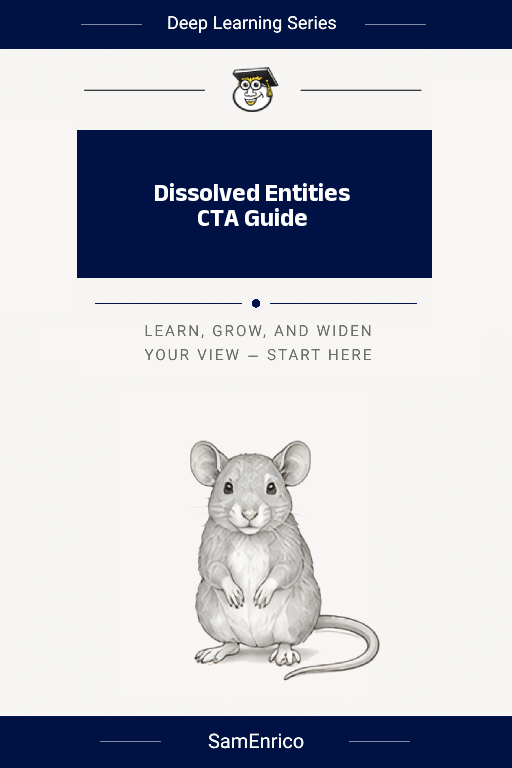
Non-FictionAnnual CheckupDissolutionInactive
Dissolved Entities CTA Guide
Understand CTA reporting for entities that dissolv
Understand CTA reporting for entities that dissolved before effective date or during reporting period.
Formats
About this book
Free sample
Chapter 1: The Walking Dead–- It was a Tuesday morning in March 2025 when Mark received the letter that would unravel three years of careful planning. He had closed his consulting LLC in December 2023—filed the final tax return, paid the last state fees, even threw away the corporate seal. He had done everything right. Or so he believed. The letter, bearing the seal of the Financial Crimes Enforcement Network (Fin CEN), informed Mark that his "dead" company owed $87,500 in penalties for failing to file a Beneficial Ownership Information (BOI) report under the Corporate Transparency Act (CTA).
The company had dissolved before the law even took effect, Mark thought. How could it owe anything to anyone? The answer, as this chapter will reveal, lies in one of the most misunderstood and dangerous provisions in modern business law: the CTA's treatment of entities that cease to exist.Mark is not alone. Thousands of business owners, corporate attorneys, and CPAs are discovering that the assumption of "death" for a closed business has no meaning under the CTA unless specific, often misunderstood conditions are met. The law creates a category of entities that are neither fully alive nor fully dead—what practitioners have come to call "walking dead" entities.
These are companies that have stopped operating, closed their bank accounts, and faded from memory, yet remain legally alive for purposes of federal reporting. And the penalties for ignoring them are staggering: up to $500 per day, every day, with no statutory cap.This chapter introduces the central paradox of the CTA as it applies to dissolved entities. It explains why your assumption about what it means to "close" a business is almost certainly wrong, how the CTA creates traps for unwary former business owners, and why understanding the distinction between "ceasing operations" and "ceasing to exist" could save you from financial ruin. By the end of this chapter, you will understand why a company that has no bank account, no employees, and no revenue may still be required to file reports with the federal government—and why failing to do so can follow you for years…
This is the end of the free sample. Get the eBook to keep going. Buy now
Contents
- Chapter 1
- Chapter 2
- Chapter 3
- Chapter 4
- Chapter 5
- Chapter 6
- Chapter 7
- Chapter 8
- Chapter 9
- Chapter 10
- Chapter 11
- Chapter 12
Details
- Author
- Waggoner Dortha
- Publisher
- SamEnrico
- Language
- English
- Genre
- Non-Fiction, Annual Checkup, Dissolution, Inactive
- Released
- 2026-05-30
- Pages (approx.)
- 155
- Available as
- eBook, Audiobook

Read better in the ZLOADR app
Your eBooks on your phone or tablet. Sign in with your SamEnrico account and start reading.
More by Waggoner Dortha
 CrossFit Competition Prep HandbookWaggoner Dortha$11.99
 Crop Insurance Agency DirectoryWaggoner Dortha$11.99
 The Shame of Loneliness WorkbookWaggoner Dortha$11.99
 Meditation for Sickle Cell PainWaggoner Dortha$11.99
 Beginner Fitness Warm Up GuideWaggoner Dortha$11.99
 The Last Tycoon’s Island: How Howard Hughes Bought His Own ParadiseWaggoner Dortha$11.99
 The Ballot Rebellion: How a Single Town Overturned a GovernorWaggoner Dortha$11.99
 Understanding D-glyceric AcidemiaWaggoner Dortha$17.99
 Docker Certification GuideWaggoner Dortha$12.99
 VivariumsWaggoner Dortha$11.99
 How to Become a Charger OperatorWaggoner Dortha$11.99
You may also like
 Hong Kong Handover 1997Dunn Johnnie$11.99
 Zumba For Postnatal Recovery CourseNeal Christian$11.99
 Zumba for BeginnersLadner Nikia$11.99
 YouTube Comment Mining GuideHumes Pandora$12.99
 Worry Box MeditationCarlin Rudy$11.99
 Workplace Stress MeditationNguyen Lynn$11.99
 Workplace Stress and Sleep RepairHawley Ivory$11.99
 Workplace Perfectionism CureDelaney Jeffry$11.99
 Workplace Injustice Anger GuideWallen Isabelle$11.99
 Work Addiction and Burnout LinkGreenwood Ester$11.99
 Women in Yoga and WellnessBeattie Galina$11.99
 Women in Stand Up ComedyChun Evangeline$11.99