
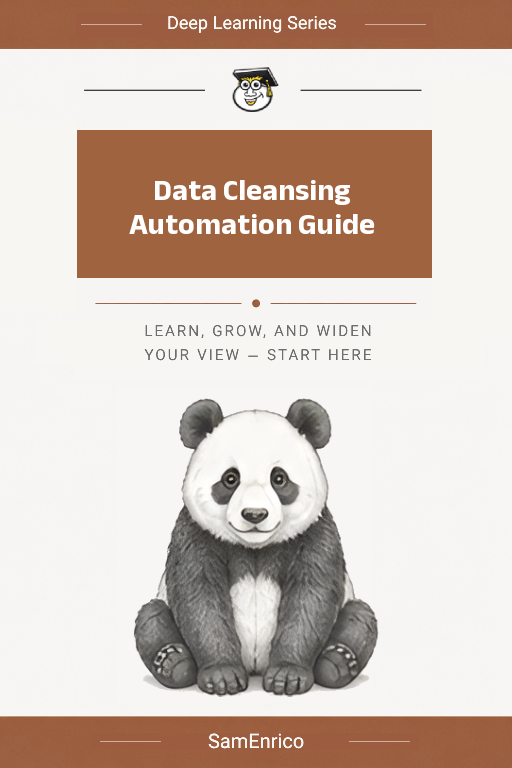
Non-FictionAI OperatorData Quality
Data Cleansing Automation Guide eBook
Use AI workflows to identify and correct data qual
Use AI workflows to identify and correct data quality issues in operational databases continuously.
Formats
Free sample
Chapter 1: The $47 Million Trailing Space--The quarterly earnings report was due in six hours, and Maria Chen, the lead data engineer at Omni Retail, had not slept in thirty-one.She stared at her screen, watching the same error message flash for the hundredth time: JOIN KEY MISMATCH: 47,832,091 records excluded. The company’s CRM database contained 48.2 million customer records. The ERP system contained 48.1 million. After a four-hour join operation that had cost $12,000 in cloud compute credits, exactly 47.8 million rows had matched. The remaining 10,000 rows—the difference between the two systems—had vanished.Those 10,000 rows represented $47 million in inventory that the company had purchased, stored, and sold but could not reconcile.
The auditors would not sign off. The CFO was pacing outside Maria’s glass-walled office. And somewhere in a database cluster three time zones away, a single trailing space after a customer ID was about to cost Omni Retail its quarterly earnings guidance.This is not a hypothetical story. It happens every day, at companies you know by name, to engineers who thought they had done everything right. The only difference is the dollar amount and the name on the lawsuit.The Scale of the Invisible Crisis Let us begin with a number that sounds fictional but is not: enterprises now generate, store, and process the equivalent of over 2.5 quintillion bytes daily.
That is 2.5 followed by eighteen zeros. According to the IDC Data Sphere report (2023), global data creation reached approximately 120 zettabytes annually, with enterprises accounting for roughly forty percent of that volume. To put this in perspective: if every byte were a grain of sand, the daily enterprise data volume would fill Olympic swimming pools more times than there are stars in the Milky Way. The problem is not that we have too much data. The problem is that much of it is wrong the moment it arrives.Data quality researchers have studied this problem for decades, and their findings are uniformly sobering.
A 2021 study published in the Harvard Data Science Review found that between twelve and twenty percent of enterprise data contains at least one critical error. Gartner has repeatedly estimated that poor data quality costs organizations an average of 12.9millionperyear.IBM’sannual Data Qualityreportpegsthecosttothe USeconomyaloneat12.9 million per year. IBM’s annual Data Quality report pegs the cost to the US economy alone at 12.9millionperyear.IBM’sannual Data Qualityreportpegsthecosttothe USeconomyaloneat3.1 trillion annually. These numbers are so large that they cease to be meaningful—until they become personal.For Maria Chen, the number became personal when her boss’s boss called at 2 AM. “The audit committee wants to know why our inventory doesn’t match our sales records,” he said.
“And they want to know before the market opens.”The trailing space that caused Omni Retail’s crisis was invisible. It had arrived eighteen months earlier through a CSV export from a legacy system that had been scheduled for decommissioning but never quite made it to the top of anyone’s priority list. In the source system, customer ID ORD-45231 had no space. In the CSV file, some quirk of the export process had rendered it as ORD-45231 —same digits, same dashes, same everything, except for an invisible ASCII character 32 at the end. The CRM system stored the ID without the space.
The ERP system stored it with the space. Every join between the two systems silently failed for those ten thousand customers. No error was thrown. No alert was triggered. The data just disappeared.Introducing Data Scars and Data Shocks Throughout this book, we will use two concepts to understand the damage that dirty data inflicts.
The first is Data Scars. A Data Scar is the long-term, cumulative business damage that results from persistent data quality failures. It is called a scar because, like a physical scar, it forms slowly, it never fully heals, and it serves as a permanent reminder of an injury. Data Scars appear as reduced customer lifetime value (because you cannot identify your best customers), inflated operational costs (because you pay humans to fix what machines should handle), degraded AI model accuracy (because garbage in produces garbage out), and regulatory fines (because compliance reporting requires accurate data). Scars are the thousand small cuts that bleed an organization dry over years.The second concept is Data Shocks.
A Data Shock is a sudden, catastrophic pipeline failure caused by unexpected dirty data. Unlike scars, shocks are acute events. A null value crashes a mission-critical production model at 3 AM. A schema change breaks fifty downstream dashboards simultaneously. A silent join failure causes a multimillion-dollar inventory reconciliation crisis six hours before an earnings report.
Shocks are what wake engineers up at night, what trigger post-mortems, and what make executives suddenly very interested in data quality after years of underinvesting in it.Omni Retail suffered both. The ten thousand missing customers created an immediate Data Shock—a 47millionreconciliationgapthatthreatenedthequarterlyearningscall.Butthecompanyhadalsoaccumulatedyearsof Data Scars:marketingcampaignsthattargetedthewrongsegments,customersupportticketsthatcouldnotfindorderhistory,andarecommendationenginethatsuggestedproductscustomershadalreadypurchased.Thesescarshadcostthecompanyanestimated47 million reconciliation gap that threatened the quarterly earnings call. But the company had also accumulated years of Data Scars: marketing campaigns that targeted the wrong segments, customer support tickets that could not find order history, and a recommendation engine that suggested products customers had already purchased. These scars had cost the company an estimated 47millionreconciliationgapthatthreatenedthequarterlyearningscall.Butthecompanyhadalsoaccumulatedyearsof Data Scars:marketingcampaignsthattargetedthewrongsegments,customersupportticketsthatcouldnotfindorderhistory,andarecommendationenginethatsuggestedproductscustomershadalreadypurchased.Thesescarshadcostthecompanyanestimated8 million annually, but because the costs were distributed across departments and quarters, no one had connected them to data quality until the shock made it impossible to ignore.Why Traditional Methods Have Failed You If you have worked with data for more than six months, you have likely encountered the standard responses to dirty data. Someone suggests running a one-time cleanup script.
Someone else proposes writing a set of validation rules. A third person argues for more manual QA reviews. These approaches are not wrong. They are insufficient. Let us examine each in turn.The One-Time Scrub Fallacy The one-time scrub is the data equivalent of cleaning your apartment by throwing everything into a closet and closing the door.
It feels productive in the moment, but it does not address the underlying problem. You run a Python script that deduplicates customers, standardizes date formats, and removes invalid email addresses. Your dashboard looks beautiful. For about three days. Then new data arrives—some from the same broken sources, some from new integrations, some from acquisitions—and your clean dataset is dirty again.
The one-time scrub fails because data is not static. It is a living, breathing, constantly mutating organism. Cleaning it once is like bathing a toddler once and assuming they will stay clean forever.The Rule Avalanche The alternative to one-time scrubs is often an ever-growing collection of validation rules. You write a rule that rejects emails without an @ symbol. Another rule that flags dates before 1900.
Another rule that checks foreign key integrity. These rules work. The problem is that they scale catastrophically. As your data sources multiply, your rule count grows linearly. As your rules grow, maintenance costs grow superlinearly.
Eventually, you reach a state known as Rule Paralysis: the rule engine has become so complex that no one understands the full system, and every change breaks something unexpected. A Fortune 500 financial services company I consulted for had accumulated 12,000 data quality rules…
This is the end of the free sample. Get the eBook to keep going. Buy now
About this book
Details
- Author
- Casteel Jerrold
- Publisher
- SamEnrico
- Language
- English
- Genre
- Non-Fiction, AI Operator, Data Quality
- Released
- 2026-06-01
- Pages (approx.)
- 149
- Available as
- eBook, Audiobook

Read better in the ZLOADR app
Your eBooks on your phone or tablet. Sign in with your SamEnrico account and start reading.
More by Casteel Jerrold
 Mindfulness for Test Anxiety WorkbookCasteel Jerrold$11.99
 Mindful Driving Stress ReductionCasteel Jerrold$11.99
 The Remote Work Talent Shift GuideCasteel Jerrold$11.99
 Teen Self Esteem and Chronic IllnessCasteel Jerrold$11.99
 Ayurvedic Lung Health GuideCasteel Jerrold$11.99
 The Forge of the First Sword: Arthur’s Lost Creation MythCasteel Jerrold$11.99
 UltimateCasteel Jerrold$11.99
 Brazil Dropshipping Automation ToolsCasteel Jerrold$12.99
 Understanding Methylmalonyl-coenzyme a Mutase DeficiencyCasteel Jerrold$17.99
 How to Start a Building Materials Made of Vegetable Substances Business (Beginners Guide)Casteel Jerrold$11.99
You may also like
 Hong Kong Handover 1997Dunn Johnnie$11.99
 Zumba For Postnatal Recovery CourseNeal Christian$11.99
 Zumba for BeginnersLadner Nikia$11.99
 YouTube Comment Mining GuideHumes Pandora$12.99
 Worry Box MeditationCarlin Rudy$11.99
 Workplace Stress MeditationNguyen Lynn$11.99
 Workplace Stress and Sleep RepairHawley Ivory$11.99
 Workplace Perfectionism CureDelaney Jeffry$11.99
 Workplace Injustice Anger GuideWallen Isabelle$11.99
 Work Addiction and Burnout LinkGreenwood Ester$11.99
 Women in Yoga and WellnessBeattie Galina$11.99
 Women in Stand Up ComedyChun Evangeline$11.99