
Non-FictionBusiness BriefAudit
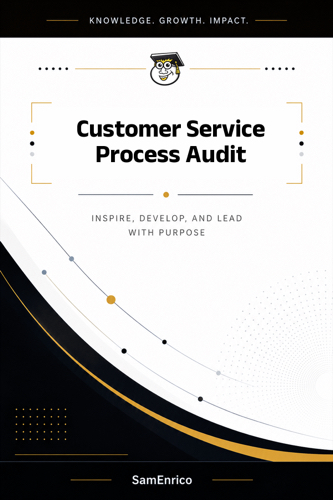
Customer Service Process Audit eBook
Review existing workflows to identify bottlenecks
Review existing workflows to identify bottlenecks and improvement opportunities.
Formats
Free sample
Chapter 1: The Hidden Factory...--–- At exactly 2:47 PM on a Tuesday, a customer named Sarah pressed “0” for the seventh time. She had been on the phone for thirty-one minutes. She had already explained her problem to three different people. Her account number had been entered into four different systems. Nobody had solved anything.
Sarah was not angry. She was exhausted. And that exhaustion—quiet, invisible, unreported—was costing the company on the other end of the line more money than any single complaint ever would.This chapter argues that every customer service interaction contains a “hidden factory” of invisible work, delays, and redundant steps that most managers never see. Not because they aren't looking, but because the factory is designed to be invisible. The metrics they track—average handle time, customer satisfaction scores, first contact resolution—are all outputs of a machine whose internal workings remain largely unexamined.
The result is a slow, silent bleed of money, loyalty, and employee morale.The Iceberg of Customer Service Costs Most leaders believe they understand the cost of customer service. They calculate agent salaries. They add software licensing fees. They factor in phone bills and chat platform subscriptions. But these are the visible costs—the tip of the iceberg.
Beneath the waterline lies a much larger mass of hidden expenses: the cost of customers repeating themselves, the cost of agents switching between seven different browser tabs, the cost of tickets that sit untouched for days because nobody owns the next step.This chapter introduces the concept of the process tax—the cumulative cost (in time, money, and customer loyalty) of every unnecessary transfer, every redundant system login, and every waiting period that adds no value to the customer or the business. Unlike the operational metrics covered in Chapter 10 (which tell you how to measure after you fix things), the process tax is an upfront diagnostic tool. It answers one question: How much value is your current workflow destroying before a human even touches the ticket?Consider a simple example. A customer calls to change their shipping address on an order placed twenty minutes ago. On the surface, this is a thirty-second task.
But behind the scenes, the process tax might look like this:Customer waits 4 minutes in the IVR (process tax: $0.67 in customer time value)Customer repeats their order number to the first agent (process tax: $0.33)Agent discovers they cannot edit orders after fifteen minutes, so transfers to shipping (process tax: $1.00 in agent time + $1.33 in customer frustration)Second agent asks for the order number again (process tax: $0.33)Second agent realizes shipping cannot edit either, transfers to a supervisor (process tax: $1.00)Supervisor has the authority but needs to log into a different system, taking 90 seconds (process tax: $1.50 in agent time + $2.00 in customer hold time)The actual work—changing the address—took ten seconds. The process tax consumed eleven minutes and cost the company approximately $8.16 in direct labor and customer time value. Multiplied by ten thousand such calls per month, the process tax becomes a seven-figure line item that appears nowhere on the profit and loss statement.Three Bottlenecks That Drain Your Business Through analyzing hundreds of service workflows across retail, banking, telecommunications, and software companies, three specific bottlenecks emerge as the most common and most costly sources of process tax. These are not the only bottlenecks—later chapters will reveal more—but they are the ones that hide most effectively from standard reporting.The Hand-off Gap When a customer is transferred between departments, context is lost up to 99 percent of the time. This is not an exaggeration; it is a finding from a study of fifty thousand support tickets conducted by a major CRM provider.
The study found that in transfers involving more than two departments, the probability of all relevant context surviving dropped to below 2 percent.Why does this happen? Because most customer service systems were designed for individual agents, not for workflows. An agent closes a ticket, writes a brief note (if they have time), and moves on. The next agent opens what looks like a fresh problem. The customer, who has already explained everything once, must now do it again.
And again. And sometimes again.The hand-off gap has a cruel asymmetry. To the company, each transfer looks like a simple routing event. The customer is moved from Queue A to Queue B. The system logs it as a normal transaction.
But to the customer, each transfer is a reset button. Everything they have already communicated is wiped clean. They are not being served; they are being handed off like a package that no one wants to open.A regional bank we studied had an average of 2.7 transfers per complex ticket. Customers repeating their account number, date of birth, and problem description three times each. The bank measured first contact resolution at 68 percent—a respectable figure by industry standards.
But when they looked at actual resolution time from the customer's first contact to final close, they discovered that “resolved on first contact” often meant “the first agent closed the ticket without solving the problem, and the customer called back the next day.” The hand-off gap was not just inefficient; it was actively generating rework that masqueraded as success.Invisible Work: The Swivel Chair The single most expensive motion in customer service is the agent turning from one screen to another. Not physically turning, but mentally—closing a browser tab, opening a different system, re-entering data that another system already possesses. This is called the swivel chair integration, and it consumes between 30 and 40 percent of an agent's handle time in typical organizations.Here is what the swivel chair looks like in practice. A customer calls about a missing shipment. The agent opens the CRM to see the customer's history.
They then open the shipping carrier's tracking portal in another tab. They copy the tracking number from the CRM, paste it into the carrier portal, and see that the package was delivered. They return to the CRM, open the order management system, verify that the order status matches. They then open a third system—the warehouse management platform—to see if the item was actually picked and packed. Each of these steps takes only ten to fifteen seconds.
But there are eight of them. The customer has been on hold for ninety seconds while the agent performs digital calisthenics.The swivel chair is invisible because it is composed of small, justifiable actions. No single data entry seems unreasonable. But aggregated across thousands of tickets, the cost is staggering. A mid-sized e-commerce company with fifty agents each handling forty tickets per day loses approximately 1.2 million dollars per year to swivel chair inefficiency, assuming an average agent cost of $25 per hour and thirty seconds of swivel time per ticket.The tragedy of the swivel chair is that it is entirely solvable with existing technology.
API integrations, single sign-on, and unified agent desktops have been available for years. The barrier is not technical; it is organizational. Different departments own different systems. Integration requires cooperation. And cooperation requires someone to measure the problem first.Idle Ticket Decay The third bottleneck is the most deceptive.
Unlike the hand-off gap (which customers experience directly) or the swivel chair (which consumes agent time), idle ticket decay happens…
This is the end of the free sample. Get the eBook to keep going. Buy now
About this book
Details
- Author
- Dunaway Abram
- Publisher
- SamEnrico
- Language
- English
- Genre
- Non-Fiction, Business Brief, Audit
- Released
- 2026-06-09
- Pages (approx.)
- 149
- Available as
- eBook, Audiobook

Read better in the ZLOADR app
Your eBooks on your phone or tablet. Sign in with your SamEnrico account and start reading.
More by Dunaway Abram
 Saint Francis Crusade EncounterDunaway Abram$11.99
 Burnout Recovery Podcast GuideDunaway Abram$11.99
 Keto Bread Alternatives GuideDunaway Abram$11.99
 The Herbert von Karajan GuideDunaway Abram$11.99
 The Opium King's Blackmail: The Extortion Scheme That Shook 19th-Century Hong KongDunaway Abram$11.99
 Learn to Play the DhaaDunaway Abram$11.99
 Technical Seo ManagerDunaway Abram$11.99
 Faceless YouTube True CrimeDunaway Abram$12.99
 Agile for Agency StartupsDunaway Abram$12.99
 How to Become a Line WalkerDunaway Abram$11.99
You may also like
 Hong Kong Handover 1997Dunn Johnnie$11.99
 Zumba For Postnatal Recovery CourseNeal Christian$11.99
 Zumba for BeginnersLadner Nikia$11.99
 YouTube Comment Mining GuideHumes Pandora$12.99
 Worry Box MeditationCarlin Rudy$11.99
 Workplace Stress MeditationNguyen Lynn$11.99
 Workplace Stress and Sleep RepairHawley Ivory$11.99
 Workplace Perfectionism CureDelaney Jeffry$11.99
 Workplace Injustice Anger GuideWallen Isabelle$11.99
 Work Addiction and Burnout LinkGreenwood Ester$11.99
 Women in Yoga and WellnessBeattie Galina$11.99
 Women in Stand Up ComedyChun Evangeline$11.99