
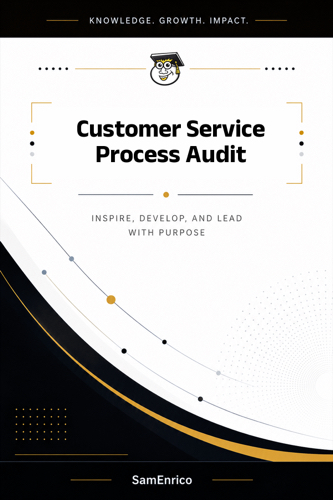
Non-FictionBusiness BriefAudit
Customer Service Process Audit Audiobook
Review existing workflows to identify bottlenecks
Review existing workflows to identify bottlenecks and improvement opportunities.
Formats
Free sample
Chapter 1: The Hidden Factory...--–- At exactly 2:47 PM on a Tuesday, a customer named Sarah pressed “0” for the seventh time. She had been on the phone for thirty-one minutes. She had already explained her problem to three different people. Her account number had been entered into four different systems. Nobody had solved anything.
Sarah was not angry. She was exhausted. And that exhaustion—quiet, invisible, unreported—was costing the company on the other end of the line more money than any single complaint ever would.This chapter argues that every customer service interaction contains a “hidden factory” of invisible work, delays, and redundant steps that most managers never see. Not because they aren't looking, but because the factory is designed to be invisible. The metrics they track—average handle time, customer satisfaction scores, first contact resolution—are all outputs of a machine whose internal workings remain largely unexamined.
The result is a slow, silent bleed of money, loyalty, and employee morale.The Iceberg of Customer Service Costs Most leaders believe they understand the cost of customer service. They calculate agent salaries. They add software licensing fees. They factor in phone bills and chat platform subscriptions. But these are the visible costs—the tip of the iceberg.
Beneath the waterline lies a much larger mass of hidden expenses: the cost of customers repeating themselves, the cost of agents switching between seven different browser tabs, the cost of tickets that sit untouched for days because nobody owns the next step.This chapter introduces the concept of the process tax—the cumulative cost (in time, money, and customer loyalty) of every unnecessary transfer, every redundant system login, and every waiting period that adds no value to the customer or the business. Unlike the operational metrics covered in Chapter 10 (which tell you how to measure after you fix things), the process tax is an upfront diagnostic tool. It answers one question: How much value is your current workflow destroying before a human even touches the ticket?Consider a simple example. A customer calls to change their shipping address on an order placed twenty minutes ago. On the surface, this is a thirty-second task.
But behind the scenes, the process tax might look like this:Customer waits 4 minutes in the IVR (process tax: $0.67 in customer time value)Customer repeats their order number to the first agent (process tax: $0.33)Agent discovers they cannot edit orders…
This is the end of the free sample. Get the Audiobook to keep going. Buy now
About this book
Details
- Author
- Dunaway Abram
- Publisher
- SamEnrico
- Language
- English
- Genre
- Non-Fiction, Business Brief, Audit
- Released
- 2026-06-09
- Pages (approx.)
- 149
- Available as
- eBook, Audiobook

Listen in the VoxFlicks app
Audiobooks and audio dramas wherever you go. Sign in with your SamEnrico account and press play.
More by Dunaway Abram
 Saint Francis Crusade EncounterDunaway Abram$11.99
 Burnout Recovery Podcast GuideDunaway Abram$11.99
 Keto Bread Alternatives GuideDunaway Abram$11.99
 The Herbert von Karajan GuideDunaway Abram$11.99
 The Opium King's Blackmail: The Extortion Scheme That Shook 19th-Century Hong KongDunaway Abram$11.99
 Learn to Play the DhaaDunaway Abram$11.99
 Technical Seo ManagerDunaway Abram$11.99
 Faceless YouTube True CrimeDunaway Abram$12.99
 Agile for Agency StartupsDunaway Abram$12.99
 How to Become a Line WalkerDunaway Abram$11.99
You may also like
 Hong Kong Handover 1997Dunn Johnnie$11.99
 Zumba For Postnatal Recovery CourseNeal Christian$11.99
 Zumba for BeginnersLadner Nikia$11.99
 YouTube Comment Mining GuideHumes Pandora$12.99
 Worry Box MeditationCarlin Rudy$11.99
 Workplace Stress MeditationNguyen Lynn$11.99
 Workplace Stress and Sleep RepairHawley Ivory$11.99
 Workplace Perfectionism CureDelaney Jeffry$11.99
 Workplace Injustice Anger GuideWallen Isabelle$11.99
 Work Addiction and Burnout LinkGreenwood Ester$11.99
 Women in Yoga and WellnessBeattie Galina$11.99
 Women in Stand Up ComedyChun Evangeline$11.99