
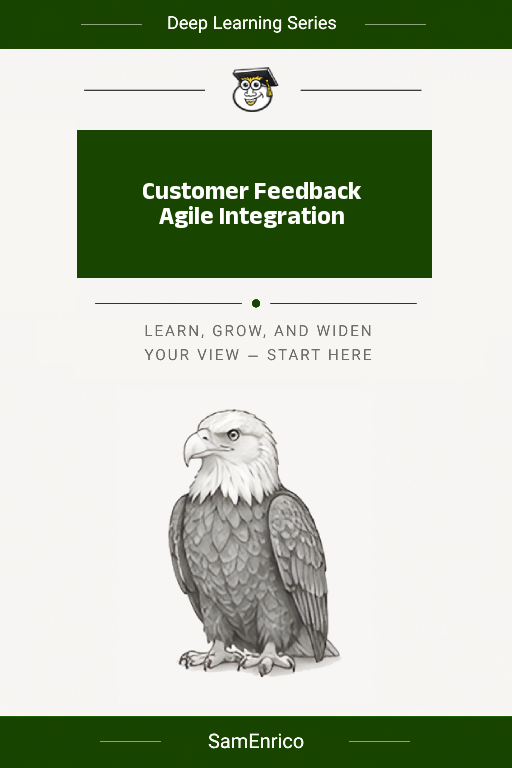
Non-FictionStartup GuideCustomer Development
Customer Feedback Agile Integration eBook
Inject user interviews and analytics into agile ba
Inject user interviews and analytics into agile backlogs. Prioritize stories using customer evidence instead of founder intuition for early-stage startups.
Formats
Free sample
Chapter 1: The 90% Graveyard...--–- Every failed startup has a beautiful graveyard. You cannot see it from the outside. The pitch decks are polished, the founders are charismatic, and the landing pages are immaculate. But beneath the surface, buried in closed pull requests and abandoned Jira tickets, lies the evidence of something far more tragic than a lack of effort. It is the graveyard of features built on intuition.
Features that nobody asked for. Features that solved problems nobody had. Features that cost weeks of engineering time, thousands of dollars in opportunity cost, and ultimately, the confidence of a team that trusted its founder to know best.This chapter is not an abstract critique of founder vision. It is a surgical dissection of why startup failure is rarely a market problem and almost always an evidence problem. You will learn the difference between intuition as a hypothesis and intuition as a fact.
You will encounter three specific failure patterns that kill startups before they find product-market fit. And you will meet two founders—one who trusted his gut into bankruptcy and another who trusted her users into a Series A. By the end of this chapter, you will never again write a user story without asking the single most dangerous question in product development: “Says who?”The Myth of the Visionary Silicon Valley has canonized a dangerous archetype: the Visionary Founder. Steve Jobs. Elon Musk.
Jeff Bezos. The narrative goes something like this: a brilliant, stubborn individual ignores all feedback, trusts their gut, and builds something the world didn't know it needed. This story sells magazines and gets standing ovations at conferences. It is also, for ninety-nine out of one hundred founders, a death sentence.The problem is not vision. Vision is essential.
The problem is the conflation of vision with spec. A vision is a direction—a North Star. A spec is a detailed set of instructions for engineers to build something. When a founder says, “I have a vision for this feature,” they are making a hypothesis. But when they hand that hypothesis to a development team as a requirement, they have quietly transformed a guess into a command.
And commands do not get tested. They get built.This book introduces what we call the 90% Myth. After analyzing more than two hundred early-stage startups across five accelerators, a consistent pattern emerged: approximately ninety percent of features built solely on founder intuition—with no supporting customer evidence—either failed to move a single key metric or were never used at all by the intended audience. Not “underperformed.” Not “needed iteration.” Failed. Completely.Let that sink in for a moment.
Nine out of ten features that you build because you feel they are right will accomplish nothing except burning your runway and demoralizing your team.The remaining ten percent? Those are the features that would have been built anyway because they address obvious, screaming market needs. In other words, founder intuition is not a superpower. It is a coin flip at best, and at worst, it is an expensive mechanism for self-deception.The Illusion of Speed If intuition-driven development is so dangerous, why does every founder fall into its trap? The answer lies in what we call the Illusion of Speed.When a founder has an idea and immediately translates it into a user story, the path from concept to code is breathtakingly short.
No interviews. No prototyping. No user testing. Just a Slack message that says, “Let’s build X,” followed by a sprint planning session where the team obediently estimates the work. This feels fast.
It feels decisive. It feels like leadership.But here is what actually happens. The team spends two weeks building the feature. They deploy it. Nobody uses it.
Or worse, users actively complain about it. The founder is confused. The team is demoralized. The feature is either rolled back or abandoned. Two weeks are gone.
The team then repeats the cycle with the next “brilliant” idea. After three or four such cycles, the startup has burned two months and has nothing to show for it except technical debt and a growing sense of dread.Now contrast this with the evidence-driven approach. A founder has an idea. Instead of writing a user story, they write a hypothesis: “We believe that adding an autosave feature will reduce customer support tickets about lost work by thirty percent.” They then spend two days conducting five Discovery Micro-Interviews with actual users. They discover that only one of the five users has ever lost work, and that user lost it because the save button was poorly labeled.
The real problem is not missing autosave—it is a confusing UI label. The founder spends one day fixing the label. The fix takes two hours to deploy. Customer support tickets drop by forty percent.The intuition-driven founder spent two weeks building the wrong thing. The evidence-driven founder spent three days building the right thing.
Who was faster? The evidence-driven founder, by a massive margin. But our brains do not perceive it that way because the evidence-driven founder appeared to be “slowing down” to do research.This is the Illusion of Speed: building without evidence feels fast but is catastrophically slow. Building with evidence feels slow but is radically fast.The Wasteful Sprint Audit To make this concrete, let us examine three specific failure patterns that emerge when founder intuition replaces customer evidence. These patterns are so common that they have names inside venture-backed startups.
We will call them the Selfish Feature, the Hedgehog, and the 'Me Too.'The Selfish Feature The Selfish Feature is built because the founder personally wants it. Not because users asked for it. Not because data supports it. Because the founder, as a user of their own product, finds something annoying or desirable.Here is how it manifests. A founder is building a project management tool for construction crews.
The founder has never worked in construction. But the founder uses the tool daily for internal operations and finds that the dark mode hurts their eyes. So the founder prioritizes a “light mode” theme. The team spends three days implementing light mode. Meanwhile, actual construction crews are complaining that they cannot upload photos from the job site because the mobile app crashes on large files.
The light mode feature ships. Nobody in construction cares. The crash bug remains. Users churn.The Selfish Feature is seductive because the founder experiences the pain firsthand. But unless the founder is the ideal target customer, their personal pain is irrelevant.
The only pain that matters is the pain of the customer you are trying to serve.How to spot the Selfish Feature: Ask the founder, “When was the last time a paying customer mentioned this problem without being prompted?” If the answer is “never,” you are looking at a Selfish Feature.The Hedgehog The Hedgehog is the “safe” feature. It is the feature that pleases no one because it was designed to offend no one. The Hedgehog emerges when a founder is afraid to make a bold bet, so they build something generic that they believe will appeal to everyone.Here is an example. A founder is building a CRM for real estate agents. The founder…
This is the end of the free sample. Get the eBook to keep going. Buy now
About this book
Details
- Author
- Getz Winnifred
- Publisher
- SamEnrico
- Language
- English
- Genre
- Non-Fiction, Startup Guide, Customer Development
- Released
- 2026-05-30
- Pages (approx.)
- 138
- Available as
- eBook, Audiobook

Read better in the ZLOADR app
Your eBooks on your phone or tablet. Sign in with your SamEnrico account and start reading.
More by Getz Winnifred
 Social Confidence RecoveryGetz Winnifred$11.99
 High Demand Career Survival GuideGetz Winnifred$11.99
 Academic Burnout RecoveryGetz Winnifred$11.99
 The Great Escape of the White-Collar Fugitive: Australia's Insider Trading ScandalGetz Winnifred$11.99
 How to Produce Baby Carrier AccessoriesGetz Winnifred$11.99
 Recurrent Neural Network OperatorGetz Winnifred$11.99
 How to Start a Beet Sugar Business (Beginners Guide)Getz Winnifred$11.99
You may also like
 Hong Kong Handover 1997Dunn Johnnie$11.99
 Zumba For Postnatal Recovery CourseNeal Christian$11.99
 Zumba for BeginnersLadner Nikia$11.99
 YouTube Comment Mining GuideHumes Pandora$12.99
 Worry Box MeditationCarlin Rudy$11.99
 Workplace Stress MeditationNguyen Lynn$11.99
 Workplace Stress and Sleep RepairHawley Ivory$11.99
 Workplace Perfectionism CureDelaney Jeffry$11.99
 Workplace Injustice Anger GuideWallen Isabelle$11.99
 Work Addiction and Burnout LinkGreenwood Ester$11.99
 Women in Yoga and WellnessBeattie Galina$11.99
 Women in Stand Up ComedyChun Evangeline$11.99