
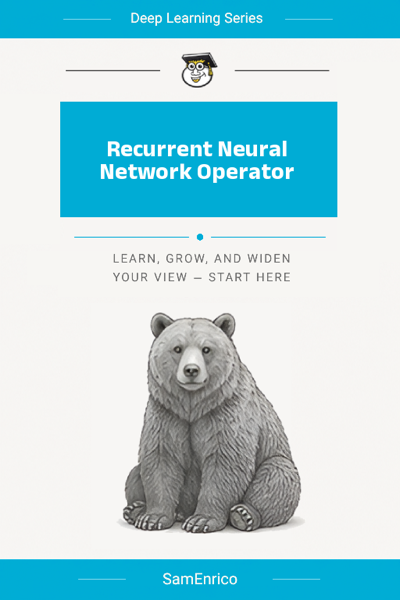
Recurrent Neural Network Operator
A Coursebook on Recurrent Neural Network Operator
A Coursebook on Recurrent Neural Network Operator
Formats
About this book
Free sample
Chapter 1: The Operator’s Gambit...--–- The first lie you were told about neural networks is that they are static. A standard feedforward network looks at a single input—a picture, a row of data, a moment frozen in time—and produces an output. It has no memory of what came before, no expectation of what comes next. It exists in a perpetual present, blind to the arrow of time. This book begins from a different premise: that intelligence—whether biological or artificial—is fundamentally about sequences.
We do not think in isolated snapshots. We think in sentences, in stories, in cause and effect stretched across seconds, minutes, or years. To build machines that truly understand, we must teach them to operate on time itself.The mathematician’s name for this kind of time-aware transformation is an operator. An operator takes one thing and turns it into another according to a fixed rule. The Fourier operator turns a signal into its frequencies.
The derivative operator turns a function into its slope. And the recurrent neural network operator—the subject of this book—turns a sequence of inputs into a sequence of hidden states that summarize everything the network has seen so far. This chapter introduces that operator not as a mere algorithm, but as a way of thinking about sequential data, about memory, and about the fundamental trade-off between expressiveness and computational cost that defines modern deep learning.1.1 The Myth of the Independent Observation Most machine learning courses begin with a dangerous simplification: the assumption that your data points are independent and identically distributed (i.i.d.). This assumption is mathematically convenient—it makes maximum likelihood estimation tractable and generalization bounds provable—but it is almost always false in the real world. The price of a stock today depends on yesterday’s price.
The next word in a sentence depends on all the previous words. Your location at 3:00 PM depends on where you were at 2:59 PM.When you violate the i.i.d. assumption, standard neural networks fail in predictable ways. Consider a feedforward network trained to predict the next…
This is the end of the free sample. Get the eBook to keep going. Buy now
Contents
- Chapter 1
- Chapter 2
- Chapter 3
- Chapter 4
- Chapter 5
- Chapter 6
- Chapter 7
- Chapter 8
- Chapter 9
- Chapter 10
- Chapter 11
- Chapter 12
Details
- Author
- Getz Winnifred
- Publisher
- SamEnrico
- Language
- English
- Genre
- Non-Fiction, Informative, Educational
- Released
- 2026-05-09
- Pages (approx.)
- 157
- Available as
- eBook, Audiobook

Read better in the ZLOADR app
Your eBooks on your phone or tablet. Sign in with your SamEnrico account and start reading.
More by Getz Winnifred
 Social Confidence RecoveryGetz Winnifred$11.99
 High Demand Career Survival GuideGetz Winnifred$11.99
 Academic Burnout RecoveryGetz Winnifred$11.99
 The Great Escape of the White-Collar Fugitive: Australia's Insider Trading ScandalGetz Winnifred$11.99
 Customer Feedback Agile IntegrationGetz Winnifred$12.99
 How to Produce Baby Carrier AccessoriesGetz Winnifred$11.99
 How to Start a Beet Sugar Business (Beginners Guide)Getz Winnifred$11.99