
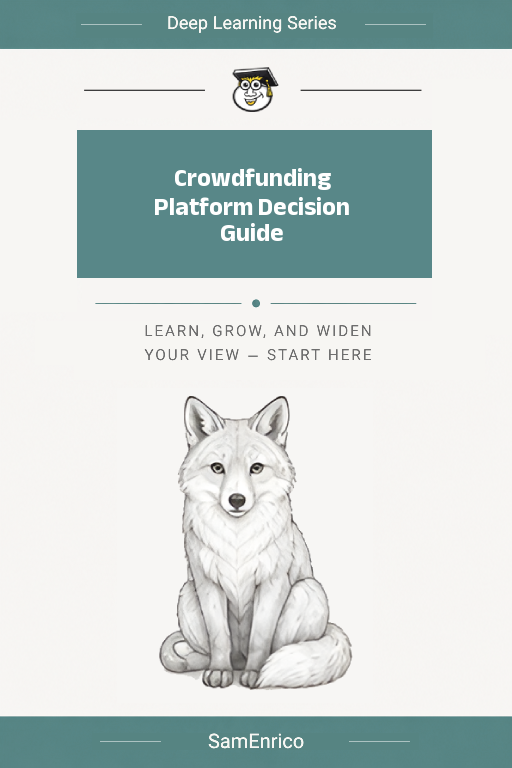
Non-FictionFirst 30 DaysCapital RaisingAction Guide
Crowdfunding Platform Decision Guide
Compare all-or-nothing vs keep-what-you-raise mode
Compare all-or-nothing vs keep-what-you-raise models for product, cause, or African campaigns. Includes fee breakdowns, funding timelines, and best-use worksheets.
Formats
About this book
Free sample
Chapter 1: The Scarcity Trap--The moment you set a funding goal, you have already made your most important decision. Most creators never realize this. They spend weeks perfecting their video, designing reward tiers, and building an email list, only to fail because they chose the wrong engine before they wrote a single word of their pitch. The All-or-Nothing model looks simple on the surface: raise the full amount or walk away with nothing. But beneath that binary outcome lies a sophisticated psychological mechanism that has been studied, optimized, and exploited by the most successful campaigns in crowdfunding history.
Understanding this mechanism is the difference between joining the 36 percent of campaigns that succeed and the 64 percent that fail.The Psychology of Scarcity and the Fear of Loss Behavioral economists have known for decades that humans are not rational actors. We do not evaluate choices based on objective value alone. Instead, we are driven by a powerful asymmetry: the pain of losing something is approximately twice as intense as the pleasure of gaining the same thing. This is called loss aversion, and it is the psychological engine that powers the All-or-Nothing model.When you pledge $100 to an AON campaign, you are not simply buying a product that will ship in six months. You are entering into a psychological contract with the creator and with every other backer.
If the campaign fails, you lose nothing financially because your credit card is never charged. But you do lose something else: the possibility of the project existing at all. That loss feels real, and the fear of it drives action.Consider two identical campaigns offering the same reward at the same price. Campaign A uses AON. Campaign B uses Flexible funding, meaning it keeps whatever it raises regardless of the total.
Which one attracts more pledges per visitor? Data from multiple platform studies shows that AON campaigns convert at rates 22 to 35 percent higher than Flexible campaigns when all other variables are controlled. The reason is not rational calculation. It is fear. Backers look at an AON campaign with 45,000raisedtowarda45,000 raised toward a 45,000raisedtowarda50,000 goal…
This is the end of the free sample. Get the eBook to keep going. Buy now
Contents
- Chapter 1
- Chapter 2
- Chapter 3
- Chapter 4
- Chapter 5
- Chapter 6
- Chapter 7
- Chapter 8
- Chapter 9
- Chapter 10
- Chapter 11
- Chapter 12
Details
- Author
- Rauch Anjanette
- Publisher
- SamEnrico
- Language
- English
- Genre
- Non-Fiction, First 30 Days, Capital Raising, Action Guide
- Released
- 2026-05-30
- Pages (approx.)
- 141
- Available as
- eBook, Audiobook

Read better in the ZLOADR app
Your eBooks on your phone or tablet. Sign in with your SamEnrico account and start reading.
More by Rauch Anjanette
 Self Esteem Apology Giver GuideRauch Anjanette$11.99
 Last Mile Driver Retention Strategies GuideRauch Anjanette$11.99
 Perinatal Depression Low Income GuideRauch Anjanette$11.99
 Energy Management for Shift WorkRauch Anjanette$11.99
 The Frozen Depths: Exploring the Underwater Caves of the New WorldRauch Anjanette$11.99
 Glass Shadows: The Silent Cartel of the 1980sRauch Anjanette$11.99
 Understanding Herpetic EmbryopathyRauch Anjanette$17.99
 Data Room CleanerRauch Anjanette$11.99
 How to Start a Press-studs Business (Beginners Guide)Rauch Anjanette$11.99
You may also like
 Hong Kong Handover 1997Dunn Johnnie$11.99
 Zumba For Postnatal Recovery CourseNeal Christian$11.99
 Zumba for BeginnersLadner Nikia$11.99
 YouTube Comment Mining GuideHumes Pandora$12.99
 Worry Box MeditationCarlin Rudy$11.99
 Workplace Stress MeditationNguyen Lynn$11.99
 Workplace Stress and Sleep RepairHawley Ivory$11.99
 Workplace Perfectionism CureDelaney Jeffry$11.99
 Workplace Injustice Anger GuideWallen Isabelle$11.99
 Work Addiction and Burnout LinkGreenwood Ester$11.99
 Women in Yoga and WellnessBeattie Galina$11.99
 Women in Stand Up ComedyChun Evangeline$11.99