

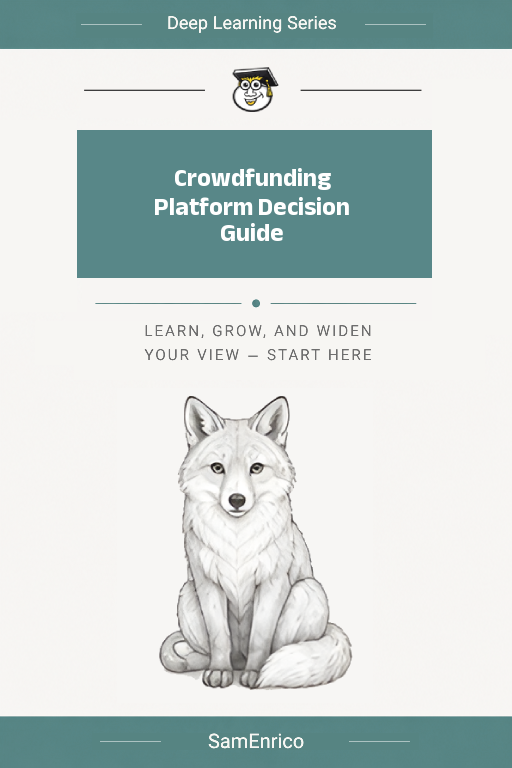
Non-FictionFirst 30 DaysCapital RaisingAction Guide
Crowdfunding Platform Decision Guide eBook
Compare all-or-nothing vs keep-what-you-raise mode
Compare all-or-nothing vs keep-what-you-raise models for product, cause, or African campaigns. Includes fee breakdowns, funding timelines, and best-use worksheets.
Formats
Free sample
Chapter 1: The Scarcity Trap--The moment you set a funding goal, you have already made your most important decision. Most creators never realize this. They spend weeks perfecting their video, designing reward tiers, and building an email list, only to fail because they chose the wrong engine before they wrote a single word of their pitch. The All-or-Nothing model looks simple on the surface: raise the full amount or walk away with nothing. But beneath that binary outcome lies a sophisticated psychological mechanism that has been studied, optimized, and exploited by the most successful campaigns in crowdfunding history.
Understanding this mechanism is the difference between joining the 36 percent of campaigns that succeed and the 64 percent that fail.The Psychology of Scarcity and the Fear of Loss Behavioral economists have known for decades that humans are not rational actors. We do not evaluate choices based on objective value alone. Instead, we are driven by a powerful asymmetry: the pain of losing something is approximately twice as intense as the pleasure of gaining the same thing. This is called loss aversion, and it is the psychological engine that powers the All-or-Nothing model.When you pledge $100 to an AON campaign, you are not simply buying a product that will ship in six months. You are entering into a psychological contract with the creator and with every other backer.
If the campaign fails, you lose nothing financially because your credit card is never charged. But you do lose something else: the possibility of the project existing at all. That loss feels real, and the fear of it drives action.Consider two identical campaigns offering the same reward at the same price. Campaign A uses AON. Campaign B uses Flexible funding, meaning it keeps whatever it raises regardless of the total.
Which one attracts more pledges per visitor? Data from multiple platform studies shows that AON campaigns convert at rates 22 to 35 percent higher than Flexible campaigns when all other variables are controlled. The reason is not rational calculation. It is fear. Backers look at an AON campaign with 45,000raisedtowarda45,000 raised toward a 45,000raisedtowarda50,000 goal and think, "This will disappear if I don't act." That thought triggers a cascade of urgency that no amount of persuasive copy can replicate.The Deadline Effect and the False Urgency of Time The second psychological lever of the AON model is the deadline.
Every campaign has a countdown clock, usually set between 30 and 60 days. That clock is not merely a logistical tool. It is a manufactured scarcity device that exploits what psychologists call the "goal gradient effect": humans work harder and feel more urgency as they approach a deadline.But not all deadlines are created equal. Data from Kickstarter's internal analytics, published in their 2023 Transparency Report and analyzed by researchers at the University of Pennsylvania, reveals a striking pattern. Campaigns of 30 days see a 22 percent higher conversion rate than campaigns of 60 days.
Campaigns of 45 days see a 15 percent drop in daily pledge velocity compared to 30-day campaigns. Campaigns longer than 45 days suffer from what the industry calls "backer fatigue" – potential supporters see a distant deadline and defer their pledge, then forget entirely.The shape of a successful AON campaign follows a predictable J-curve. The first 48 hours produce approximately 30 percent of total pledges, driven by the creator's inner circle and early momentum. Then follows a "trough of sorrow" – days 3 through 20, where pledges slow dramatically. The final 48 hours produce another 30 to 40 percent of total pledges, driven by the fear of missing out as the deadline approaches.
The middle days are not dead; they are where the work happens. Creators who treat those days as a time to rest fail. Creators who use them to send updates, pitch journalists, and activate their network succeed.The Binary Outcome as a Trust Signal Perhaps the most counterintuitive aspect of the AON model is that its all-or-nothing nature actually increases trust. This seems backward. Why would backers trust a model that might leave a creator with nothing?
The answer lies in signaling theory.When a creator chooses AON, they send a powerful signal to the market: "I am confident enough in this project that I am willing to risk receiving nothing if I fall short. I am not here to collect partial funding and disappear. I am here to deliver a finished product, and I will only take your money if I can guarantee that outcome." This signal is credible because it is costly. Choosing AON imposes a real risk on the creator. That risk is not shared equally – the creator risks wasted time and marketing spend, while backers risk nothing financially if the campaign fails.
But the very existence of that creator-side risk signals commitment.Flexible funding sends the opposite signal. Backers see a Flexible campaign and think, "This creator will take my money even if they raise only 10 percent of their goal. Will they still deliver the reward? Probably not, but they will keep my money anyway." This perception is not always accurate, but it is pervasive. Crowdfunding backers have been burned before.
They have pledged to campaigns that raised partial funds, delivered partial rewards, and then disappeared. The Flexible model, for all its advantages in certain contexts, suffers from a trust deficit that no amount of beautiful design can overcome.The Data Does Not Lie: Success Rates and Average Raises Let us examine the hard numbers. According to Kickstarter's 2023 Transparency Report, which is the most reliable public dataset in crowdfunding, 39.8 percent of projects that reached their goal succeeded. That is the Goal Success rate. The remaining 60.2 percent failed to reach their goal and received nothing.
Indiegogo does not publish consolidated success rates, but third-party analyses by Crowdfunding PR and The Crowdfunding Center put Indiegogo's AON success rate between 33 and 37 percent. Taking an average across the five major AON platforms, the industry-wide Goal Success rate is approximately 36.4 percent.At first glance, 36 percent sounds terrible. More than six out of ten campaigns fail. But this number requires context. The average successful AON campaign raises between 25,000and25,000 and 25,000and100,000, depending on the category.
The average successful Flexible campaign, by contrast, raises between 5,000and5,000 and 5,000and15,000. AON campaigns attract larger pledges because backers perceive higher value in projects that have passed the market validation test of reaching their goal.More importantly, the 36 percent success rate is not random. It clusters by category and by creator preparation. Hardware and technology campaigns have success rates between 32 and 38 percent. Film and video campaigns have success rates between 40 and 45 percent.
Publishing and comics have success rates exceeding 50 percent. The difference is not luck. It is audience readiness. Film makers often spend years building fan bases before launching. Hardware creators often launch with only a prototype and a dream.
The success rate reflects preparation more than it reflects the inherent quality of the idea.The Hidden Value of Failure: Market Validation at Zero Cost One of the most misunderstood aspects of the AON model is that failure is not a total loss. In fact, for certain types of projects, an AON failure can be more valuable than a Flexible success. This claim sounds absurd until you understand the concept of market validation.Consider a hardware creator who sets a 50,000goaltocovermoldtoolingandminimumorderquantityfromafactory.Theyruna30−day AONcampaign,buildanemaillistof2,000potentialbackers,generate50,000 goal to cover mold…
This is the end of the free sample. Get the eBook to keep going. Buy now
About this book
Details
- Author
- Rauch Anjanette
- Publisher
- SamEnrico
- Language
- English
- Genre
- Non-Fiction, First 30 Days, Capital Raising, Action Guide
- Released
- 2026-05-30
- Pages (approx.)
- 141
- Available as
- eBook, Audiobook

Read better in the ZLOADR app
Your eBooks on your phone or tablet. Sign in with your SamEnrico account and start reading.
More by Rauch Anjanette
 Self Esteem Apology Giver GuideRauch Anjanette$11.99
 Last Mile Driver Retention Strategies GuideRauch Anjanette$11.99
 Perinatal Depression Low Income GuideRauch Anjanette$11.99
 Energy Management for Shift WorkRauch Anjanette$11.99
 The Frozen Depths: Exploring the Underwater Caves of the New WorldRauch Anjanette$11.99
 Glass Shadows: The Silent Cartel of the 1980sRauch Anjanette$11.99
 Understanding Herpetic EmbryopathyRauch Anjanette$17.99
 Data Room CleanerRauch Anjanette$11.99
 How to Start a Press-studs Business (Beginners Guide)Rauch Anjanette$11.99
You may also like
 Hong Kong Handover 1997Dunn Johnnie$11.99
 Zumba For Postnatal Recovery CourseNeal Christian$11.99
 Zumba for BeginnersLadner Nikia$11.99
 YouTube Comment Mining GuideHumes Pandora$12.99
 Worry Box MeditationCarlin Rudy$11.99
 Workplace Stress MeditationNguyen Lynn$11.99
 Workplace Stress and Sleep RepairHawley Ivory$11.99
 Workplace Perfectionism CureDelaney Jeffry$11.99
 Workplace Injustice Anger GuideWallen Isabelle$11.99
 Work Addiction and Burnout LinkGreenwood Ester$11.99
 Women in Yoga and WellnessBeattie Galina$11.99
 Women in Stand Up ComedyChun Evangeline$11.99