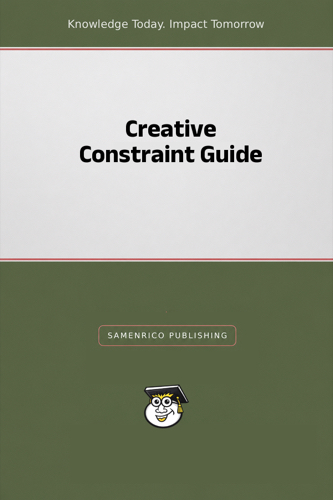
Creative Constraint Guide Audiobook
Use limitations as creative catalysts rather than
Use limitations as creative catalysts rather than obstacles.
Formats
Free sample
Chapter 1: The Empty Throne--–- In 1962, the artist Yves Klein stood before a bare white canvas in a Parisian gallery. The canvas was entirely empty—no brushstrokes, no color, no form. A crowd had gathered to witness the premiere of his latest work, The Void. Klein had spent weeks preparing the room: painting every surface white, removing all furniture, and installing nothing but a single empty cabinet. When the doors opened, the audience stood in confusion.
Some walked out. Others whispered that he had lost his mind. One critic called it “the most expensive nothing ever sold.”But Klein was not being lazy. He was not blocked. He was not suffering from a lack of ideas.
In fact, he had spent years mastering traditional painting, figurative drawing, and even judo. His early works were technically proficient, even brilliant. So why would a skilled artist choose to present nothing?The answer changed the way I think about creativity forever.Klein later explained that The Void was not about emptiness. It was about the condition that makes anything possible. He had imposed upon himself the most radical constraint imaginable: absolute minimalism.
By removing every possible element—color, form, texture, subject—he forced his audience (and himself) to confront the raw architecture of perception itself. The emptiness was not a lack. It was a fence. And inside that fence, something paradoxical happened: the audience began to see more, not less. They noticed the quality of the light.
The texture of the white paint. The weight of their own breathing. The constraint of “nothing” had amplified everything.This is the central paradox of creative constraint, and it is the subject of this book.The Lie We All Believe Most of us grow up believing that creativity requires freedom. More space. More time.
More money. More options. We look at the blank page, the empty studio, the unfilled calendar, and we think: If only I had more resources, I could finally create something great.This belief is not just wrong. It is actively destructive.For the past fifteen years, I have studied how creative people actually work—not how they say they work in interviews, but the hidden structures, rituals, and limitations they impose upon themselves. I have analyzed the habits of Nobel Prize winners, Mac Arthur “Genius Grant” recipients, Oscar-winning screenwriters, and Fortune 500 innovation teams.
And I have found a consistent, counterintuitive pattern running through almost every success story.The pattern is this: The most creative…
This is the end of the free sample. Get the Audiobook to keep going. Buy now
About this book
Details
- Author
- Mccall Saundra
- Publisher
- SamEnrico
- Language
- English
- Genre
- Non-Fiction, Self-Help, Constraints
- Released
- 2026-06-09
- Pages (approx.)
- 136
- Available as
- eBook, Audiobook

Listen in the VoxFlicks app
Audiobooks and audio dramas wherever you go. Sign in with your SamEnrico account and press play.
More by Mccall Saundra
 Immigrant Education Tutoring Business GuideMccall Saundra$11.99
 Teaching Active Listening GuideMccall Saundra$11.99
 The Broken GuitarMccall Saundra$11.99
 Sensitive Information PenaltiesMccall Saundra$11.99
 Huston Dynasty - Anjelica HustonMccall Saundra$11.99
 Soccer Injury Prevention GuideMccall Saundra$11.99
 Peer Mentorship CirclesMccall Saundra$11.99
 Assertiveness For Family ConversationsMccall Saundra$11.99
 Ticking Toward Tomorrow: The Timekeepers Who Built the Modern WorldMccall Saundra$11.99
 Midnight in the Mediterranean: The Vanishing of the Emerald EmpressMccall Saundra$11.99
 Blood Moon Conspiracy: The Jaguar Priest’s GambitMccall Saundra$11.99
 Short-Form UGC Monetization ModelsMccall Saundra$11.99