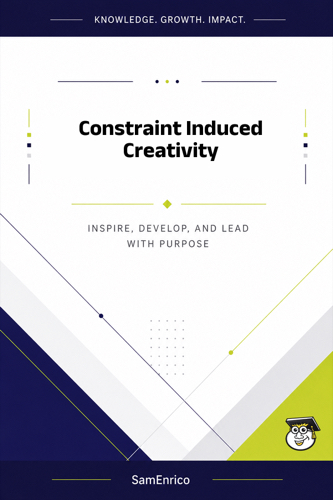
Constraint Induced Creativity eBook
Add artificial limits to force unconventional thin
Add artificial limits to force unconventional thinking.
Formats
Free sample
Chapter 1: The Blank Page Lie--–- The sheet of paper stares back at you. Pure white. Infinite potential. Everything is possible. And you feel nothing.
Worse than nothing—you feel dread. Your chest tightens. Your mind, which moments ago was buzzing with half-formed ideas, now offers nothing but static. You open a new document. You stare at the blinking cursor.
You close the document. You open it again. You check your email. You check your phone. You reorganize your desk.
Anything except face that blank page.This experience is so universal that we have given it a name: writer's block, creative paralysis, the empty canvas syndrome. And for centuries, we have been told the same cure. Just start. Trust the process. Let the ideas flow.
Don't force it. But here is the truth that no creativity seminar wants to admit: those instructions are useless. Telling someone to "just start" when faced with infinite possibility is like telling someone lost in a desert to "just find water." The instruction is correct in theory and completely unhelpful in practice.This chapter will argue something that sounds like heresy in a culture that worships freedom, possibility, and unlimited potential. The blank page is not your friend. It is your enemy.
Not because you lack talent, or discipline, or the right mindset. But because the human brain was not designed to operate in a vacuum of infinite choice. We have been sold a lie: that creativity requires freedom, that constraints are obstacles, and that the most innovative thinking happens when we "think outside the box." The evidence says otherwise. The most creative breakthroughs in history—from literature to jazz to software design—emerged not from unlimited freedom, but from carefully chosen, often severe, limitations.This book is called Constraint Induced Creativity because that phrase captures a counterintuitive truth: limits unlock original thought. Not just any limits, but the right limits, applied deliberately, with an understanding of how the brain responds to boundaries.
This chapter is the foundation. It will dismantle the myth of unlimited potential, introduce you to the cognitive science of choice overload, and give you your first diagnostic tool: the Constraint Profile. By the time you finish, you will understand why the blank page terrifies you—and why that terror is not a failure, but a signal that you are missing the one thing creativity requires above all else: a box.The Myth of Unlimited Potential We live in an age that worships possibility. Open floor plans. Unlimited vacation days.
"The sky's the limit." "You can be anything you want to be." "Think outside the box." These phrases are so embedded in our cultural vocabulary that we have stopped questioning them. But consider what they actually mean. If everything is possible, then nothing is privileged. If you can do anything, then every choice is equally valid and equally paralyzing. The ideology of unlimited potential sounds liberating, but in practice, it produces the opposite effect.Let me show you what I mean.
Imagine you walk into an ice cream shop that offers three flavors: chocolate, vanilla, and strawberry. You choose quickly. You enjoy your cone. Now imagine you walk into a shop that offers one hundred flavors. You stand at the counter, reading labels, paralyzed by indecision.
Should you try the honey lavender or the salted caramel? What if you pick something and regret it? What if there is a better flavor you haven't seen yet? This is not a metaphor. This is a controlled finding from cognitive psychology.The psychologist Sheena Iyengar conducted a famous study at a gourmet grocery store.
She set up a tasting booth for high-quality jams. Some days, she offered 24 flavors. Other days, she offered 6 flavors. The results were striking. When 24 flavors were available, more people stopped to look—60% of shoppers paused at the booth.
But only 3% of them actually bought a jar. When only 6 flavors were available, fewer people stopped—only 40%. But 30% of those shoppers made a purchase. More choice led to more browsing and less buying. More choice led to paralysis.This is choice overload.
The human brain has a limited bandwidth for evaluation. When faced with too many options, we cannot compare them all. We default to one of two behaviors: we choose nothing (procrastination), or we choose the most familiar option (cliché). In Iyengar's study, the shoppers who faced 24 flavors often walked away empty-handed. That is procrastination.
In creative work, the equivalent is staring at a blank page and doing nothing. In both cases, the problem is not a lack of options. The problem is an excess of options without a framework for choosing.Now apply this to creative work. A blank page is the ultimate choice overload. Every word is possible.
Every structure is possible. Every idea is possible. Your brain, faced with infinity, does what Iyengar's shoppers did: it walks away. It checks email. It cleans the desk.
It scrolls social media. Not because you are lazy, but because your brain is trying to protect itself from an impossible decision. The blank page is not an invitation to create. It is a threat. And your brain responds to threats by avoiding them.The Freedom Paradox This brings us to what I call the Freedom Paradox: absolute freedom does not produce originality; it produces conformity.
This sounds backwards, so let me explain.When faced with unlimited choice, the brain cannot process all possibilities. But it still has to produce something. So it reaches for the easiest, most available, most familiar option. It takes the neural highway. The result is not innovative.
The result is predictable. In writing classes, this is called the "cliché draft." The first thing everyone writes about love is a rose. The first thing everyone writes about sadness is rain. These are not chosen because they are good. They are chosen because they are available.
They require no effort. They are the chocolate and vanilla of creative work.I have seen this pattern in every field. A design team with "complete creative freedom" produces a logo that looks like every other logo in their industry. A marketing team with "unlimited budget" runs the same campaigns as their competitors, just louder. A startup with "no constraints" builds a product with so many features that no one knows what it does.
Freedom leads to clichés. Boundaries lead to breakthroughs.The writer David Epstein, in his 2026 book Inside the Box, documents this paradox across multiple industries. He tells the story of a hospital that tried to reduce medication errors. The first team was told "be creative, find any solution." They spent months researching, generated hundreds of ideas, and implemented nothing. The second team was given a single constraint: "All solutions must cost less than $100." That team implemented a new protocol within three weeks, reducing errors by 40%.
The constraint—a cheap, simple, tight budget—forced them to focus. It eliminated the option of expensive technology and forced them to look at process changes. The blank page gave them nothing. The box gave them everything.I want you to pause here and notice your reaction. If you feel resistance to this idea—if you think "but constraints feel limiting, they feel oppressive"—that resistance is not evidence that I…
This is the end of the free sample. Get the eBook to keep going. Buy now
About this book
Details
- Author
- Shively Sarina
- Publisher
- SamEnrico
- Language
- English
- Genre
- Non-Fiction, Self-Help, Constraints
- Released
- 2026-06-12
- Pages (approx.)
- 135
- Available as
- eBook, Audiobook

Read better in the ZLOADR app
Your eBooks on your phone or tablet. Sign in with your SamEnrico account and start reading.
More by Shively Sarina
 Senior Remarriage EsteemShively Sarina$11.99
 Police Officer High Stress HandbookShively Sarina$11.99
 Russian Chemical Weapons DiversionShively Sarina$11.99
 Airline Pilot Anger GuideShively Sarina$11.99
 TM Consistency HabitsShively Sarina$11.99
 Interventional Master GuideShively Sarina$11.99
 Action Plan for Career AdvancementShively Sarina$11.99
 Whispers of the Marid: The Djinn King’s BargainShively Sarina$11.99
 The Hatton Garden Heist: The UK's Greatest Diamond CaperShively Sarina$11.99
 How to Produce Ear CleanerShively Sarina$11.99
 How to Start a Plaster (wholesale) Business (Beginners Guide)Shively Sarina$11.99
 How to Produce Prenatal Heart Rate MonitorsShively Sarina$11.99