
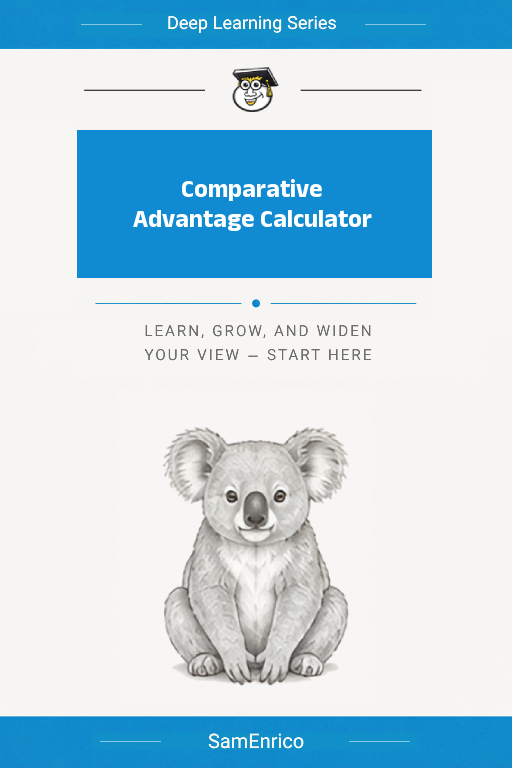
Comparative Advantage Calculator
Compute opportunity costs and determine trade patt
Compute opportunity costs and determine trade patterns using Excel. Solve Ricardian model exam questions with comparative advantage tables efficiently.
Formats
About this book
Free sample
Chapter 1: The Calculator Mindset--You have probably memorized the definition of comparative advantage. You might even be able to recite David Ricardo’s famous example about England and Portugal, wine and cloth. But when the exam proctor says “begin,” and you see a table of numbers asking for opportunity costs and trade patterns, something happens. Your mind goes blank. Your hand hovers over the calculator.
You start dividing numbers without knowing which number goes on top. Ten minutes later, you have a page full of fractions, half-erased ratios, and a sinking feeling that you got it backwards.This book exists because that feeling is avoidable. Not “manageable” or “reducible.” Avoidable. As in, you never have to experience it again.The problem is not your intelligence. It is not your work ethic.
It is not even your understanding of economics. The problem is that you have been treating comparative advantage as a theory to understand rather than a calculation to perform. Ricardo gave us a beautiful insight about trade, but he did not give us a workflow for exam day. Your textbook gives you paragraphs of explanation but no step-by-step system for turning raw data into correct answers under time pressure.This chapter introduces the single most important shift you will make in mastering comparative advantage problems: moving from a “theory mindset” to a “calculator mindset.”The Theory Mindset versus The Calculator Mindset The theory mindset sounds like this: “I need to understand why trade happens. I need to grasp the intuition behind opportunity costs.
I need to feel confident that I know what comparative advantage means before I try to calculate it.” This is how most students approach the Ricardian model. They read the chapter. They highlight the definitions. They nod along with the examples. And then they sit down to solve a problem and realize that understanding the concept and performing the calculation are two completely different skills.The calculator mindset sounds like this: “Every comparative advantage problem has the same structure.
Input productivity numbers. Compute opportunity costs using a fixed formula. Identify the lowest cost using MIN or RANK. Output trade…
This is the end of the free sample. Get the eBook to keep going. Buy now
Contents
- Chapter 1
- Chapter 2
- Chapter 3
- Chapter 4
- Chapter 5
- Chapter 6
- Chapter 7
- Chapter 8
- Chapter 9
- Chapter 10
- Chapter 11
- Chapter 12
Details
- Author
- Franco Georgine
- Publisher
- SamEnrico
- Language
- English
- Genre
- Non-Fiction, Student's Shortcut, International Trade
- Released
- 2026-06-01
- Pages (approx.)
- 138
- Available as
- eBook, Audiobook

Read better in the ZLOADR app
Your eBooks on your phone or tablet. Sign in with your SamEnrico account and start reading.
More by Franco Georgine
 Mindfulness for SeniorsFranco Georgine$11.99
 Elizabeth I Charter Company GuideFranco Georgine$11.99
 Financial Stress and Shopping AddictionFranco Georgine$11.99
 The Contrast EffectFranco Georgine$11.99
 The Druids of Gaul: Keepers of Celtic Wisdom and French LegacyFranco Georgine$11.99
 Digital Delivery ManagerFranco Georgine$11.99
 How to Start a Picture Postcard Business (Beginners Guide)Franco Georgine$11.99
 How to Produce an Audio Tape RecorderFranco Georgine$11.99