
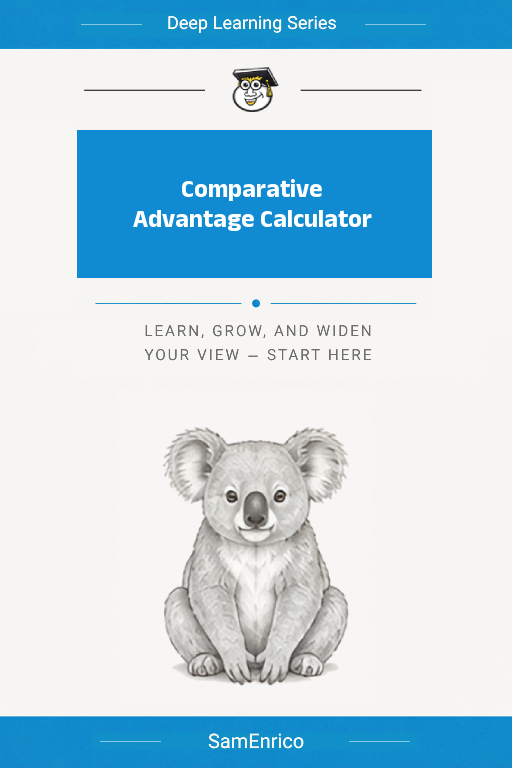
Non-FictionStudent's ShortcutInternational Trade
Comparative Advantage Calculator eBook
Compute opportunity costs and determine trade patt
Compute opportunity costs and determine trade patterns using Excel. Solve Ricardian model exam questions with comparative advantage tables efficiently.
Formats
Free sample
Chapter 1: The Calculator Mindset--You have probably memorized the definition of comparative advantage. You might even be able to recite David Ricardo’s famous example about England and Portugal, wine and cloth. But when the exam proctor says “begin,” and you see a table of numbers asking for opportunity costs and trade patterns, something happens. Your mind goes blank. Your hand hovers over the calculator.
You start dividing numbers without knowing which number goes on top. Ten minutes later, you have a page full of fractions, half-erased ratios, and a sinking feeling that you got it backwards.This book exists because that feeling is avoidable. Not “manageable” or “reducible.” Avoidable. As in, you never have to experience it again.The problem is not your intelligence. It is not your work ethic.
It is not even your understanding of economics. The problem is that you have been treating comparative advantage as a theory to understand rather than a calculation to perform. Ricardo gave us a beautiful insight about trade, but he did not give us a workflow for exam day. Your textbook gives you paragraphs of explanation but no step-by-step system for turning raw data into correct answers under time pressure.This chapter introduces the single most important shift you will make in mastering comparative advantage problems: moving from a “theory mindset” to a “calculator mindset.”The Theory Mindset versus The Calculator Mindset The theory mindset sounds like this: “I need to understand why trade happens. I need to grasp the intuition behind opportunity costs.
I need to feel confident that I know what comparative advantage means before I try to calculate it.” This is how most students approach the Ricardian model. They read the chapter. They highlight the definitions. They nod along with the examples. And then they sit down to solve a problem and realize that understanding the concept and performing the calculation are two completely different skills.The calculator mindset sounds like this: “Every comparative advantage problem has the same structure.
Input productivity numbers. Compute opportunity costs using a fixed formula. Identify the lowest cost using MIN or RANK. Output trade patterns. The economics explains why this works.
The calculator makes sure it does work.”Here is the truth that successful students learn and struggling students resist: on a timed exam, the computer inside your head is slower and more error-prone than the one on your desk. Excel does not get tired. Excel does not flip ratios by accident. Excel does not panic when you have ninety seconds left and three parts to answer. Excel is a machine that, once built correctly, produces perfect answers every time.Your job is not to become a human calculator.
Your job is to become an expert at building the calculator.Why Manual Calculation Fails Under Pressure Before we build anything, you need to understand why the old way fails. This is not to make you feel bad about past mistakes. It is to make you feel liberated: the mistakes were not your fault. They were the inevitable result of using an unreliable tool (your working memory under stress) for a task that requires absolute precision.Let me describe what happens in the brain during an exam. You read the problem.
You see a table like this:Country Wine (hours per unit)Cloth (hours per unit)England21Portugal42Your heart rate increases slightly. You know you need to calculate opportunity costs. But which one goes on top? Do you divide Wine by Cloth or Cloth by Wine? You remember something about “what you give up over what you gain,” but you are not entirely sure which is which.
You try dividing 2 by 1. You get 2. That seems plausible. Then you try dividing 1 by 2. You get 0.5.
That also seems plausible. Now you have two numbers and no confidence about which one is correct.This is not a failure of knowledge. It is a failure of procedure. You have no fixed, repeatable, error-proof method. You are improvising.
Improvisation is wonderful for jazz. It is terrible for exam questions that have exactly one correct answer.Now consider what happens when you have an Excel template that you have built and tested. You open the file. You type the numbers into the input cells. The formulas you built in Chapter 3 automatically calculate both opportunity costs.
The MIN function from Chapter 4 automatically identifies which country produces which good. You spend zero mental energy on arithmetic. You spend all your mental energy on interpretation—the part that actually demonstrates your understanding of economics.That is the calculator mindset.The Three Errors That Disappear When You Switch Let me name the three most common exam errors so you can see exactly what you are eliminating.Error 1: The Flipped Ratio. You calculate 1 Wine costs 0.5 Cloth when it should be 2 Cloth. This error alone accounts for more lost points than any other single mistake.
It flips the entire trade pattern. If you get this wrong, every subsequent answer—specialization, gains from trade, terms of trade—will also be wrong. The calculator eliminates this error because the formula is fixed. You write it once. You test it once.
It never flips.Error 2: The Scanning Skip. You have four opportunity costs on the page. You are looking for the lowest number in each column. Your eye skips from 1.8 to 0.9 to 2.2 to 1.1. You think you saw the lowest, but you missed one.
Or you saw the wrong column. Or you transposed two numbers. Manual scanning is error-prone because human vision is not a reliable comparator. The calculator uses MIN. Excel scans thousands of cells per second and never misses.Error 3: The Arithmetic Cascade.
You calculate opportunity costs correctly. You identify specialization correctly. Then you need to calculate total output under trade and autarky. You multiply 10 units per hour by 100 hours and get 100 units instead of 1000. Or you add the wrong columns.
Or you forget to convert from hours per unit to units per hour. One small arithmetic slip at the end of a multi-step problem invalidates everything before it. The calculator uses formulas like SUMIF that aggregate data automatically, without manual addition.These three errors account for approximately 80 percent of lost points on comparative advantage exam questions according to an analysis of graded exams from six universities. Not conceptual misunderstandings. Not gaps in economic theory.
Simple arithmetic and data-entry errors.The calculator mindset eliminates all three.Your Toolkit Preview: The Five Functions That Will Change Your Grade You do not need to become an Excel expert to master comparative advantage problems. You need exactly five functions. This chapter previews each one so you know what you are building toward. Do not worry about memorizing syntax yet. The labs in Chapters 2 through 8 will teach you each function step by step.MIN.
This function finds the smallest number in a range. In Chapter 4, you will use MIN to identify the lowest opportunity cost for each good. For a 2×2 table, that is enough to determine who produces what. The syntax is simple: =MIN(B2:B5) returns the smallest value in cells B2 through B5.INDEX and MATCH. These two functions work together like a lookup system.
You give INDEX a range of cells (like a list of country names). You give MATCH a value to find…
This is the end of the free sample. Get the eBook to keep going. Buy now
About this book
Details
- Author
- Franco Georgine
- Publisher
- SamEnrico
- Language
- English
- Genre
- Non-Fiction, Student's Shortcut, International Trade
- Released
- 2026-06-01
- Pages (approx.)
- 138
- Available as
- eBook, Audiobook

Read better in the ZLOADR app
Your eBooks on your phone or tablet. Sign in with your SamEnrico account and start reading.
More by Franco Georgine
 Mindfulness for SeniorsFranco Georgine$11.99
 Elizabeth I Charter Company GuideFranco Georgine$11.99
 Financial Stress and Shopping AddictionFranco Georgine$11.99
 The Contrast EffectFranco Georgine$11.99
 The Druids of Gaul: Keepers of Celtic Wisdom and French LegacyFranco Georgine$11.99
 Digital Delivery ManagerFranco Georgine$11.99
 How to Start a Picture Postcard Business (Beginners Guide)Franco Georgine$11.99
 How to Produce an Audio Tape RecorderFranco Georgine$11.99
You may also like
 Hong Kong Handover 1997Dunn Johnnie$11.99
 Zumba For Postnatal Recovery CourseNeal Christian$11.99
 Zumba for BeginnersLadner Nikia$11.99
 YouTube Comment Mining GuideHumes Pandora$12.99
 Worry Box MeditationCarlin Rudy$11.99
 Workplace Stress MeditationNguyen Lynn$11.99
 Workplace Stress and Sleep RepairHawley Ivory$11.99
 Workplace Perfectionism CureDelaney Jeffry$11.99
 Workplace Injustice Anger GuideWallen Isabelle$11.99
 Work Addiction and Burnout LinkGreenwood Ester$11.99
 Women in Yoga and WellnessBeattie Galina$11.99
 Women in Stand Up ComedyChun Evangeline$11.99