
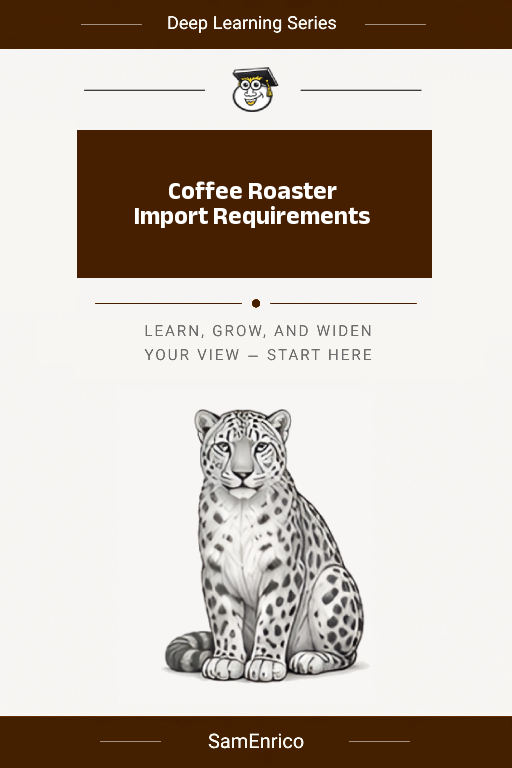
Non-FictionBusiness BriefFood SafetyExport Operations
Coffee Roaster Import Requirements Audiobook
Navigate EU food safety, traceability, and packagi
Navigate EU food safety, traceability, and packaging rules for green bean exports to Italian and German specialty coffee roasters.
Formats
Free sample
Chapter 1: The Container’s Last Stop--–- The first time a German customs inspector sliced open a jute bag from your latest container, you felt nothing. Not because you were calm, but because you were eight thousand kilometers away, staring at a spreadsheet that could not tell you whether the coffee inside matched the paperwork you had sent. The inspector found a plastic liner that the EU had not yet banned but was already suspicious of. The lot code on the bag did not match the commercial invoice. The organic certificate, painstakingly obtained from your control body, referred to a consignee that no longer had a valid tax ID in Italy.
That container sat in the Port of Hamburg for forty-seven days. The roaster canceled the order. You paid demurrage, storage, and eventually, disposal fees. And somewhere in that sequence of disasters, you realized that exporting specialty coffee to Europe was no longer about cupping scores and long-term relationships. It was about compliance architecture.This chapter does not begin with a map of coffee-growing regions or a romantic history of the espresso.
It begins with the container’s last stop: the EU border. Because everything that happens before that moment—the harvest, the milling, the sorting, the bagging, the ocean voyage—becomes irrelevant if the coffee fails to clear customs in Hamburg, Genoa, or any other European port of entry. The specialty coffee industry has spent two decades perfecting traceability as a marketing tool, telling stories of single farms and micro-lots. But the European Union does not care about stories. It cares about HS codes, maximum residue levels, lot codes, and whether your packaging contains PFAS.
This chapter establishes the foundational question that every exporter must answer before shipping a single bag: Is your coffee legally allowed to enter the EU, and if so, what documentation proves it?The chapter is structured as a practical diagnostic. We begin with the most basic gatekeeper—the Harmonized System code—because using the wrong tariff classification will stop your container faster than any contamination issue. Then we move to the Positive List, the obscure but deadly requirement that your origin country must be explicitly authorized to export Coffea species to the EU. Finally, we contrast the two most important ports for specialty coffee: Hamburg, representing Germany’s high-speed, IT-driven customs regime, and Genoa, representing Italy’s warehouse-intensive, document-focused approach. By the end of this chapter, you will know…
This is the end of the free sample. Get the Audiobook to keep going. Buy now
About this book
Details
- Author
- Olivarez Joaquin
- Publisher
- SamEnrico
- Language
- English
- Genre
- Non-Fiction, Business Brief, Food Safety, Export Operations
- Released
- 2026-06-01
- Pages (approx.)
- 141
- Available as
- eBook, Audiobook

Listen in the VoxFlicks app
Audiobooks and audio dramas wherever you go. Sign in with your SamEnrico account and press play.
More by Olivarez Joaquin
 Postpartum Depression Self Care GuideOlivarez Joaquin$11.99
 Mayor of a Film Festival TownOlivarez Joaquin$11.99
 Instagram Follower AnxietyOlivarez Joaquin$11.99
 Validating Dissociation GuideOlivarez Joaquin$11.99
 Coping With Tax Debt StressOlivarez Joaquin$11.99
 Methimazole GuideOlivarez Joaquin$11.99
 Time Boundary GuideOlivarez Joaquin$11.99
 Emotional Intelligence for CrisisOlivarez Joaquin$11.99
 Melatonin Timing For RecallOlivarez Joaquin$11.99
 Frozen Echoes: The Last Broadcast of the SS BaychimoOlivarez Joaquin$11.99
 The Vanishing of Flight 19: The Bermuda Triangle’s Last BroadcastOlivarez Joaquin$11.99
 Bread or Blood: The Great Flour Riot of 1867Olivarez Joaquin$11.99
You may also like
 Hong Kong Handover 1997Dunn Johnnie$11.99
 Zumba For Postnatal Recovery CourseNeal Christian$11.99
 Zumba for BeginnersLadner Nikia$11.99
 YouTube Comment Mining GuideHumes Pandora$12.99
 Worry Box MeditationCarlin Rudy$11.99
 Workplace Stress MeditationNguyen Lynn$11.99
 Workplace Stress and Sleep RepairHawley Ivory$11.99
 Workplace Perfectionism CureDelaney Jeffry$11.99
 Workplace Injustice Anger GuideWallen Isabelle$11.99
 Work Addiction and Burnout LinkGreenwood Ester$11.99
 Women in Yoga and WellnessBeattie Galina$11.99
 Women in Stand Up ComedyChun Evangeline$11.99