
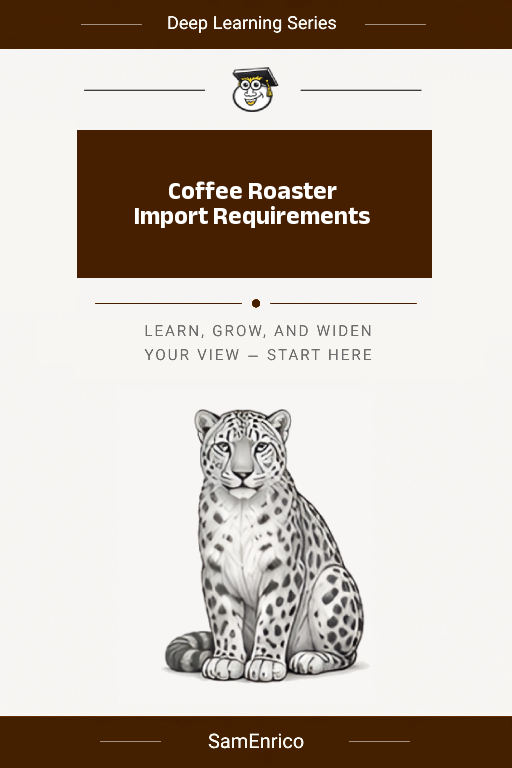
Coffee Roaster Import Requirements
Navigate EU food safety, traceability, and packagi
Navigate EU food safety, traceability, and packaging rules for green bean exports to Italian and German specialty coffee roasters.
Formats
About this book
Free sample
Chapter 1: The Container’s Last Stop--–- The first time a German customs inspector sliced open a jute bag from your latest container, you felt nothing. Not because you were calm, but because you were eight thousand kilometers away, staring at a spreadsheet that could not tell you whether the coffee inside matched the paperwork you had sent. The inspector found a plastic liner that the EU had not yet banned but was already suspicious of. The lot code on the bag did not match the commercial invoice. The organic certificate, painstakingly obtained from your control body, referred to a consignee that no longer had a valid tax ID in Italy.
That container sat in the Port of Hamburg for forty-seven days. The roaster canceled the order. You paid demurrage, storage, and eventually, disposal fees. And somewhere in that sequence of disasters, you realized that exporting specialty coffee to Europe was no longer about cupping scores and long-term relationships. It was about compliance architecture.This chapter does not begin with a map of coffee-growing regions or a romantic history of the espresso.
It begins with the container’s last stop: the EU border. Because everything that happens before that moment—the harvest, the milling, the sorting, the bagging, the ocean voyage—becomes irrelevant if the coffee fails to clear customs in Hamburg, Genoa, or any other European port of entry. The specialty coffee industry has spent two decades perfecting traceability as a marketing tool, telling stories of single farms and micro-lots. But the European Union does not care about stories. It cares about HS codes, maximum residue levels, lot codes, and whether your packaging contains PFAS.
This chapter establishes the foundational question that every exporter must answer before shipping a single bag: Is your coffee legally allowed to enter the EU, and if so, what documentation proves it?The chapter is structured as a practical diagnostic. We begin with the most basic gatekeeper—the Harmonized System code—because using the wrong tariff classification will stop your container faster than any contamination issue. Then we move to the Positive List, the obscure but deadly…
This is the end of the free sample. Get the eBook to keep going. Buy now
Contents
- Chapter 1
- Chapter 2
- Chapter 3
- Chapter 4
- Chapter 5
- Chapter 6
- Chapter 7
- Chapter 8
- Chapter 9
- Chapter 10
- Chapter 11
- Chapter 12
Details
- Author
- Olivarez Joaquin
- Publisher
- SamEnrico
- Language
- English
- Genre
- Non-Fiction, Business Brief, Food Safety, Export Operations
- Released
- 2026-06-01
- Pages (approx.)
- 141
- Available as
- eBook, Audiobook

Read better in the ZLOADR app
Your eBooks on your phone or tablet. Sign in with your SamEnrico account and start reading.
More by Olivarez Joaquin
 Postpartum Depression Self Care GuideOlivarez Joaquin$11.99
 Mayor of a Film Festival TownOlivarez Joaquin$11.99
 Instagram Follower AnxietyOlivarez Joaquin$11.99
 Validating Dissociation GuideOlivarez Joaquin$11.99
 Coping With Tax Debt StressOlivarez Joaquin$11.99
 Methimazole GuideOlivarez Joaquin$11.99
 Time Boundary GuideOlivarez Joaquin$11.99
 Emotional Intelligence for CrisisOlivarez Joaquin$11.99
 Melatonin Timing For RecallOlivarez Joaquin$11.99
 Frozen Echoes: The Last Broadcast of the SS BaychimoOlivarez Joaquin$11.99
 The Vanishing of Flight 19: The Bermuda Triangle’s Last BroadcastOlivarez Joaquin$11.99
 Bread or Blood: The Great Flour Riot of 1867Olivarez Joaquin$11.99