
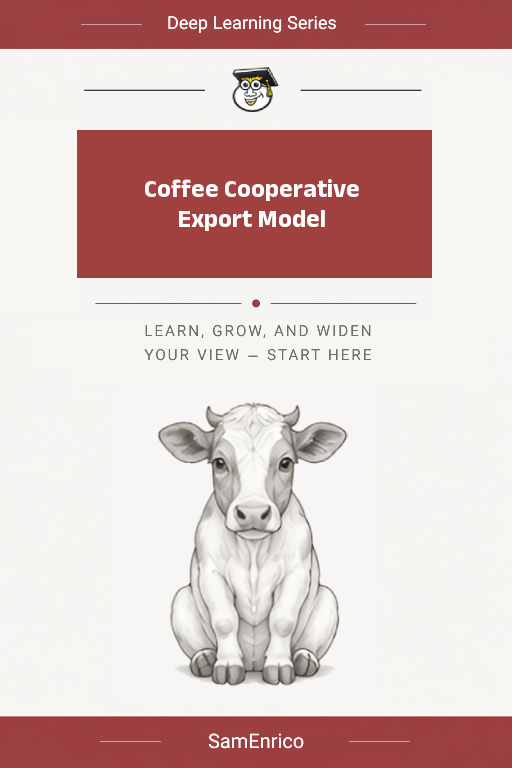
Coffee Cooperative Export Model
Pool smallholder coffee production into export coo
by Redmon Stan
Pool smallholder coffee production into export cooperative to capture higher international prices directly.
Formats
About this book
Free sample
Chapter 1: The Latte Divide--The farmer wakes before dawn, as she has every day for forty years. Her hands, cracked and stained deep brown from decades of coffee cherry pulp, wrap around a tin cup of tea. Outside her wooden home in the highlands of western Uganda, the mist clings to the slopes of the Rwenzori Mountains. She can smell the ripening cherries on her two hectares of land—a sweet, heavy scent that promises survival, though never abundance.By mid-morning, she and her daughters have picked 25 kilograms of the reddest cherries, selecting each one by hand, rejecting the green and the overripe. They carry the sacks on their heads down a mud path to the roadside.
There, a man in a faded Toyota pickup waits. He is the coyote—the middleman. He weighs her sacks on a rusted scale, squints at the needle, and does the math in his head."Fifty cents per pound," he says."But the price last week was sixty cents," she replies."Market dropped."She knows he is lying. She also knows that if she does not sell today, the cherries will over-ripen by tomorrow. Fermentation will begin.
Mold will bloom. She will have nothing. So she accepts. The coyote hands her a thin stack of worn bills. For six months of labor—pruning, weeding, fertilizing, picking, sorting—she has earned the equivalent of $12.50.That same week, a woman in a coffee shop on Lafayette Street in Manhattan orders a latte.
The barista steams organic whole milk, pulls a double shot of espresso from a brass machine, and pours a rosetta into the foam. The transaction takes ninety seconds. The customer taps her phone. Payment: $5.00.The farmer grew the beans that became that latte. She received 0.50perpound.Thelattecontainsapproximatelyone−twentiethofapoundofcoffee—abouttwotablespoonsofgroundbeans.Thecoffeeinthatlattecosttheroasterroughly0.50 per pound.
The latte contains approximately one-twentieth of a pound of coffee—about two tablespoons of ground beans. The coffee in that latte cost the roaster roughly 0.50perpound.Thelattecontainsapproximatelyone−twentiethofapoundofcoffee—abouttwotablespoonsofgroundbeans.Thecoffeeinthatlattecosttheroasterroughly0.03. The farmer received a fraction of that.Where did the other $4.97 go?This question is not an abstraction. It is the central injustice of the global coffee trade—a $200…
This is the end of the free sample. Get the eBook to keep going. Buy now
Contents
- Chapter 1
- Chapter 2
- Chapter 3
- Chapter 4
- Chapter 5
- Chapter 6
- Chapter 7
- Chapter 8
- Chapter 9
- Chapter 10
- Chapter 11
- Chapter 12
Details
- Author
- Redmon Stan
- Publisher
- SamEnrico
- Language
- English
- Genre
- Non-Fiction, Business Brief, Agricultural Coops
- Released
- 2026-06-01
- Pages (approx.)
- 142
- Available as
- eBook, Audiobook

Read better in the ZLOADR app
Your eBooks on your phone or tablet. Sign in with your SamEnrico account and start reading.
More by Redmon Stan
 Forgiveness for Business FailureRedmon Stan$11.99
 Inventory Turnover AnalysisRedmon Stan$11.99
 Loneliness Support GroupRedmon Stan$11.99
 Fortnite Gaming Detox PlanRedmon Stan$11.99
 Self Esteem for Non Profit WorkRedmon Stan$11.99
 Applewhite's Son Speaks OutRedmon Stan$11.99
 The Mechanic Who FixedRedmon Stan$11.99
 Growth Mindset for PilotsRedmon Stan$11.99
 The Iron Outback: How the Pioneers Tamed the Red DesertRedmon Stan$11.99
 The Healing Hands of Timbuktu: The Surgeons of the Mali EmpireRedmon Stan$11.99
 How to Produce JarsRedmon Stan$11.99
 Service Providers Guide to Computer TrainingRedmon Stan$11.99