
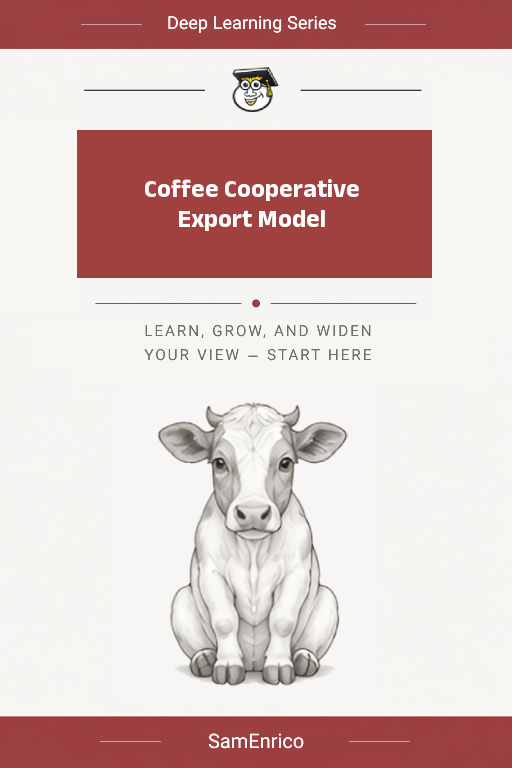
Non-FictionBusiness BriefAgricultural Coops
Coffee Cooperative Export Model eBook
Pool smallholder coffee production into export coo
by Redmon Stan
Pool smallholder coffee production into export cooperative to capture higher international prices directly.
Formats
Free sample
Chapter 1: The Latte Divide--The farmer wakes before dawn, as she has every day for forty years. Her hands, cracked and stained deep brown from decades of coffee cherry pulp, wrap around a tin cup of tea. Outside her wooden home in the highlands of western Uganda, the mist clings to the slopes of the Rwenzori Mountains. She can smell the ripening cherries on her two hectares of land—a sweet, heavy scent that promises survival, though never abundance.By mid-morning, she and her daughters have picked 25 kilograms of the reddest cherries, selecting each one by hand, rejecting the green and the overripe. They carry the sacks on their heads down a mud path to the roadside.
There, a man in a faded Toyota pickup waits. He is the coyote—the middleman. He weighs her sacks on a rusted scale, squints at the needle, and does the math in his head."Fifty cents per pound," he says."But the price last week was sixty cents," she replies."Market dropped."She knows he is lying. She also knows that if she does not sell today, the cherries will over-ripen by tomorrow. Fermentation will begin.
Mold will bloom. She will have nothing. So she accepts. The coyote hands her a thin stack of worn bills. For six months of labor—pruning, weeding, fertilizing, picking, sorting—she has earned the equivalent of $12.50.That same week, a woman in a coffee shop on Lafayette Street in Manhattan orders a latte.
The barista steams organic whole milk, pulls a double shot of espresso from a brass machine, and pours a rosetta into the foam. The transaction takes ninety seconds. The customer taps her phone. Payment: $5.00.The farmer grew the beans that became that latte. She received 0.50perpound.Thelattecontainsapproximatelyone−twentiethofapoundofcoffee—abouttwotablespoonsofgroundbeans.Thecoffeeinthatlattecosttheroasterroughly0.50 per pound.
The latte contains approximately one-twentieth of a pound of coffee—about two tablespoons of ground beans. The coffee in that latte cost the roaster roughly 0.50perpound.Thelattecontainsapproximatelyone−twentiethofapoundofcoffee—abouttwotablespoonsofgroundbeans.Thecoffeeinthatlattecosttheroasterroughly0.03. The farmer received a fraction of that.Where did the other $4.97 go?This question is not an abstraction. It is the central injustice of the global coffee trade—a $200 billion industry that keeps the people who grow its raw material in persistent poverty. And the answer, as this chapter will reveal, is not conspiracy or simple greed.
It is fragmentation. The coffee supply chain is broken into so many pieces, with so many hands taking slices along the way, that the farmer at the origin captures only 1 to 5 percent of the final retail price. The rest evaporates into logistics, branding, rent-seeking, and the hidden costs of isolation.This book is about how smallholder farmers can reverse that math. But before we can build the solution, we must understand the problem with unflinching clarity. This chapter dissects the traditional "sack economy"—the system of fragmented, opaque, and exploitative exchange that has governed coffee for more than a century.
It names the players, maps the value chain, and quantifies the waste. And it poses the thesis that will guide every page to follow: Isolation is not poverty. Isolation is economic inefficiency encoded into the supply chain. The only way to break the cycle is aggregation.The Journey of a Coffee Bean To understand why the farmer receives so little, follow the bean. It travels a path that is simultaneously simple (only a few handoffs) and complex (each handoff extracts value while erasing information).Step One: The Farm.
There are approximately 25 million coffee farmers worldwide. The vast majority—an estimated 80 percent—cultivate less than two hectares of land. They are not agribusinesses. They are families. They grow coffee intercropped with bananas, beans, and maize for subsistence.
They use hand tools, not tractors. They compost, if they can afford to, or use no fertilizer at all. Their trees produce perhaps 500 kilograms of cherry per hectare—half the yield of a well-managed commercial farm.The farmer bears every risk. If rains come too early or too late, the flowering is disrupted and the yield collapses. If a pest like coffee berry borer infests the trees, there are no pesticides because they cost too much.
If the global "C" market price crashes—as it did in 2001, 2013, and 2018—the farmer has no hedge, no contract, no safety net. She simply earns less. The risk of weather, disease, and price volatility is entirely hers.Step Two: The Coyote. The local middleman—known as the coyote in Mexico, the marroquinero in Guatemala, the licensed buyer in Kenya—is the farmer's only connection to the market. The coyote drives a truck from village to village during harvest season, buying cherries for cash.
He does not pay premium prices for quality because he cannot verify quality at the roadside. He cannot cup the coffee. He cannot measure moisture content. He sees only a sack of red fruit. So he pays the average price for average quality, or slightly below, because his margin depends on buying low and selling high to the next link in the chain.The coyote provides one genuine service: immediate cash.
The farmer needs money today for food, school fees, or medical care. She cannot wait six months for an export payment. The coyote's cash advance, however, comes at a devastating cost. Interest rates on these informal loans—because that is what a cash advance against future harvest effectively is—range from 20 to 50 percent per season. A farmer who sells to the same coyote year after year is not a business partner.
She is a debt peon.Step Three: The Local Exporter. The coyote sells his accumulated bags to a local exporter with a warehouse and a dry mill. This exporter removes the parchment layer from the bean, dries the green coffee to a stable moisture content of 10 to 12 percent, and grades it by screen size and defect count. The exporter also consolidates—mixing beans from hundreds of farmers, from dozens of villages, into lots large enough to fill a shipping container.This consolidation is both necessary and destructive. It is necessary because an individual farmer produces perhaps 500 kilograms of green bean per year, far below the 19,000 kilograms required to fill a container.
The exporter's warehouse creates the volume that global trade requires. But consolidation destroys traceability. Once beans from 500 farms are mixed in a single silo, there is no way to know which farmer grew the exceptional lot and which farmer grew the defective one. The good coffee subsidizes the bad. Quality is averaged into mediocrity.Step Four: The International Importer.
The local exporter sells to an importer in Europe, North America, or Asia. This importer finances the shipment (often providing a letter of credit that allows the exporter to be paid before the beans arrive), arranges ocean freight, and warehouses the beans in destination countries. The importer also performs quality control, cupping samples to verify that the coffee meets the buyer's specifications.The importer's margin is typically 10 to 15 percent. This is not exploitation—importers provide real services of financing, logistics, and quality assurance. But each margin adds to the final price while contributing nothing to the farmer's income.Step Five: The Roaster.
The roaster is the first player in the chain who significantly adds value. Green beans are transformed into aromatic, flavorful…
This is the end of the free sample. Get the eBook to keep going. Buy now
About this book
Details
- Author
- Redmon Stan
- Publisher
- SamEnrico
- Language
- English
- Genre
- Non-Fiction, Business Brief, Agricultural Coops
- Released
- 2026-06-01
- Pages (approx.)
- 142
- Available as
- eBook, Audiobook

Read better in the ZLOADR app
Your eBooks on your phone or tablet. Sign in with your SamEnrico account and start reading.
More by Redmon Stan
 Forgiveness for Business FailureRedmon Stan$11.99
 Inventory Turnover AnalysisRedmon Stan$11.99
 Loneliness Support GroupRedmon Stan$11.99
 Fortnite Gaming Detox PlanRedmon Stan$11.99
 Self Esteem for Non Profit WorkRedmon Stan$11.99
 Applewhite's Son Speaks OutRedmon Stan$11.99
 The Mechanic Who FixedRedmon Stan$11.99
 Growth Mindset for PilotsRedmon Stan$11.99
 The Iron Outback: How the Pioneers Tamed the Red DesertRedmon Stan$11.99
 The Healing Hands of Timbuktu: The Surgeons of the Mali EmpireRedmon Stan$11.99
 How to Produce JarsRedmon Stan$11.99
 Service Providers Guide to Computer TrainingRedmon Stan$11.99
You may also like
 Hong Kong Handover 1997Dunn Johnnie$11.99
 Zumba For Postnatal Recovery CourseNeal Christian$11.99
 Zumba for BeginnersLadner Nikia$11.99
 YouTube Comment Mining GuideHumes Pandora$12.99
 Worry Box MeditationCarlin Rudy$11.99
 Workplace Stress MeditationNguyen Lynn$11.99
 Workplace Stress and Sleep RepairHawley Ivory$11.99
 Workplace Perfectionism CureDelaney Jeffry$11.99
 Workplace Injustice Anger GuideWallen Isabelle$11.99
 Work Addiction and Burnout LinkGreenwood Ester$11.99
 Women in Yoga and WellnessBeattie Galina$11.99
 Women in Stand Up ComedyChun Evangeline$11.99