
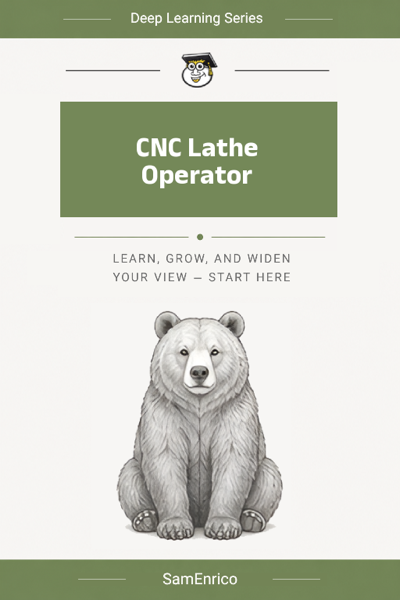
CNC Lathe Operator
A Coursebook on CNC Lathe Operator
by Roberge Cole
A Coursebook on CNC Lathe Operator
Formats
About this book
Free sample
Chapter 1: The Spinning Enigma--–- Before you ever write a single line of G-code or push the green cycle-start button, you must understand what you are commanding. A CNC lathe is not a manual lathe with a computer bolted on. It is a fundamentally different machine that demands a fundamentally different mindset. The manual lathe operator feels the cut through the handwheel, hears the change in pitch as the tool engages, and reacts in real time. The CNC lathe operator thinks in sequences, anticipates motions, and builds processes that repeat perfectly for the hundredth part as they did for the first.
This chapter strips away the mystery and establishes the bedrock knowledge you need before touching any control panel. We will explore how the modern turning center evolved from its manual ancestor, dissect the major machine configurations you will encounter on the shop floor, define your precise role among machinists and programmers, ingrain non-negotiable safety habits, and finally name every major component on a typical CNC lathe. By the end, you will see the machine not as a intimidating black box but as a collection of understandable systems working in harmony.The Evolutionary Leap from Manual to CNC Turning To appreciate the CNC lathe, you must first understand what it replaced. The manual engine lathe, perfected over two centuries, is a beautiful exercise in mechanical feedback. The operator turns handwheels connected to lead screws, engaging gears to move the carriage and cross-slide.
Cutting speed is controlled by changing belt positions or gearbox settings. Depth of cut is a matter of feel. The operator's eyes watch the chip color—straw yellow for steel, blue for too fast. The ears listen for chatter. The hands feel the resistance through the handwheel.
Skilled manual machinists are artists.The first numerical control (NC) lathes emerged in the 1950s and 1960s, using punched paper tape to store sequences of coordinates. These machines were rigid, slow to program, and met with deep skepticism from traditional machinists. But they solved a critical problem: repeatability. A manual lathe operator could make one perfect part, maybe ten, but by the…
This is the end of the free sample. Get the eBook to keep going. Buy now
Contents
- Chapter 1
- Chapter 2
- Chapter 3
- Chapter 4
- Chapter 5
- Chapter 6
- Chapter 7
- Chapter 8
- Chapter 9
- Chapter 10
- Chapter 11
- Chapter 12
Details
- Author
- Roberge Cole
- Publisher
- SamEnrico
- Language
- English
- Genre
- Non-Fiction, Informative, Educational
- Released
- 2026-05-06
- Pages (approx.)
- 114
- Available as
- eBook, Audiobook

Read better in the ZLOADR app
Your eBooks on your phone or tablet. Sign in with your SamEnrico account and start reading.
More by Roberge Cole
 Social Anxiety Research ReviewRoberge Cole$11.99
 Melchizedek Priesthood EscapeRoberge Cole$11.99
 Global Market Talent Flows HandbookRoberge Cole$11.99
 The Workaholism Sabbatical Planning GuideRoberge Cole$11.99
 Purpose Driven Longevity GuideRoberge Cole$11.99
 The Whispering Djinn of the Empty QuarterRoberge Cole$11.99
 Retail Real Estate Evolution GuideRoberge Cole$12.99
 One Page Marketing Funnel PrimerRoberge Cole$12.99
 Understanding Leiner DiseaseRoberge Cole$17.99
 How to Start a Buoys (not Plastic) Business (Beginners Guide)Roberge Cole$11.99