
Non-FictionSelf-HelpSabbaticals
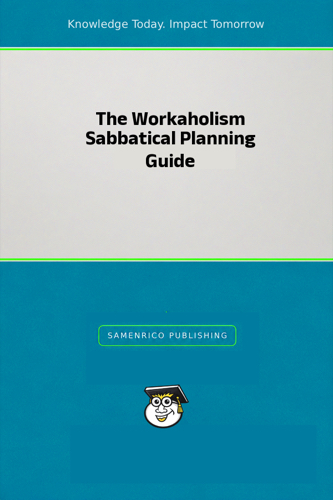
The Workaholism Sabbatical Planning Guide
Teaches how to take extended leave to reset addict
by Roberge Cole
Teaches how to take extended leave to reset addictive work patterns.
Formats
About this book
Free sample
Chapter 1: The Hijacked Brain--–- You are not lazy. You are not undisciplined. You are not secretly hoping your family will leave you alone so you can answer just one more email. The fact that you cannot sit still on a Sunday afternoon without feeling a low-grade hum of panic is not evidence of a strong work ethic. It is evidence of a brain that has been chemically rewired by an environment designed to exploit you.Let that land for a moment.
Every time your phone buzzes with a Slack message, every time an email lands in your inbox with a red notification badge, every time a deadline approaches and your heart rate spikes—you are pulling the lever on a slot machine. And like any slot machine, the house always wins.This chapter will reframe everything you think you know about your relationship with work. By the time you finish reading, you will understand why traditional vacations fail, why the first 48 hours of any break feel like withdrawal from a drug, and why you need a structured 30-day sabbatical—not a longer vacation, not a burnout leave, but a specific therapeutic intervention—to reset your brain. You will also complete a self-assessment that determines whether you meet the clinical threshold for workaholism and begin a one-week "Brain Hijack Log" to track your craving patterns before the sabbatical even begins.The Slot Machine in Your Pocket The neuroscience of behavioral addiction has advanced dramatically in the past decade, and one finding stands above all others: the human brain cannot distinguish between a chemical addiction (like cocaine or nicotine) and a behavioral addiction (like gambling, gaming, or working). Both hijack the same dopamine pathway.
Both create tolerance (you need more to feel the same effect). Both produce withdrawal when the stimulus is removed.Here is how the modern workplace has been accidentally (or not so accidentally) engineered to exploit this vulnerability.In the 1950s, psychologist B.F. Skinner discovered that animals responded most compulsively not to consistent rewards (press lever, get pellet every time) but to variable rewards (press lever, get pellet unpredictably). A…
This is the end of the free sample. Get the eBook to keep going. Buy now
Contents
- Chapter 1
- Chapter 2
- Chapter 3
- Chapter 4
- Chapter 5
- Chapter 6
- Chapter 7
- Chapter 8
- Chapter 9
- Chapter 10
- Chapter 11
- Chapter 12
Details
- Author
- Roberge Cole
- Publisher
- SamEnrico
- Language
- English
- Genre
- Non-Fiction, Self-Help, Sabbaticals
- Released
- 2026-06-10
- Pages (approx.)
- 121
- Available as
- eBook, Audiobook

Read better in the ZLOADR app
Your eBooks on your phone or tablet. Sign in with your SamEnrico account and start reading.
More by Roberge Cole
 Social Anxiety Research ReviewRoberge Cole$11.99
 Melchizedek Priesthood EscapeRoberge Cole$11.99
 Global Market Talent Flows HandbookRoberge Cole$11.99
 Purpose Driven Longevity GuideRoberge Cole$11.99
 The Whispering Djinn of the Empty QuarterRoberge Cole$11.99
 Retail Real Estate Evolution GuideRoberge Cole$12.99
 One Page Marketing Funnel PrimerRoberge Cole$12.99
 Understanding Leiner DiseaseRoberge Cole$17.99
 CNC Lathe OperatorRoberge Cole$11.99
 How to Start a Buoys (not Plastic) Business (Beginners Guide)Roberge Cole$11.99
You may also like
 Hong Kong Handover 1997Dunn Johnnie$11.99
 Zumba For Postnatal Recovery CourseNeal Christian$11.99
 Zumba for BeginnersLadner Nikia$11.99
 YouTube Comment Mining GuideHumes Pandora$12.99
 Worry Box MeditationCarlin Rudy$11.99
 Workplace Stress MeditationNguyen Lynn$11.99
 Workplace Stress and Sleep RepairHawley Ivory$11.99
 Workplace Perfectionism CureDelaney Jeffry$11.99
 Workplace Injustice Anger GuideWallen Isabelle$11.99
 Work Addiction and Burnout LinkGreenwood Ester$11.99
 Women in Yoga and WellnessBeattie Galina$11.99
 Women in Stand Up ComedyChun Evangeline$11.99