
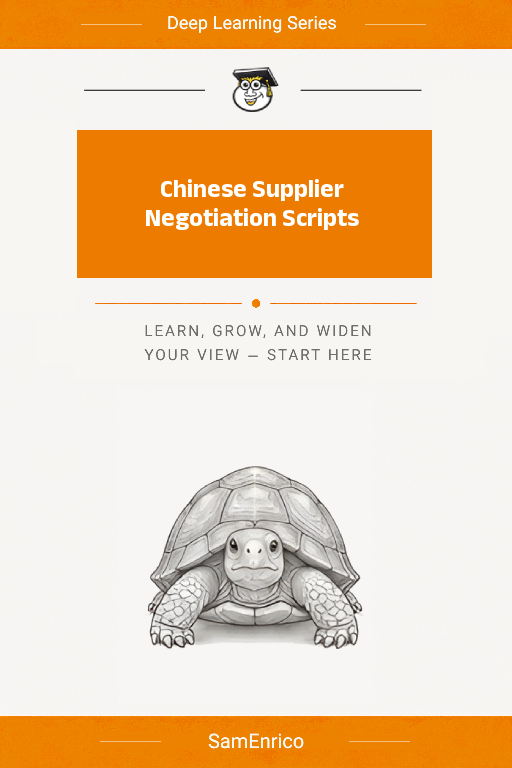
Chinese Supplier Negotiation Scripts Audiobook
Use proven phrases and counter-offers for common n
Use proven phrases and counter-offers for common negotiation scenarios.
Formats
Free sample
Chapter 1: The Should-Cost Flip--–- The first time I watched a Chinese factory owner drop his price by 22% without a single counter-offer, I was sitting in a conference room in Dongguan. The buyer, a woman from Ohio who sourced automotive components, had not asked for a discount. She had not threatened to walk. She had not mentioned competitors. Instead, she had opened her laptop, turned the screen toward the supplier, and said something I have never forgotten.
"I am not looking for a discount," she said calmly. "I am looking for transparency. My math shows your raw material cost at 4.87perunit.Yourquoteis4.87 per unit. Your quote is 4.87perunit.Yourquoteis12.40. Can you help me understand the difference?" The silence that followed lasted seventeen seconds.
Then the factory owner laughed, said "You are not a normal American buyer," and reduced the price to 9.65.Inseventeenseconds,shehadsavednearly9.65. In seventeen seconds, she had saved nearly 9.65.Inseventeenseconds,shehadsavednearly3 per unit on an order of 50,000 pieces. She had not negotiated better. She had negotiated differently.Most buyers walk into Chinese supplier negotiations carrying the wrong weapon. They carry charm, or persistence, or the threat of volume.
These are all useful. But the most powerful weapon you can carry is not a negotiation tactic at all. It is a spreadsheet. This chapter will teach you how to build and deploy what procurement professionals call a "should-cost model"—a bottom-up calculation of what a product must cost based on physics, public commodity prices, and basic manufacturing logic. More importantly, this chapter will teach you the exact script that turns that spreadsheet into a psychological weapon that Chinese suppliers do not expect and often cannot counter.The reason this approach works is rooted in a simple asymmetry.
Most buyers negotiate from the supplier's quote downward. They ask "Can you do better?" or "What is your best price?" These questions concede the entire frame to the supplier. You are begging for a reduction from a number they invented. The supplier expects this. They have built margin into that number specifically for you to negotiate away.
When you ask for a discount, you are playing their game by their rules. The should-cost model flips the script. Instead of negotiating down from their quote, you build up from the raw materials. You are no longer asking for a favor. You are asking for an explanation.
That shift—from begging to auditing—changes the entire power dynamic.Why the "Foreigner Tax" Exists Before we get to the script itself…
This is the end of the free sample. Get the Audiobook to keep going. Buy now
About this book
Details
- Author
- Montoya Chelsey
- Publisher
- SamEnrico
- Language
- English
- Genre
- Non-Fiction, Business Brief
- Released
- 2026-06-01
- Pages (approx.)
- 144
- Available as
- eBook, Audiobook

Listen in the VoxFlicks app
Audiobooks and audio dramas wherever you go. Sign in with your SamEnrico account and press play.
More by Montoya Chelsey
 The EQ for Freelancers GuideMontoya Chelsey$11.99
 Restless Leg Syndrome Compression TherapyMontoya Chelsey$11.99
 Messner Manaslu Winter AscentMontoya Chelsey$11.99
 Twelve Step Meeting AnxietyMontoya Chelsey$11.99
 NVC For Conflict Resolution GuideMontoya Chelsey$11.99
 Should Statements Challenging GuideMontoya Chelsey$11.99
 Nuclear Energy Capital AllocationMontoya Chelsey$11.99
 Yehuda Halevi Kuzari ArgumentsMontoya Chelsey$11.99
 Progress Billing GuideMontoya Chelsey$11.99
 The Last Pharaoh's Gambit: Cleopatra's Secret CoronationMontoya Chelsey$11.99
 The Marble and the Myth: The First Olympic Scandal in the Middle EastMontoya Chelsey$11.99
 The Mineral Guide to VanadiniteMontoya Chelsey$11.99
You may also like
 Hong Kong Handover 1997Dunn Johnnie$11.99
 Zumba For Postnatal Recovery CourseNeal Christian$11.99
 Zumba for BeginnersLadner Nikia$11.99
 YouTube Comment Mining GuideHumes Pandora$12.99
 Worry Box MeditationCarlin Rudy$11.99
 Workplace Stress MeditationNguyen Lynn$11.99
 Workplace Stress and Sleep RepairHawley Ivory$11.99
 Workplace Perfectionism CureDelaney Jeffry$11.99
 Workplace Injustice Anger GuideWallen Isabelle$11.99
 Work Addiction and Burnout LinkGreenwood Ester$11.99
 Women in Yoga and WellnessBeattie Galina$11.99
 Women in Stand Up ComedyChun Evangeline$11.99