
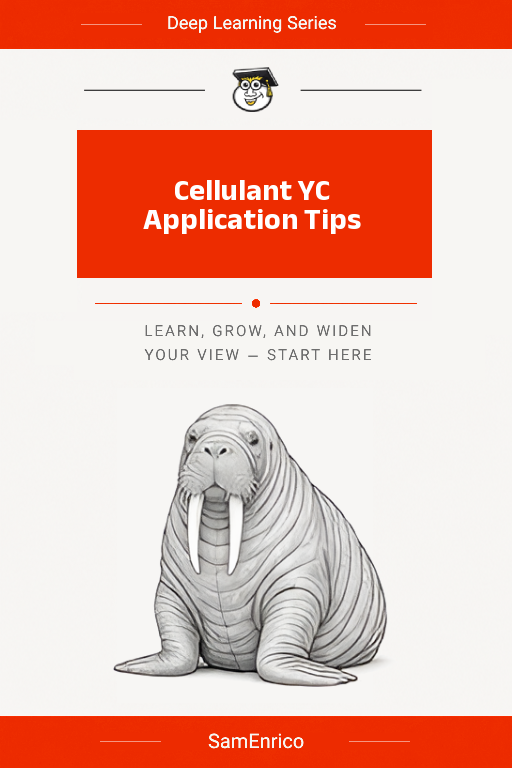
Non-FictionStartup GuideAccelerator PrepEnterprise Sales
Cellulant YC Application Tips eBook
Learn Cellulant Y Combinator application for payme
by Rountree Deb
Learn Cellulant Y Combinator application for payment aggregation and apply their enterprise sales story.
Formats
Free sample
Chapter 1: The Invisible Layer...--The most dangerous question in the Y Combinator application is not “What is your valuation?” or “How many users do you have?” It is a deceptively simple question buried in the early paragraphs: “What important truth do very few people agree with you on?”Peter Thiel popularized this question in Zero to One because he understood something that most founders miss. The question is not a philosophy exercise. It is a filter. YC partners have read thousands of applications from fintech founders who all say the same thing: “Banking is slow. Payments are fragmented.
We are building a faster API.” Those founders are not wrong. They are just obvious. They are competing on a truth that everyone already agrees on.A great startup is not built on obvious truths. It is built on a secret—a specific, measurable, counterintuitive insight that almost no one else believes. If you cannot articulate your secret, you do not have a monopoly.
You have a feature.This chapter reveals Cellulant’s secret. It is not about speed. It is not about lower fees. It is not about a prettier dashboard. The secret is structural and uncomfortable: Banks in emerging markets cannot aggregate payments.
They never will. The monopoly lies not in owning the end-user, but in owning the invisible connection between banks, businesses, and the last-mile customer.If you are applying to YC with a payment aggregation startup, or any B2B infrastructure company serving emerging markets, this chapter will force you to ask yourself: What is my secret? And if you do not have one, stop writing the application and go back to the field.The Obvious Truth That Everyone Believes Let us start with what most fintech founders believe. Walk into any startup accelerator in Lagos, Nairobi, or Cairo and you will hear the same pitch:“Banks are slow. Their APIs are broken.
It takes three days to settle a transaction. We are building a modern payment gateway that settles in 24 hours. Our competitors are Flutterwave, Paystack, and Monnify.”This is the obvious truth. It is demonstrably correct. Bank APIs in emerging markets are, in fact, slow and fragmented.
Settlement times are, in fact, measured in days rather than seconds. But here is the problem: Everyone knows this. Every investor has heard this pitch a hundred times. Every YC partner has read this exact application.When you build a company on an obvious truth, you enter a crowded market where differentiation is impossible. You compete on price.
You compete on speed. You compete on the number of integrations. These are all zero-sum games. You win only if someone else loses.Peter Thiel’s insight is that a monopoly is not built by being slightly better than the competition. It is built by being the only company that understands a secret.
Uber understood that people would get into a stranger’s car if you made the payment seamless. Airbnb understood that people would sleep in a stranger’s home if you built trust through reviews and insurance. Stripe understood that developers would choose a payment API with terrible documentation if it meant they never had to talk to a bank again.These were not obvious truths in 2009, 2008, or 2010. They were secrets. People thought Uber was illegal.
People thought Airbnb was dangerous. People thought Stripe would never beat the incumbent payment processors. The founders were not wrong. They were just early.Cellulant’s secret is similarly counterintuitive. And if you are applying to YC, you need to find yours.The Secret: Aggregation Is Not a Banking Problem Here is the secret that almost no one agrees with: The reason banks cannot aggregate payments has nothing to do with their technology.
It has everything to do with their business model.Banks are designed to serve the formal economy. They are regulated to protect deposits. They are incentivized to lend money to low-risk borrowers. Their entire infrastructure—from compliance departments to branch networks—is optimized for customers who have steady incomes, documented addresses, and smartphones.The informal economy in emerging markets—farmers, market vendors, motorcycle taxi drivers, small distributors—is invisible to banks. Not because banks are evil or incompetent.
Because these customers do not fit the bank’s business model. A farmer who earns $200 per month in irregular lump sums, lives in a village without a street address, and carries a Nokia 105 is not a profitable customer for a Tier-1 bank. The compliance costs alone would exceed any possible revenue.This is the structural failure that most fintech founders miss. They assume that if they build a faster API, banks will adopt it. They assume that if they offer better documentation, banks will integrate.
They assume that banks want to serve the informal economy but are simply too slow.These assumptions are wrong.Banks do not want to serve the informal economy because it is unprofitable. The cost of customer acquisition, compliance, and fraud prevention for a rural farmer is an order of magnitude higher than for an urban salary earner. A bank that tries to serve farmers directly will lose money on every transaction.But here is the second part of the secret: Banks desperately need access to the informal economy because that is where the growth is. Urban salary earners are already banked. The unbanked and underbanked—the farmers, the vendors, the drivers—represent the only remaining growth market.
Banks cannot ignore this segment, but they cannot serve it profitably on their own.This is the gap that Cellulant fills. Cellulant is not a faster API. Cellulant is a neutral, non-bank infrastructure provider that sits between banks and the informal economy. Cellulant handles the last-mile logistics: the agent networks, the offline reconciliation, the feature-phone interfaces, the cash-in/cash-out points. The bank provides the accounts, the compliance, and the regulatory license.
Cellulant provides the distribution.This is the B2B2C layer: Banks → Cellulant → Enterprises → Farmers. The bank never touches the farmer directly. The enterprise (a seed distributor, a fertilizer company, a logistics provider) uses Cellulant to pay farmers. The bank settles the transaction in the background. The farmer receives an SMS confirmation.
Everyone wins.This is the secret. And almost no one believes it.Why Banks Have Failed Unilaterally To understand why this secret is true, you need to understand the three specific capabilities that banks lack. These are not temporary deficiencies that can be fixed with a software update. They are structural gaps rooted in the bank’s core business model.Capability 1: Last-Mile Distribution A bank’s distribution network consists of branches, ATMs, and digital channels. Branches are expensive to operate and impossible to scale into rural villages.
ATMs require electricity, internet, and physical security. Digital channels require smartphones and data plans.The informal economy operates through agent networks. A farmer does not go to a bank branch. He goes to the local market vendor, the motorcycle taxi driver, the small shop owner who holds cash and keeps a paper ledger. These agents are the real distribution network in rural Africa.
They know the farmer by name. They trust him. They extend credit informally.Banks cannot recruit and manage these agents at scale. The compliance requirements alone—know-your-customer checks, anti-money…
This is the end of the free sample. Get the eBook to keep going. Buy now
About this book
Details
- Author
- Rountree Deb
- Publisher
- SamEnrico
- Language
- English
- Genre
- Non-Fiction, Startup Guide, Accelerator Prep, Enterprise Sales
- Released
- 2026-05-29
- Pages (approx.)
- 138
- Available as
- eBook, Audiobook

Read better in the ZLOADR app
Your eBooks on your phone or tablet. Sign in with your SamEnrico account and start reading.
More by Rountree Deb
 Email Triage System WorkbookRountree Deb$11.99
 Remote Documentation GuideRountree Deb$11.99
 Governor of the Opioid StateRountree Deb$11.99
 IBS Rifaximin Retreatment GuideRountree Deb$11.99
 Data Leak Remediation Offer ScriptsRountree Deb$11.99
 The Vanishing of the SS Baychimo: The Arctic Ghost Ship That Refused to SinkRountree Deb$11.99
 The Forgotten Canopy: Nikolai Przewalski’s Rainforest OdysseyRountree Deb$11.99
 How to Start a Hobby in Lego BuildingRountree Deb$11.99
 Understanding Cleidocranial DysplasiaRountree Deb$17.99
 Agile Production SchedulingRountree Deb$12.99
 Wealth Management Business LaunchRountree Deb$11.99
You may also like
 Hong Kong Handover 1997Dunn Johnnie$11.99
 Zumba For Postnatal Recovery CourseNeal Christian$11.99
 Zumba for BeginnersLadner Nikia$11.99
 YouTube Comment Mining GuideHumes Pandora$12.99
 Worry Box MeditationCarlin Rudy$11.99
 Workplace Stress MeditationNguyen Lynn$11.99
 Workplace Stress and Sleep RepairHawley Ivory$11.99
 Workplace Perfectionism CureDelaney Jeffry$11.99
 Workplace Injustice Anger GuideWallen Isabelle$11.99
 Work Addiction and Burnout LinkGreenwood Ester$11.99
 Women in Yoga and WellnessBeattie Galina$11.99
 Women in Stand Up ComedyChun Evangeline$11.99