
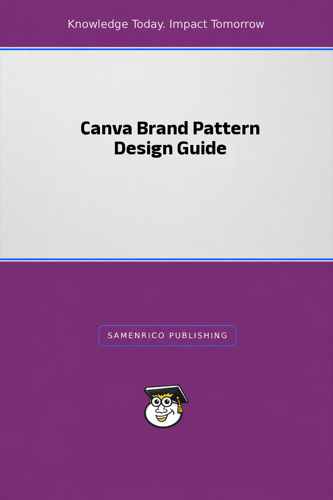
Canva Brand Pattern Design Guide
Create repeating brand patterns for packaging, bac
Create repeating brand patterns for packaging, backgrounds, and textiles using Canva's pattern tools.
Formats
About this book
Free sample
Chapter 1: Beyond the Grid--–- For most people, a blank page is an invitation to place something in the center. A logo sits dead center on a business card. A photograph places its subject in the middle of the frame. A website header centers its headline and button. This instinct toward centrality is not wrong, but for pattern design, it is a trap.
When you build a seamless repeating pattern, the center of your canvas is almost irrelevant. What matters are the edges. The top edge, the bottom edge, the left edge, the right edge—and how the elements that touch those edges reappear on the opposite side. If you start designing by placing a beautiful motif in the middle of your tile, you have already made your work harder. You have built an anchor that will fight you when you try to create a seamless repeat.This chapter introduces the fundamental mind shift of surface pattern design: you are not designing a single composition.
You are designing a relationship between four edges. Every successful pattern in this book, from the simplest background texture to the most complex all-over floral, is built on this principle. The geometry that governs these edge relationships is simple, elegant, and learnable by anyone who can use a ruler. But most designers never learn it because they start with software tutorials instead of spatial reasoning. They learn how to click "Pattern Preview" in Illustrator or how to use Canva's duplicate function, but they do not understand why those tools work.
When the tools fail—when a seam appears, when a motif cuts off awkwardly, when the pattern looks obviously tiled—they have no fallback. You will have a fallback. By the end of this chapter, you will understand the underlying architecture of every seamless pattern you will ever create.The Anatomy of a Pattern Tile Before we manipulate any digital tools, I want you to perform a physical exercise. Take a blank sheet of paper. Draw a square in the center, roughly four inches by four inches.
This square is your pattern tile—the smallest repeatable unit of your design. Now draw a simple shape, say a small…
This is the end of the free sample. Get the eBook to keep going. Buy now
Contents
- Chapter 1
- Chapter 2
- Chapter 3
- Chapter 4
- Chapter 5
- Chapter 6
- Chapter 7
- Chapter 8
- Chapter 9
- Chapter 10
- Chapter 11
- Chapter 12
Details
- Author
- Clevenger Tamie
- Publisher
- SamEnrico
- Language
- English
- Genre
- Non-Fiction, Zero-to-One Creator
- Released
- 2026-06-06
- Pages (approx.)
- 132
- Available as
- eBook, Audiobook

Read better in the ZLOADR app
Your eBooks on your phone or tablet. Sign in with your SamEnrico account and start reading.
More by Clevenger Tamie
 Small Talk for the GrievingClevenger Tamie$11.99
 Nervous Body Language FixesClevenger Tamie$11.99
 The Olympic Weightlifting GuideClevenger Tamie$11.99
 The Pearl of Punt: A Love That Built an EmpireClevenger Tamie$11.99
 Education AssistantClevenger Tamie$11.99
 SocialBee AI CategorizationClevenger Tamie$12.99
 Learn to Play the Tenor SaxophoneClevenger Tamie$11.99
 How to Start a Carpenter N.e.c. Business (Beginners Guide)Clevenger Tamie$11.99
You may also like
 Canva Brand Identity for WinemakersKirkland Alyse$11.99
 Canva Brand Identity for Tech StartupsDonnell Aleida$11.99
 Canva Brand Asset Library SetupHornsby Delorse$11.99
 Canva Brand Identity for TutorsMessina Larita$11.99
 Canva Brand Identity for EsportsHavens Sean$11.99
 Canva Brand Archetype GuidePhipps Ashli$11.99
 Canva Brand Style Tile CreationLoftis Dawne$11.99
 Canva Brand Identity for FloristsMcneill Nancie$11.99
 Canva Brand Identity for SnapchatGood Izola$11.99
 Canva Brand Identity for InstagrammersGallegos Ruthe$11.99
 Canva Brand Mood Music GuideCasteel Jodee$11.99
 Canva Brand Identity for YouTubersNolan Hoyt$11.99