
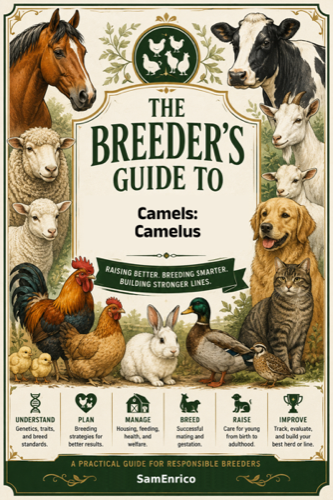
Non-FictionInformativeEducational
Camels: Camelus Audiobook
This wildlife publication, published by SamEnrico,
by Moyer Zena
This wildlife publication, published by SamEnrico, covers Camels: Camelus
Formats
Free sample
Chapter 1: The 1,500-Pound Lie--–- I have a confession to make. For the first thirty years of my life, I believed that camels stored water in their humps. I repeated this fact at dinner parties. I used it to sound smart on dates. I once corrected a tour guide in Morocco who said otherwise, citing my impeccable elementary school education.
The tour guide, a Berber man named Hamid who had grown up with thirty camels in his family, laughed so hard that tea came out of his nose. Then he grabbed my hand, pressed it against the hump of a resting dromedary, and said, “Feel that? That’s fat. Like your belly, but higher up and more useful.”That moment in the Sahara broke something open in me. If I had been so confidently wrong about the most famous fact about camels, what else had I gotten wrong?
The answer, it turns out, was almost everything.This book is the result of that humiliation. It is a full-scale investigation into the animal that has carried empires across deserts, survived where everything else dies, and somehow become the most misunderstood large mammal on Earth. And we are going to start at the very beginning, by dismantling the lie that has somehow survived for over two thousand years.The Birth of a Bad Idea The myth that camels store water in their humps is ancient, but it is not ancient enough to be excusable. The earliest written reference appears in the works of Pliny the Elder, the Roman naturalist who died in the eruption of Vesuvius in 79 CE while trying to rescue a friend. Pliny was brilliant in many ways.
He cataloged the natural world with obsessive detail. He also believed that amber was the frozen urine of lynxes and that elephants worshiped the stars. His entry on camels noted that the hump “contains the animal’s reserve of moisture, enabling it to traverse vast dry places.” Pliny had never dissected a camel. He had likely never seen one alive except in a military parade. But his word became gospel for fifteen centuries.The myth persisted through the Middle Ages, when bestiaries illustrated camels alongside unicorns and dragons.
It survived the Enlightenment, when Linnaeus classified the species but never tested the hump theory. It even made it into twentieth-century textbooks, alongside the map of the tongue showing “taste zones” (another myth) and…
This is the end of the free sample. Get the Audiobook to keep going. Buy now
About this book
Details
- Author
- Moyer Zena
- Publisher
- SamEnrico
- Language
- English
- Genre
- Non-Fiction, Informative, Educational
- Released
- 2026-06-02
- Pages (approx.)
- 158
- Available as
- eBook, Audiobook

Listen in the VoxFlicks app
Audiobooks and audio dramas wherever you go. Sign in with your SamEnrico account and press play.
More by Moyer Zena
 Kidney Failure Anticipatory GriefMoyer Zena$11.99
 Thunberg Climate ReparationsMoyer Zena$11.99
 Long Marriage Divorce RecoveryMoyer Zena$11.99
 Religion Change Parent AngerMoyer Zena$11.99
 Key Metrics Dashboard GuideMoyer Zena$11.99
 Consignment Inventory AIMoyer Zena$11.99
 Constraints for WritersMoyer Zena$11.99
 Assertiveness for Remote WorkersMoyer Zena$11.99
 Oisín’s Forgotten Lament: The Bard Who Outlived TimeMoyer Zena$11.99
 The Iron Crown of Burgundy: Maximillian I and the Birth of a DynastyMoyer Zena$11.99
 How to Produce OverallsMoyer Zena$11.99
 How to Produce Conference Room TablesMoyer Zena$11.99
You may also like
 Hong Kong Handover 1997Dunn Johnnie$11.99
 Zumba For Postnatal Recovery CourseNeal Christian$11.99
 Zumba for BeginnersLadner Nikia$11.99
 YouTube Comment Mining GuideHumes Pandora$12.99
 Worry Box MeditationCarlin Rudy$11.99
 Workplace Stress MeditationNguyen Lynn$11.99
 Workplace Stress and Sleep RepairHawley Ivory$11.99
 Workplace Perfectionism CureDelaney Jeffry$11.99
 Workplace Injustice Anger GuideWallen Isabelle$11.99
 Work Addiction and Burnout LinkGreenwood Ester$11.99
 Women in Yoga and WellnessBeattie Galina$11.99
 Women in Stand Up ComedyChun Evangeline$11.99